Bruno Colomer: "In all denominations of origin there are people who leave, and that doesn't mean that cava isn't good"
Winemaker of Codorníu

-
CAT -
CAST
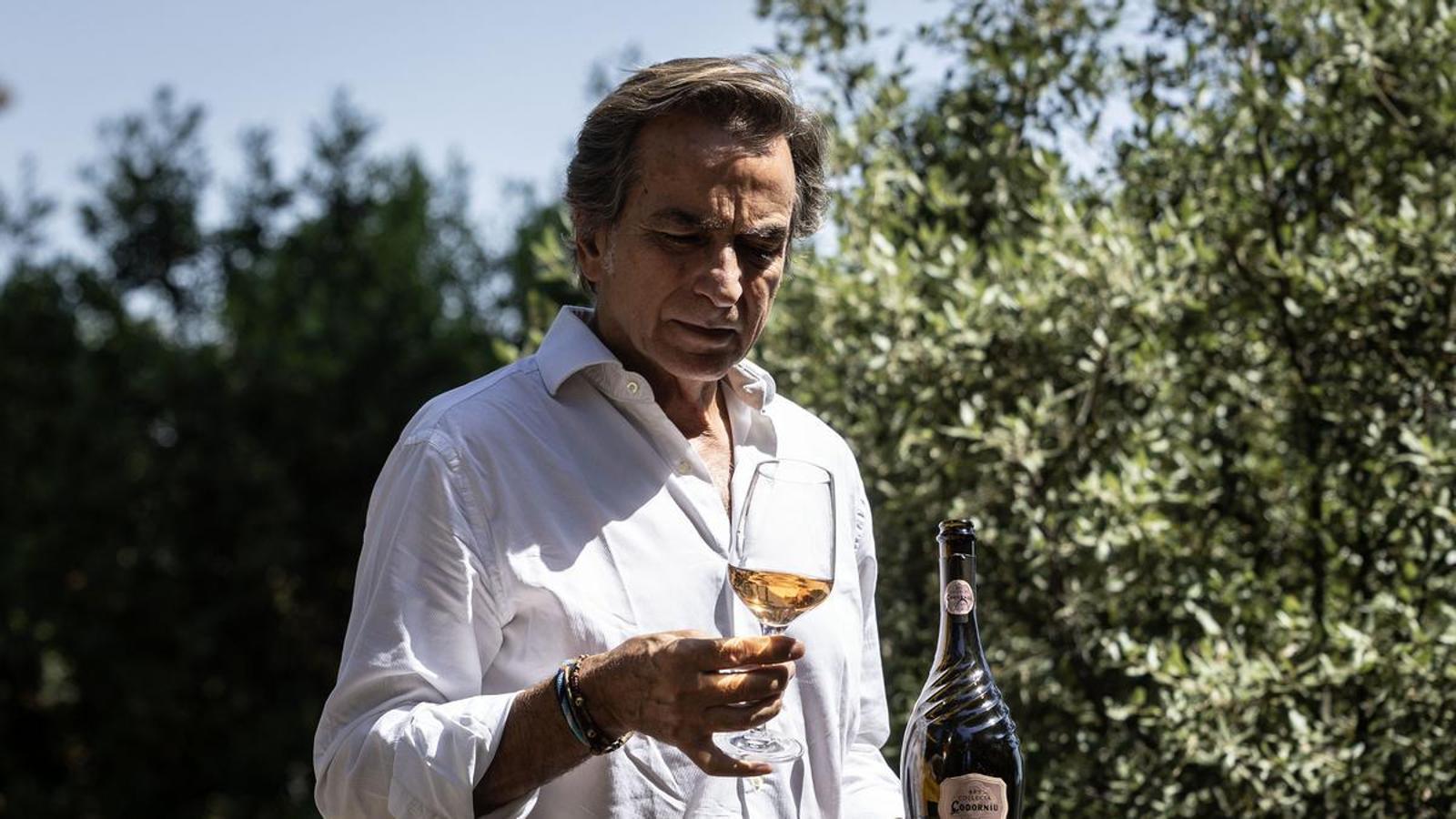
Saint Sadurní of AnoiaI am interviewing oenologist Bruno Colomer (Barcelona, 1964) at the Codorníu winery on one of the hottest days of the summer. We enter the tower built by architect Josep Puig i Cadafalch, which houses a restaurant open to the public, and the temperature is more pleasant. The oenologist is very passionate about his work, to which he came through his vocation for nature, landscape, and urban gardens. Bruno has just rejoined the board of the Denominació d’Origen Cava after years of absence. Codorníu has its ownership divided, with 38% belonging to the family and the rest to the American investment fund Carlyle. The company has just announced that it commits to buying an additional 20% of grapes to strengthen its commitment to winegrowers.

You studied oenology in Burgundy.
— I ended up there by chance. I had finished agricultural engineering and I saw a report on television featuring Jaume Gramona speaking. My family came from the textile industry, I was the first to show a vocation for the food industries, which I reached through my passion for nature and the design of urban gardens. I thought about specializing in enology because on Friday afternoons I had a class on fermentations in alcohols, taught by Juan José de Castro, which I loved. The fact is that I looked for Jaume Gramona's contact, whom I had seen on TV, and I wrote him a letter asking him where I could train in enology. He replied and recommended the school in Dijon, in Burgundy, because it was the place where he had studied. I took his advice, without knowing him, because he was the only reference I had available. I went there for two years, which, seen with perspective, I think are the best years of my life.
When you return, you start working in wineries in Penedès.
— At Caves Nadal, with Xavier Nadal, who had also studied in Dijon, even though we hadn't crossed paths there, because he was finishing when I was starting. At Caves Nadal I got to know the reality of Penedès, I understood and got to know the agricultural world. I was there for six years.
From Caves Nadal, you go to Montferran.
— In Blanes, yes. I was there for ten years and it was a job I really enjoyed. A winery that was in an emblematic city, that everyone loved. At the summer concerts, which I started, everyone from Blanes came. The city embraced everything we organized. There I met the Roca brothers and since then I have maintained the friendship. Thanks to them, I give a class, once a year, at the Sant Narcís hotel management school.
The Montferran winery is closely linked to the history of cava.
— Montferran and Codorníu are the two active wineries that began making the second fermentation in the bottle. The others, located in Reus and Vilanova i la Geltrú, no longer exist. Both the Raventós family, from Codorníu, and the Blanes family, from Montferran, attended courses at the Institut Català de Sant Isidre, where there was an engineer from Madrid who taught the Catalans how to make cava.
After Montferran you return to Penedès.
— At Mas Tinell. I wanted to change my job and I found Mas Tinell looking for job ads in the newspapers. I applied there and stayed for two years. At that time it was a small company, with low volume. We bought the grapes and we did the rest of the process in the cellar. It was while working at Mas Tinell that Codorníu contacted me. I accepted the offer and then, look how life is, I replaced Juan José de Castro, that is, the professor I had had at agrònoms, the one who taught the subject on Friday afternoons and who made me interested in oenology. Juan José de Castro was retiring, he remembered me, and I had the opportunity to tell him that he was the one who had instilled in me the passion for oenology.
At Codorníu, you take a leap into managing teams and a large volume of bottles.
— Yes, and I saw that I had no idea about anything. I knew about enology, but I hadn't managed large teams. I learned from it and from the first day I felt very good about it, because Codorníu is a company that captivates. Look at this environment, this architecture, these gardens, it's wonderful. Besides, wherever I go, when I say I come from Codorníu, they receive me in a different way. I have always been respected everywhere. Currently, there is no company that can offer me what Codorníu gives me. I love the house, and the house loves me.

You have entered the office of the new board of the Cava Designation of Origin.
— I have entered with great enthusiasm, because the concept of the designation of origin, which has given us very good brand prestige, needs to be straightened out. The DO Cava continues to be good despite some wineries leaving. Everywhere, in all organizations and designations of origin, there are people who leave, and that does not mean that cava is not good. If until yesterday we were good, if you leave it does not mean we are no longer. The DO Cava makes great cavas and we should not be ashamed to say so. I repeat: in all designations of origin there are wineries that leave because they want to change strategy. And this fact should not change the concept of quality of that designation of origin. Let's take the case of Bordeaux. Wines are sold there for six euros and this does not discredit the designation of origin.
There are also cellars for six euros.
— And the people who buy them do so with enthusiasm. I cannot tell them not to buy good things, I say it's the best they can buy for their pocket. At Codorníu, we are pioneers in having caused a price increase, in dignifying the work of the winegrowers, because we have given them multi-year contracts and set a price. During COVID, there were companies that broke multi-year contracts with the winegrowers. Codorníu is the reference price in the sector. Two years ago we raised the price a lot; everyone welcomed it. Last year we continued to raise it, but then the rest did not.
Thirty million bottles have come out of the DO Cava, which means that there will be more than three thousand hectares of vineyards with grapes that may be left unpicked.
— The winemakers are already calling us to offer them to us. We cannot absorb them. I have been a member of the Regulatory Council of Cava for fifteen days and we are studying how we can find a market for this grape. We are looking for ideas.
Now which ones?
— In the DO Cava we produce one hundred and ninety million bottles. Then, this leftover grape could be harvested to be turned into concentrated must, but it is just an idea, because large facilities are needed to turn it into concentrated must.
How many bottles do you make at Codorníu?
— Thirty-two million bottles, and we are among the best sparkling wines in the world. Being big doesn't mean you can't make very good cavas. I know we have a bad reputation because we are a big house, but I don't agree with that idea. Furthermore, we have fifteen wineries in the State, in addition to Argentina, therefore, we make different harvests that enrich us. We learn a lot from each other.
Are you integral? I mean, do you do the entire cava production process at Codorníu?
— No, because there is 15% of the wine that we buy. We buy it from cooperatives in the area, which is why we are not integral. We make these cavas for white labels that go abroad, to the United Kingdom.
What do you think about the spread of Penedès and cava?
— We are not doing it well. It cannot be that Barcelona's restaurants do not bet on Penedès wines, and, on the other hand, verdejos or ruedas are fashionable. Barcelona wines should be Penedès wines. But it is not the restaurants' fault, but our fault, because we have not made it attractive. If the customer does not buy them, it is because we have not made ourselves known. Penedès is next to Barcelona, Montserrat, the sea, and Tarragona. Why don't they know us in Barcelona?
I'm asking you about Codorníu's flagship cavas. Anna de Codorníu and Ars Collecta.
— Anna de Codorníu is a tribute to the last woman of the family who bore the Codorníu surname. We launched it in 1983, and few know that it is a blend of 30% including macabeu, parellada and xarel·lo, and the rest, 70%, is chardonnay from Raïmat. We make five million bottles, and it's not the cheapest. It costs around ten euros. We also have Anna de Codorníu Icònica, which costs 13 euros. And Ars Collecta is a project that I started seven or eight years ago to integrate all departments, always three: Raïmat, Poblet and Penedès. That is, a blend of the three territories, which is the magic number for Codorníu.
If the number three is always involved in your cavas, then you don't make varietals?
— We make it, yes, but from grapes harvested on three different days.
What do you think about the decrease in consumption worldwide?
— It's time to rack our brains to adapt to the market. We need to make lower alcohol content cavas. We have to go for 10 or 11 degrees. It's not allowed by regulation, but if we manage to prove that a change in regulation gives us a good product, we'll have to do it. At Codorníu we make a non-alcoholic line for the Nordics, which is called Codorníu Zero.
