The social license, a key tool in ecological transition projects
The three large clusters of the sector join efforts to generate consensus and trust throughout the territory
-
CAT -
CAST
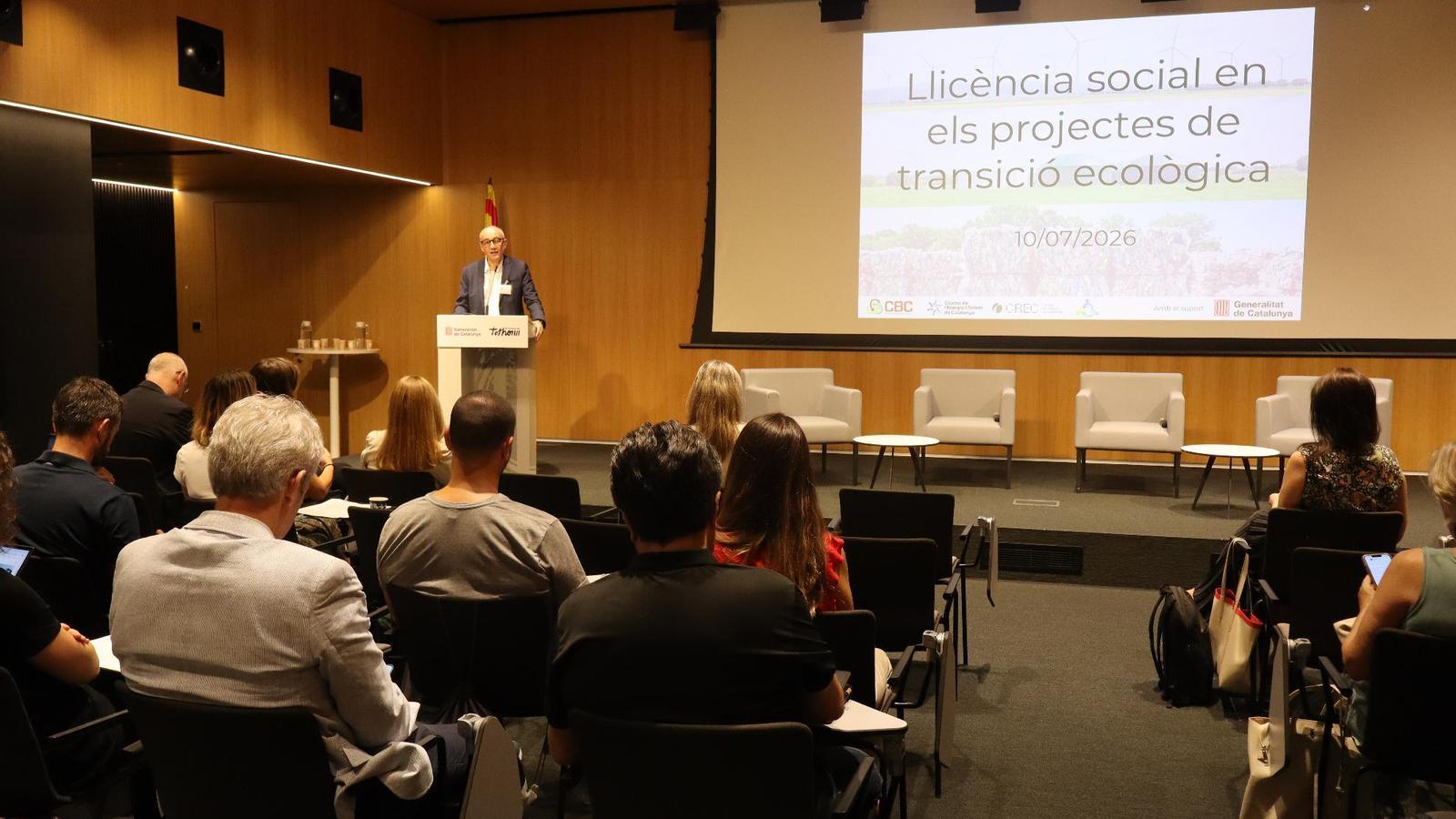
BarcelonaThe ecological transition requires not only technological solutions and appropriate regulatory frameworks, but also the support and involvement of society. In a context where it is increasingly important to generate consensus and trust in the territory to promote ecological transition projects, the work to identify tools, methodologies, and good practices that help companies address this challenge with greater guarantees of success is key. That is why the Bioenergy Cluster of Catalonia (CBC), the Efficient Energy Cluster of Catalonia (CEEC), and the Waste Cluster of Catalonia (CREC), with the support of ACCIÓ and the collaboration of ICAEN, have jointly developed the project Management of Social License and Territorial Integration of Ecological Transition Projects in Catalonia.
ARC Mediación Ambiental has designed the Guide for the management of the social license and the integration of ecological transition projects in Catalonia, a practical tool aimed at companies and developers that gathers methodologies, recommendations, and resources to foster social acceptance and facilitate the deployment of renewable energy generation projects and waste management, treatment, and recovery infrastructure.
“The social license is a crucial and strategic issue for the sector. Competitiveness no longer depends solely on innovation, technology, or efficiency, but also on our ability to generate trust, build solid relationships with the territory, and align economic development with the expectations of society,” says Vanessa Abad, president of the Bioenergy Cluster of Catalonia.
“The social license is a key factor in making business projects possible and ensuring their long-term sustainability. A challenge that can only be addressed through collaboration. This shared work will allow us to find more solid solutions, generate knowledge, and create useful tools for companies,” reminds Abad.
Another pillar of the project shares the same vision. “Social license is key and decisive for making the ecological transition a reality, which is a transformation that has to do with energy. There are projects that are essential, but this does not guarantee that they will be accepted by the territory. Social license adds trust and legitimacy to a project, but this is not achieved in a single meeting. It is necessary to demonstrate from the very first moment the value it has for the territory. It is necessary to place the social dimension at the same level as technical and economic viability,” explains Ignasi Clariana, president of the Energy Efficient Cluster of Catalonia (CEEC).
“The Guide for managing the social license is necessary, but it cannot come at the expense of the determination required to implement projects. We cannot confuse social license with a veto right used to postpone projects that are necessary,” adds Clariana.
The current geopolitical context adds uncertainty to the global scenario. “We often talk about waste as a problem, but it is also a resource. They can be a source of energy or an alternative fuel. Geopolitical tensions remind us to what extent we depend on some resources and supplies, and in this scenario, the circular economy is not just an environmental policy but a national resilience strategy,” argues Elisabet Alier, president of the Waste Cluster of Catalonia (CREC). Infrastructure is key to moving from theory to practice.
“Social license does not consist of explaining a project better, but rather has to do with relating to the territory. You must listen first to understand the local reality and know the concerns, which are legitimate. Trust must be built with actions and not just with speeches,” summarizes Alier.
More integrated and sustainable projects
The goal is to provide companies with resources and proposals to promote more integrated, sustainable, and resilient projects. Experts remind us that ecological transition projects must be built with the territory and not just on the territory.
“All stakeholders involved in the energy transition must be aligned to achieve the goal, which is the decarbonization of the country by the year 2050,” recalls Anna Camp. The director of the Catalan Energy Institute (ICAEN), who has led the information meetings for the Territorial Sectoral Plan for the Implementation of Renewable Energy in Catalonia (PLATER), emphasizes the need for information and mediation processes to avoid initial resistance to any project. “There is a group of people who are very difficult to convince and maintain a frontal opposition. Misinformation takes root very quickly and the media echoes any protest, which amplifies the rejection,” she says.
Previously, every municipality had its own landfill. “People's perception changes when they consider that waste comes from outside. We must find mechanisms to make it understood that the world is global. There are actions that generate rejection, but when they are understood, the opinion can change,” summarizes Albert Planell, director of the Waste Agency of Catalonia.
