Trump says the EU "steals" from American companies and threatens it with more tariffs
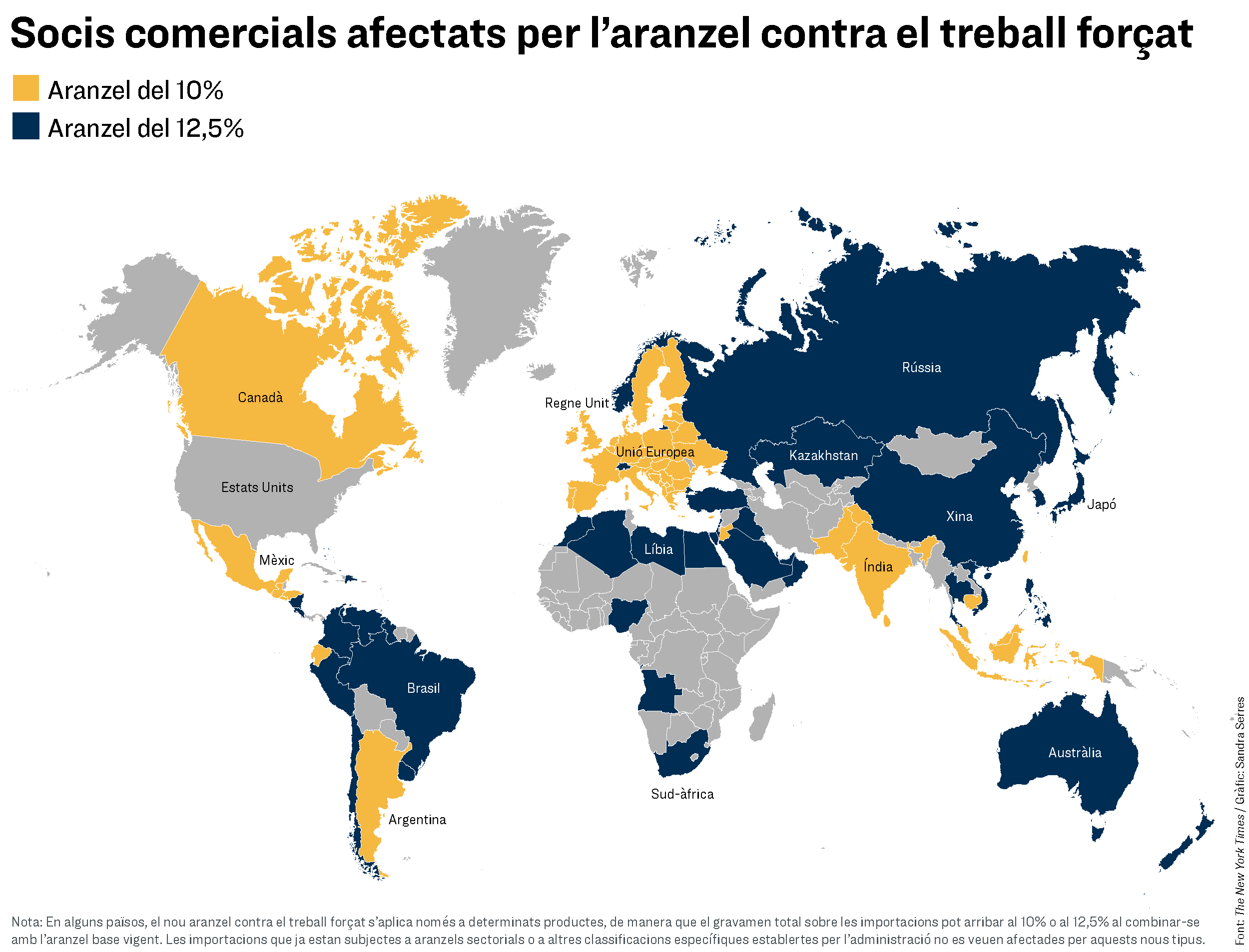
The North American president announces a new package of tariffs between 10% and 12.5% against 60 countries
-
CAT -
CAST
Washington / BrusselsIn his conviction to maintain the trade war, Donald Trump has announced a new tariff package that replaces the universal taxes that the Supreme Court annulled in February. The US president has signed a new executive order establishing levies of between 10% and 12.5% on more than 60 countries, including members of the European Union, China, and Mexico. The leader justifies this as retaliation against these states for not having taken sufficient measures to control imports of goods produced through forced labor. Furthermore, hours later, Trump also accused the EU of harming American companies through multimillion-dollar fines and threatened to impose a new tariff "as soon as possible".

- If you want to investigate the chart in more detail, open the high-resolution version in another tab.
The measure is expected to come into force on Friday at midnight, before the provisional tariffs that Trump applied in February expire following the Supreme Court ruling. Products linked to national security, such as steel, aluminum, cars and their manufactured components, will not be subject to these new tariffs. Nor are certain imported foods and agricultural products or energy goods affected. For example, Mexico is one of the main suppliers of fresh produce found on U.S. shelves.
The new tariffs are based on Article 301 of the Trade Act of 1974, which is considered legally stronger than the emergency powers the tycoon used to impose universal levies and which the Supreme Court overturned. Once in effect, import duties can be maintained indefinitely and can be unilaterally modified by the president himself.
Despite being another setback for the global economy, the real impact of these tariffs will be limited, as they only extend the effect of the initial 10% tariffs that were in place.
By directly targeting forced labor, the White House is also seeking to indirectly harm the trade relations of two giants like India and China. Both have been in the eye of the storm for allowing foreign companies – including U.S. companies – to have workers in precarious conditions. India, for example, had planned a 12.5% tariff when Washington published a preliminary report in June, but it was eventually reduced to 10% after approving a law against forced labor. However, it is not clear what room countries will have to convince the Trump administration to remove its tariffs against forced labor.
Despite the White House's desire to put a positive spin on the executive order as a measure to fight forced labor, it is clear that this is a new stratagem to continue applying the original universal tariffs. Immediately after the high court declared the taxes null, Trump lashed out at the judges and threatened them with new levies "more powerful and harmful". In his post-verdict appearance, the Republican had already warned that he could find other legal mechanisms to sustain his trade war or even aggravate it. It remains to be seen whether this new measure will be appealed in court and whether it will withstand legal scrutiny.
The news comes just as the price of a barrel of crude oil exceeds 100 dollars, while the war in Iran once again rushes towards a total conflict and the Houthis have initiated the first attacks on commercial ships in the Red Sea. After the Strait of Hormuz, practically inoperable, Bab el-Mandeb is the other major critical point for global energy flow.
Regarding the new threat to the European Union, Trump has assured on his social network —Truth Social— that he will launch an investigation "into the practice of stealing" from American companies. "The European Union will pay a very high price for this illegal and highly unethical conduct," the US president assured. In the message, Trump names various fines imposed by European institutions on companies such as Apple, Meta, Amazon, or Google.
The EU "positively values" the announcement
Despite Trump maintaining the tariff hike on powers like the European Union, the spokesperson for the Community executive on Trade, Olof Gill, assured in a statement this Thursday that the European bloc "positively values" the announcement by the President of the United States. Brussels celebrates that he respects the agreement reached last summer with Washington and that it does not exceed the maximum customs duties of 15% that they agreed upon.
The measure by the US administration also includes exemptions for some products such as cork or diamonds, which the European Commission considers can be a "positive" sign for the two powers to "continue exploring new tariff exceptions and deepen cooperation in a wide range of fields". Some of these fields may include critical materials, economic security, and, among others, artificial intelligence. In fact, the spokesperson for Trade of the European Commission explained that there are already several products that the United States has removed from the list of items to which they wanted to apply tariffs, such as aircraft and their components, and all types of generic medicines.
In the same vein, the Community executive also warns the Trump administration that the European Union has already fulfilled its part of the trade pact – it came into force on July 1 of this year – and now expects the United States to also "respect the terms" of the commitment signed last summer. "We will continue to dialogue with the US administration to ensure that it fully complies with its commitments," insisted the spokesperson for Trade of the European Commission.
In Brussels, however, the accusations by the President of the United States that there are companies and products in the European Union manufactured by forced labor have not been taken so well. One of the voices that has been most critical of the new outburst from the New York magnate has been the head of European diplomacy, Kaja Kallas, who has denied the accusation and counterattacked the North American power. "You cannot say that about the European Union. [...] If you compare our labor laws with those of the United States, we have paid holidays, we have very good working conditions for our employees, so it doesn't have much basis," replied the community leader in an interview with the Reuters news agency.
Be that as it may, almost a year after the signing of the trade agreement between the President of the European Commission, Ursula von der Leyen, and Trump – next Monday will mark its first anniversary–, the European Union continues to trust that the pact will restore the good relations that the two transatlantic powers had. However, during these twelve months, the New York magnate has not stopped launching all sorts of threats and insults against European allies that have put the fulfillment of the trade agreement at risk, such as his desire to invade Greenland – sovereign territory of Denmark, which is a member state of the EU and NATO – or the will to force European allies to get involved in the war he started in the Middle East.