The geographer accused of being a traitor who made the first modern map of Catalonia
The new Baroque Space of the Hospital de la Santa Creu i Sant Pau shows a dozen restored paintings from the 17th and 18th centuries

-
CAT -
CAST
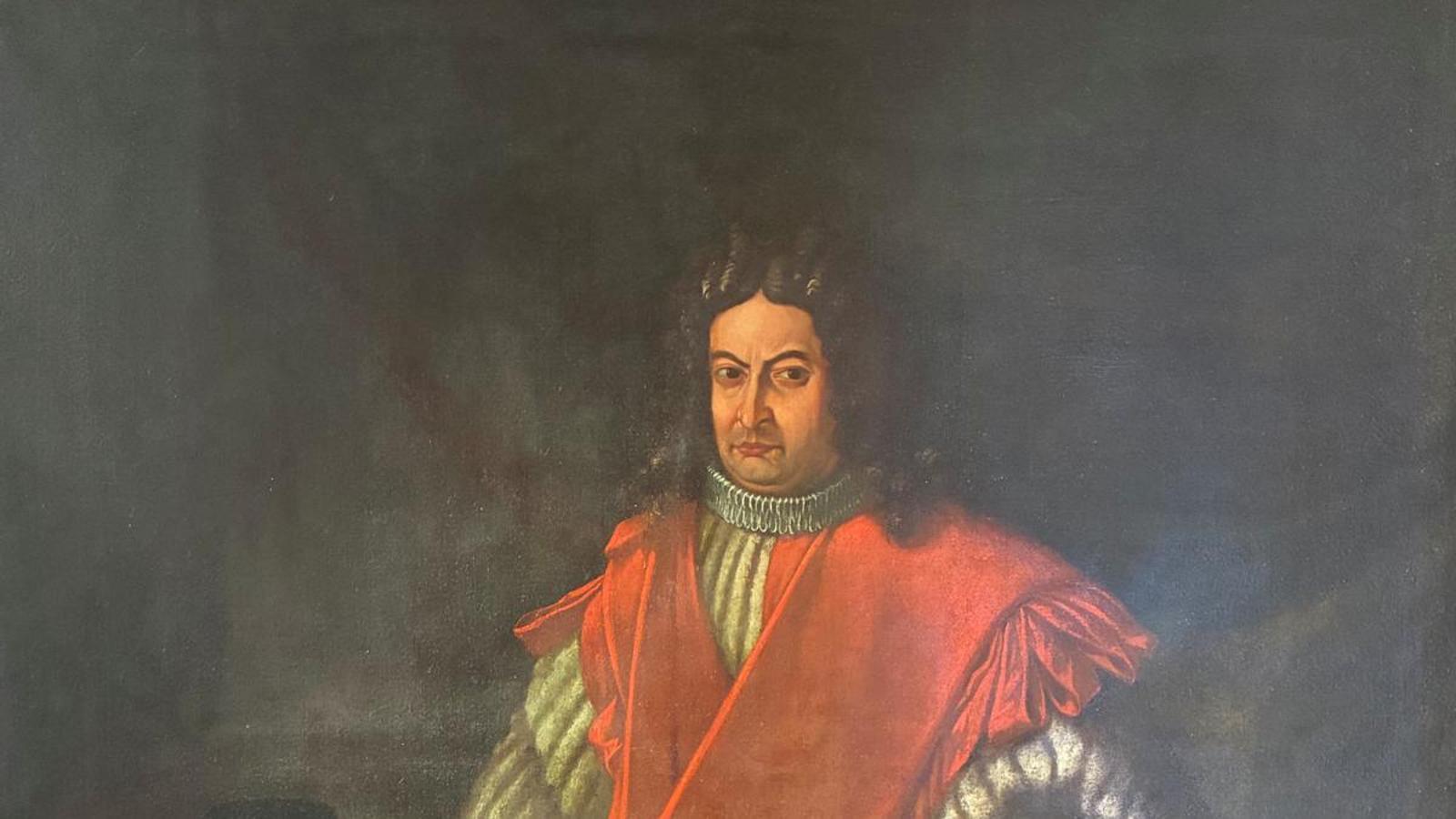
BarcelonaJosep Aparici i Fins is one of the most important geographers of 18th-century Catalonia, and at the same time, he is surrounded by controversy. During the War of the Spanish Succession, the Austrian authorities commissioned him to create the map of Catalonia and, after the war, he placed himself at the service of King Philip V, who granted him the title of Geographer to His Majesty. Furthermore, he was one of the main collaborators in the implementation of the cadastre, a measure that was detrimental to the Catalan economy. But, despite everything, his career has been considered ambiguous.
"Although at the end of his life he switched to the Bourbon side, he always claimed his position as fourth councilor of the city of Barcelona during the Austrian period," recalls Miquel Terreu, the archivist and director of the Historical Archive of Sant Pau at the Hospital de la Santa Creu i Sant Pau in Barcelona, on the occasion of the inauguration, this Wednesday, of the new Baroque Space of the Modernist Site, where Aparici is present through a portrait made of him by Joan Grau Carbonell. Aside from politics, this portrait is one of the few preserved civil portraits of the Catalan Baroque. "It was left to us as an inheritance by the Baron of Castellet, who was also an Aparici," recalls Terreu.

Another portrait, that of Pau Ferran, a work by Pasqual Bailón, caught the attention of the restorers because they detected an old restoration, carried out by the painter Josep Llanes, to whom the portrait of Charles III preserved at the Barcelona City History Museum (Muhba) is attributed. "This portrait must have been redone at the time when the other group of portraits of benefactors was made. That is to say, when the series of benefactors was inaugurated, this portrait must have been damaged. Perhaps it was in an open room, and that caused it to be quite affected," explains the art history professor Francesc Miralpeix.
Art in the life of the Hospital de la Santa Creu
With the new Baroque Space, the Sant Pau Modernist Precinct brings to the public light, restored, an extraordinary collection of 17th and 18th-century paintings, the appreciation of which dates back to the early 90s of the 20th century with the institution's former archivist, Pilar Salmerón. "Beyond artistic value, the exhibited works constitute a testimony to the history of the hospital and its bond with Barcelona society. Religious paintings, portraits of benefactors, and institutional representations allow us to understand the role of art in the daily life of the institution and in the construction of its memory," can be read in the institution's statement. The restoration was carried out by David Silvestre, Irene Panadés, and Voravit Roonthiva.
The collection is made up of a dozen paintings and a sculpture, among which are some by prominent names such as Antoni Viladomat, considered the most representative painter of the Catalan Baroque. The Baroque Space consists of two rooms on the second floor of the Administration Pavilion. The first evokes the space of the Most Illustrious Administration (MIA) of the Hospital de la Santa Creu i Sant Pau Foundation, the atmosphere of which has been reconstructed based on historical photographs. Period furniture and objects can be seen there, as well as the Baroque paintings that decorated its walls. Four of these paintings are by Antoni Viladomat, and they constitute one of the most prominent and best-preserved cycles of his production: Jesus among the Doctors, The Espousals of the Virgin Mary, The Dream of Saint Joseph and The Virgin of the Rosary with Saint Raymond of Penyafort and Saint Dominic. In addition, an extraordinary anonymous 18th-century Christ the Savior can also be seen.


The saints of Joan Gallart
The second room is a new addition to the tour, where three paintings of hermit saints attributed to Joan Gallart can be seen. His representations of Saint Jerome, Saint Onuphrius, and Saint Francis of Paola stand out for the expressive strength of the figures and the richness of the landscapes. In this space, Escut, by Joan Grau, one of the treasures of the collection, is also exhibited.
On the other hand, in this room one can see the only sculpture in the collection, a Mourning Angel attributed to Ramon Amadeu. It is an angel overcome by the pain of loss that usually accompanies the Virgin of Sorrows or the mysteries of the Pieta. This work has undergone an archaeological restoration, meaning that the different layers of paint applied over time have been left visible.
