Puerta del Sol: from a place of passage to an agora in twenty days
The campers take for granted that the end is approaching, but they see a political repercussion in the organizations and social movements

-
CAT -
CAST
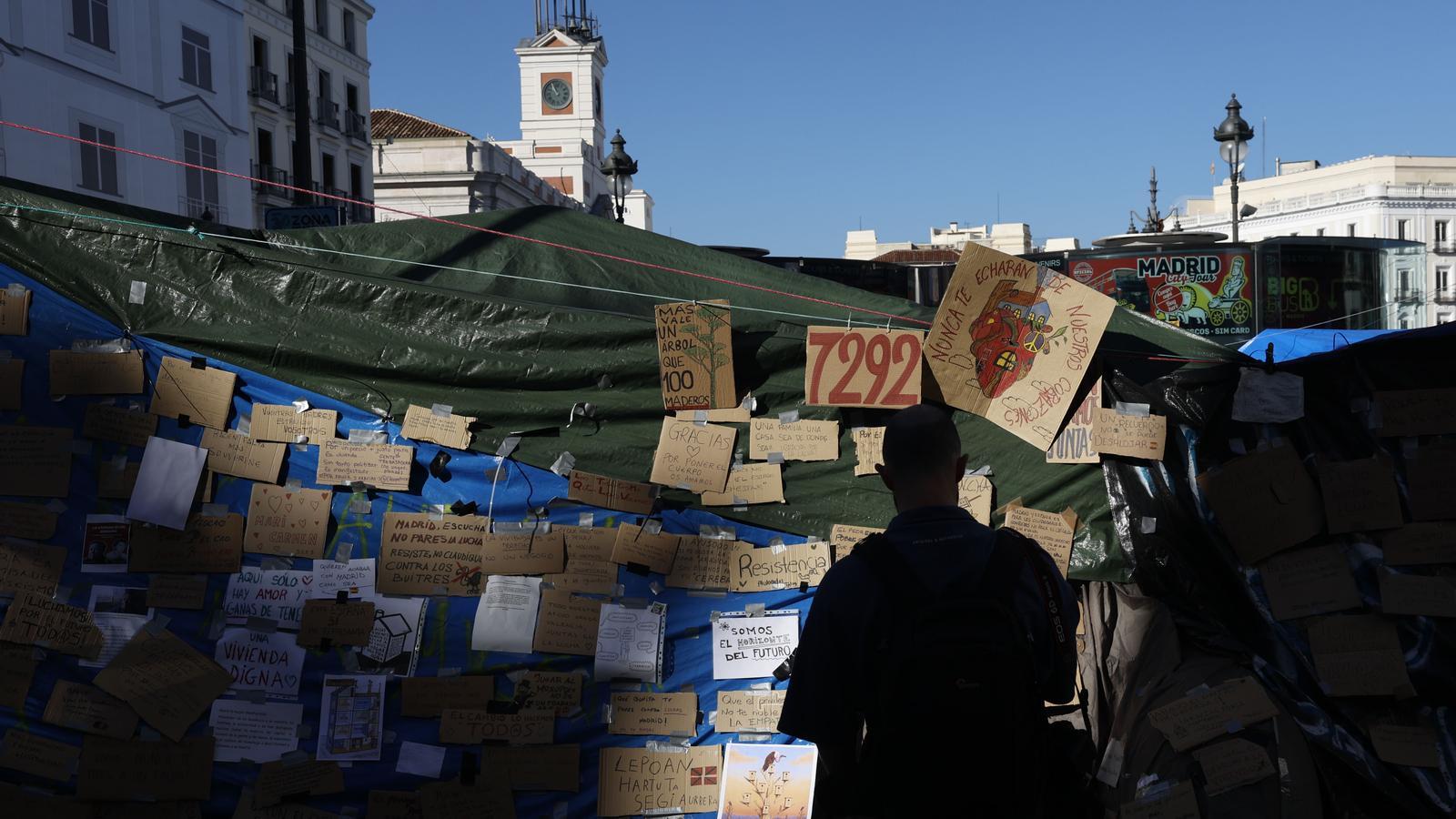
MadridA sea of thousands of green t-shirts approaches the Puerta del Sol this Wednesday at noon. "Public education for everyone and by everyone," it reads in white printed letters. They are the teachers of non-university public schools in the Community of Madrid, who are starting an indefinite general strike. They advance walking along one of the streets that leads to the kilometer zero of the Spanish capital. Upon arriving, they surround the nearly 2,000 tents that have remained installed in the square for almost twenty days: the first one was placed on the night of September 26th.
A few years ago, this place was the center of a wave of criticism due to a renovation in which concrete became the protagonist, while trees and shadows disappeared. In short, a renovation that reduced the Puerta del Sol to being solely a place of passage. Now, the awnings of the protesters who live there reign. But just as the square has, the encampment for the right to housing has also transformed, and it has done so into what it has precisely demanded since it was born: a city where one can have a roof to live under. At the same time, it has given Sol the meaning and function that the Greeks granted to such spaces: to be an agora. This Wednesday there are different talks scheduled, as well as a discussion on two readings.
"We did not expect at all that the encampment and the eviction of Maricarmen would connect in this way with a whole malaise that already existed on the streets [...] It is very exceptional that a concrete response becomes this," they reflect from the Madrid Tenants' Union, where memberships have grown since then. "For us, it is one of the most important things and now it is time to sustain it. Many people do not come from previous spaces of militancy," they acknowledge. They are already preparing for the general strike on November 11: "The goal is not just to make a show of force, but for us as a society to have to take a stand".
"Perhaps people saw it [the encampment] as an end, but it is a means. Sol has ended up being a tool for social mobilization and personal empowerment so that people continue to organize themselves in neighborhoods or groups and achieve small victories," reflects Sara (22 years old). She is a student of international relations and law and works as a waitress. She shares an apartment with two friends. She has been sleeping at Sol for days and balances it, as best she can, with her routine. She admits she is tired, but at the same time she feels enthusiastic: "Madrid was quite asleep and I want to think that whoever has set foot here sees it as friendly [to mobilize] and feels strong enough to continue [beyond the encampment]".
Hey, are you going to the "lung"?
— Yes, I will check if they need a hand.
Another protester heads to the "lung". This is the name chosen to christen the nerve center of this micropolis, which is hidden under blue plastic covers – there are more than fifty streets and dozens of squares with names (such as Maricarmen street or Gaza square) that organize the space. At half past twelve in the afternoon, several hands prepare sandwiches there to be distributed later among the campers. From here, resources are distributed: food, blankets, or clothing... There is a list of daily needs, also hygiene products or material to keep the tents stable, among others.
The "lung" is one of the commissions that has been established in recent weeks. Added to this is the urban planning commission, where everyone who arrives at the encampment for the first time passes through; the mediation one; care and medical attention; the communication one, or even one for material and repair. That is to say, a hardware store. All of this has served to organize a space that, starting from spontaneity, has not stopped growing. "When you are so many people all of a sudden, you have to make an effort of collective responsibility so that things work, so that people don't get angry or misunderstandings don't arise," adds Sara.
A transversal movement
"Every day people come, especially older people, to make some kind of donation [...] People who, from a position of privilege –they tell you they own an apartment and have their lives sorted out– also contribute because they understand the emergency situation the country is going through [...] If one has a minimum of judgment, common sense, and humanity, one stands with the encampment," says Anna (30 years old), while helping to make sandwiches. She will be there all morning because she is going to work in the afternoon. "We work here too. We even have a coworking space," she says, half-laughing in what is meant to be an implicit reference to those who have labeled them "lazy." And she throws a dart at the discourses of the right and the far-right that have criminalized the protests: "What is more in favor of Spain than defending that people can live there with dignity?"
This Wednesday, the mayor of Madrid, José Luis Martínez Almeida (PP), once again lashed out at the campers: "They shouldn't complain, they are privatizing the space," he said. Just a year ago, the City Council closed the Plaza Mayor to the public for a fashion show by the brand Carolina Herrera. The truth is that one can enter and leave this anarchic city of Sol at any time. And walk around too.
Over the days, the mobilization has transcended housing, although it remains the backbone. "It is a question of social justice," says Anna. The orange color of the Madrid Tenants' Union, who were the ones that planted the seed of the encampment, has given way to other colors and collectives. All of them have organized by neighborhoods and in a horizontal manner: neighborhood unions of Madrid, Ecologists in Action, Anticapitalists, the Socialist Youth Coordinator (CSJ)... Also individuals. "It is a mistake to think that many struggles are individual. In fact, they share many things: we work a lot and we do not have control over basic things like housing or other basic services like public education or healthcare," they point out from the Union.
Organizations in defense of public education have been present at the encampment since the first day with information points about their demands. Preschool and secondary school teachers have been demanding better working conditions and resources for months in the face of what they consider a "dismantling" of a right, and they have now decided to go on an indefinite strike. Today there have been pickets, street closures, and a demonstration that also ended in Sol. The controversy was sparked by the charges of the National Police against a group of students who were also demonstrating and which the Spanish government delegation in Madrid will investigate.
What future is there?
An assembly has been called for Thursday afternoon to address the future of the encampment. For the moment, there is no fixed date for its end, but several protesters acknowledge that the day will come, as pressure grows from the local and regional government, which have already taken the battle to the courts to evict them. For this reason, they prefer to "do it right and take everyone into account," says Anna. There are now very vulnerable profiles; also many homeless people who have found in the tents a place to avoid sleeping rough, at least for a few days, and who are the last rung of the housing crisis.
Over one and all hangs a question: what will remain of it all when the intensity drops? "That is the challenge," they admit from the Tenants' Union.
