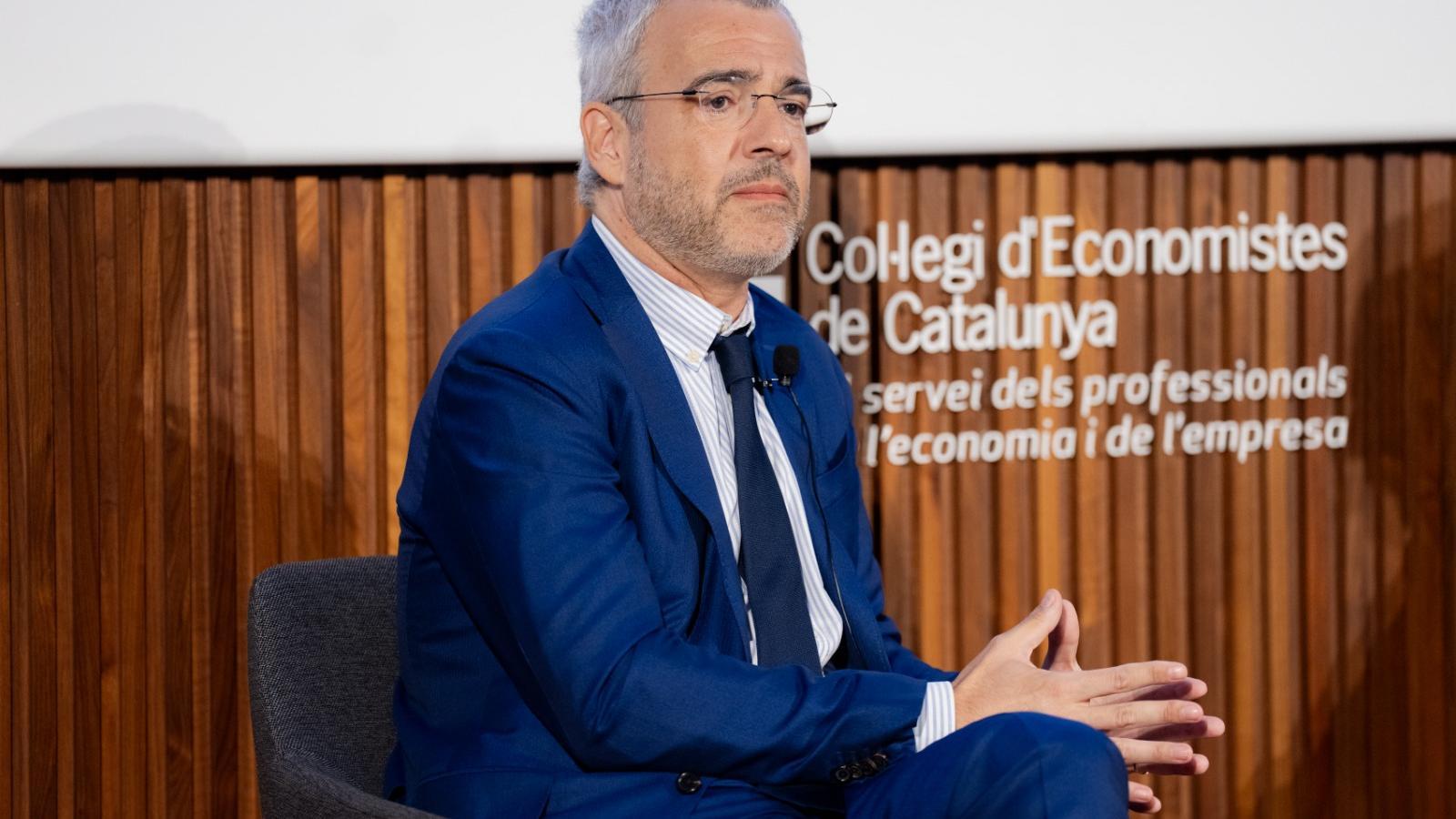
BarcelonaThe expansion of Barcelona Airport will be a reality in less than ten years. "In 2036 everything will be finished and in operation," assured the president of Aena, Maurici Lucena, this Friday at the College of Economists of Catalonia (CEC). In fact, Lucena went a step further and opened the door to advancing some investments that, for the moment, are planned for the 2032 - 2036 period.
The investment planning of the company for the next five years —included in Dora III— includes the remodeling of the El Prat terminals, while, right now, the controversial third runway falls under Dora IV. Although before getting into the matter, Lucena warned that he would not make "any announcement" during the intervention because he is subject to electoral laws —the State is the owner of 51% of the company—, he expressed his wish that "hopefully it can be possible, as sometimes happens, to advance schedules and investments," as has happened in actions at other Spanish airports.
For the umpteenth time, the head of Aena has defended tooth and nail that the protected natural spaces surrounding the airport will be "better" after the expansion than they are now. He has returned to criticize "the die-hard conservationist of natural spaces, because many things would not have changed" and distinguished them from those who are in favor of "touching them, but always with the indisputable objective of improving them".
Deficit in "more than half" of the airports
On the eve of the general elections, Lucena considered that the Spanish airport model is “very stable and works very well” and recalled that it is “very firmly anchored in regulations”, among others, with the attribution of exclusive powers to the State in the Spanish Constitution. In fact, he boasted that Aena —which handles one million passengers a day around the world— “is considered, not only as the largest airport company in the world, but as the best”.
Lucena has admitted that "probably more than half" of the 46 airports the company has in Spain "would individually be loss-making under a simple definition". "Financially, it has no importance at all", he insisted, because the "monstrous efficiencies of the large airports and the coordination mechanisms of the network" are much more relevant.
In fact, individual accounts for each one do not exist because, legally, a "network" model has been established. The president of Aena has resorted to arguments from economic theory such as economies of scale to argue how Aena's "efficiency" —in the economic sphere, but also in concrete actions— is sustained by the joint operation of all its airports. "A technical blackout like the one that happened at Heathrow is impossible to happen at Aena, but not because we are smarter, but because we have airports in coordination", he illustrated.
Tourism governance
Lucena, who has predicted that Barcelona Airport will exceed 60 million passengers this year, has left Aena out of the debate on the number of visitors that Catalonia can accommodate. While he has reduced airports to a "gateway, which can be wider, lower, or more uncomfortable", he has recalled that the governance of tourism depends "on the territory". "Who approves hotel places and tourist services?", he asked.
Along these lines, to intervene in the current model, Lucena has opined that the tourist tax is "extraordinarily powerful" as long as it is used with vehemence, and he believes that the Barcelona City Council is "rightly" choosing to influence the tourism sector through this measure.