The European country that is advancing in the opposite direction to Spain in housing
Portugal has the most overvalued market in the EU, according to the Commission

-
CAT -
CAST
BarcelonaSpain is discussing how to intervene in the market to manage the existing housing stock while, in parallel –at least on paper– it is increasing supply with new construction. The decrees that triggered the 29-N election call put on the table the extension of leases, limiting price updates (and even freezing them), and prohibiting the eviction of vulnerable people without a housing alternative. On the other side of the border, Portugal is proposing a practically opposite formula to address one of the worst housing access crises (if not the worst) in the European Union.
The Portuguese market is the most overvalued in the EU, according to the Commission, which estimates that property prices are between 25% and 35% above their real value. In this context, the government of the conservative Luís Montenegro is betting on deregulating housing to spur investment. "Without confidence, economic agents will not invest in the projects necessary for there to be more supply that can contain prices and guarantee access to housing," he proclaimed when he announced his measures.
Since coming to power in mid-2024, Montenegro has begun the procedures to abolish restrictions on raising rents and to speed up evictions, and has eliminated the obligation that existed –at least on paper– to incorporate empty apartments into the housing stock. He has also allowed municipalities to decide whether they want to increase the supply of tourist apartments, has withdrawn the extraordinary tax that holiday rentals (HUTs) had to pay, and has approved tax exemptions on the purchase of apartments or rental income.
"They are betting on overstimulating supply, whatever type it may be," summarizes researcher at the University of Lisbon Simone Tulumello. In contrast, he believes that the previous executive, led by the socialist António Costa, tried to focus on the supply of affordable housing, although he laments that neither one nor the other has addressed the "structural issues of housing policy" so far. So, does Montenegro's formula really represent a change of course regarding the socialists' recipes?
Without addressing the "structural issues"
Portugal has been immersed for years in a serious housing crisis that, for the moment, seems to be in free fall: according to the latest data from Eurostat, it is where prices are rising the most in the entire eurozone. The National Statistics Institute of Portugal estimates that the purchase price per square meter in the second quarter rose by 18.4% year-on-year and, for rent, by 10.2%. The European Council calculated at the end of last year that Lisbon is the city in the Union where tenants allocate the largest part of their salary to paying rent: 116%, ahead of the 74% in Barcelona and Madrid. In fact, the figure shows how a person's entire salary is not enough.
Families paid 476,910 euros for a 90-meter apartment in Lisbon, in line with the most sought-after cities, but an amount much higher than the country's average of 220,000 euros. The rent for the same apartment was 1,371 euros in the capital's metropolitan area, and 915 euros nationwide.
Outside the polls
Tulumello believes that housing "is a very present issue in public debate, but it has not been translated at the polls". In 2023, a wave of demonstrations swept through various cities in the country and, a year later, the socialists suffered a major defeat in the elections that paved the way to power for the conservatives.

According to Tulumello, although Costa "had a different rhetoric" on housing, "he did not have an effective policy," but rather gave leeway to negotiate "ad hoc solutions." In this vein, Cidob researcher Héctor Sánchez recalls that it was not until then that the socialists eliminated the Golden Visa, the mechanism for obtaining Portuguese residency through the purchase of homes. The OECD links this figure to "a stronger price growth" of properties around 500,000 euros (the minimum investment threshold).
Communicating vessels on the Peninsula
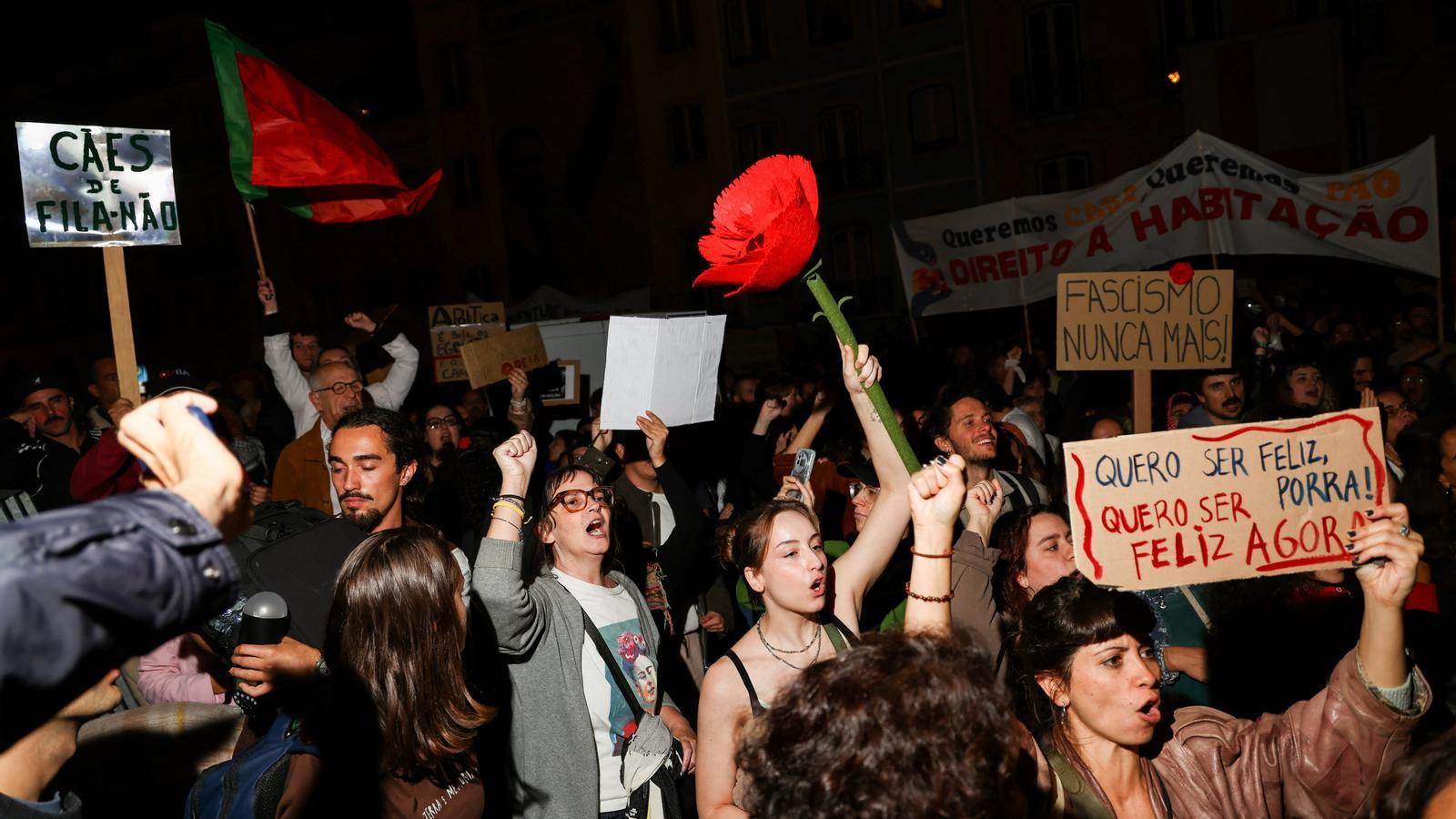
This autumn, thousands of people have once again demanded solutions to the housing crisis, going so far as to camp out in Lisbon and Porto. The eviction of Maricarmen in Madrid and the demonstrations throughout the Spanish State have spurred on a feeling of unrest that has been simmering in Portugal for years. "The protests have a transnational component; you only need something to light the fuse," explains Sánchez. "The demands may not be the same, but there is a sense of community, of not being alone."
From the Institute of Social and Political Sciences at the University of Lisbon, Romana Xerez outlines the common points shared by Southern European markets: "Portugal, Spain, Italy, and Greece have similar systems. Although housing crises are very tough all over Europe, the specific characteristics of the south have a huge impact," she explains.
On the shores of the Mediterranean, families are mostly owners of the properties where they live—a regime that is gradually losing weight, given the growing difficulties in buying—and the stock of affordable housing has little weight in the market as a whole. These are territories where the 2008 crisis, closely linked to the construction sector, had a particularly strong impact, and where there is strong tourist pressure. "Portugal starred in a great boom; after the pandemic, it attracted a lot of attention," recalls Sánchez. According to Tulumello, while the movements of 2023 were the "result of a long process of building the housing movement in Portugal," this year they have "a different composition, very young and more disorganized." A change that has not led to scenes of looting as in Barcelona or France.
