JOBarcelona tries to unite generation Z and companies looking for an "impossible" young person
The reference congress closes its 14th edition connecting 7,000 candidates with a market where youth unemployment still doubles general unemployment
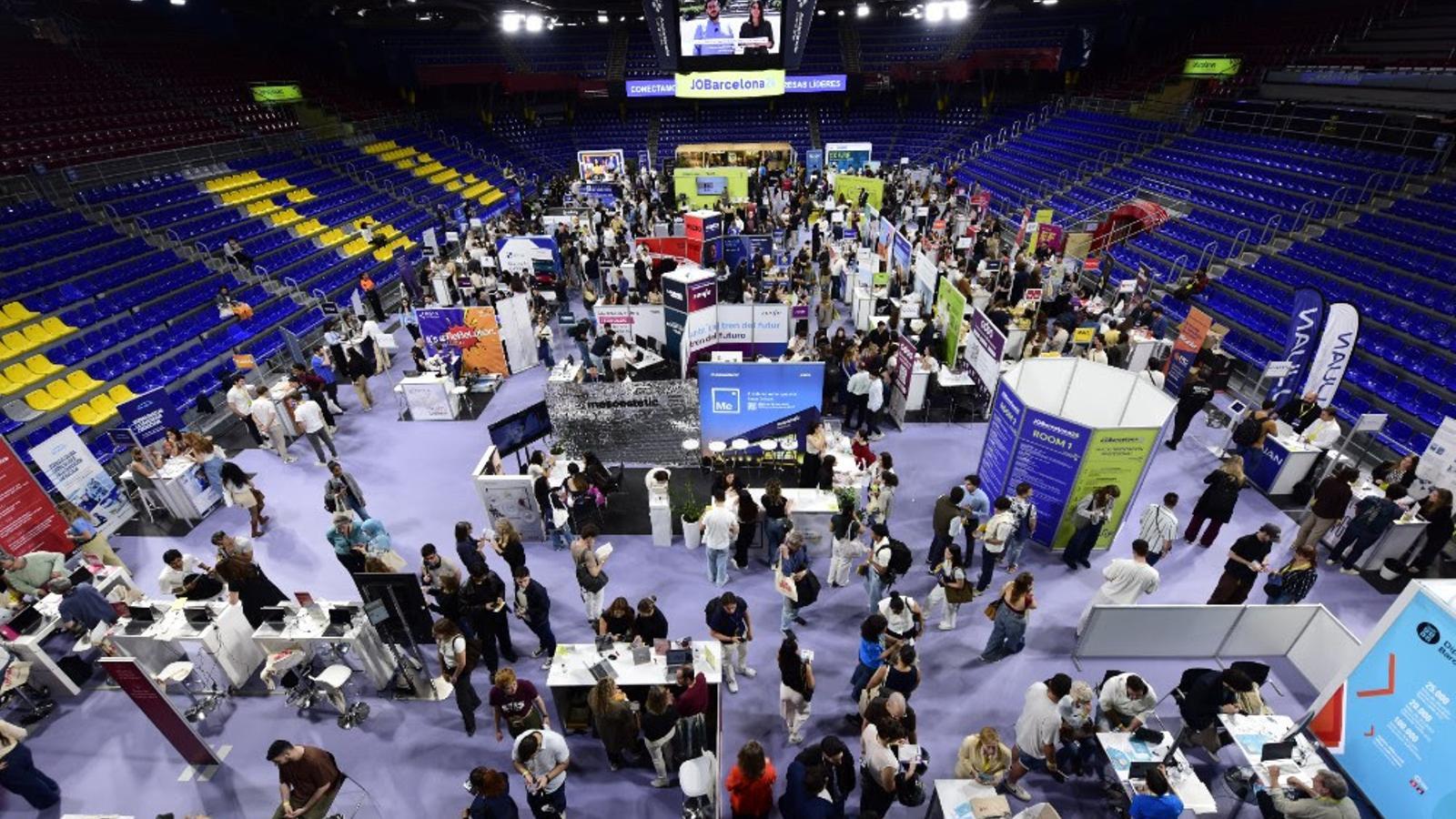
BarcelonaThe Catalan labor market suffers from a bloody contradiction. On the one hand, companies warn of the difficulty in finding and retaining talent. On the other, youth unemployment is an open wound: despite the youth unemployment rate having decreased and being set at 19.31% in 2025, this figure continues to double the unemployment of the central age group –between 25 and 54 years old–, which in 2025 was 9.78%. In this context, the 14th edition of JOBarcelona brought together more than 7,000 young people and 80 companies this Wednesday, generating more than 30,000 interviews.
At the fair, which took place at the Palau Blaugrana, young graduates and students lament the invisible wall they encounter upon finishing their studies. "I'm in limbo: they either look for someone for internships or they directly ask for five years of experience," assures Òscar in statements to ARA, a marketing graduate from ESIC. The student reflects the sentiment of the candidates, most of whom believe that universities do not always adapt to the real world and companies demand unattainable requirements for a junior profile.
To address this mismatch, thousands of young people have been able to find a complete professional orientation itinerary at the fair with practical and technological activities. Among the proposals, institutional employability improvement workshops stood out, and especially, the use of artificial intelligence tools and virtual reality interview and communication skills simulators, aimed at training candidates in real time.
70% of companies cannot find the right profile
This frustration connects with a striking piece of data from the event: 70% of companies admit that they cannot find the student profile that fits their needs. Lina Valentí, selection consultant at Lidl, believes that the problem is not training: "People are very well trained, one of the problems is that preparation for interviews is not adequate." Valentí believes that universities should work on how to face job interviews.
In this regard, Marta de Llauder, CEO of Talent Point and organizer of the fair, has added a nuance in statements to ARA. "There is a lack of information. There are three levels: internships, first jobs, where many companies ask for zero experience, and jobs with experience. Sometimes young people apply for positions that are not yet right for them," she explains. According to the expert, skills such as resilience, curiosity, or adaptability are the real differentiating elements today.
Generation Z does not commit to anyone
"Nowadays, young people look for a career plan, flexible hours, work-life balance, remote work, and social benefits. They are demanding and move very fast," assured De Llauder. The change, therefore, also goes the other way around: young people have also transformed their priorities. In this regard, Marta de Llauder explained that talent retention has become very volatile: "The current average stay [in the same company] is two and a half or three years. There is no longer that old commitment to spend your whole life in one company."
In fact, according to the global survey by the consulting firm Deloitte, more than 50% of young people in this generation choose or reject a job based on their personal values and the company's social and environmental impact. This has forced corporate giants like Danone, Indra, Aena, or the Bank of Spain – all present at JOBarcelona 2026 – to compete to offer purpose and flexibility.
Beyond technological and digital profiles, which continue to be the most in-demand, the event has also highlighted other urgent needs of the productive fabric. Carol Lorenzo, career guidance director at Barcelona Activa, warned of another major problem: "We have many sectors with a serious generational handover problem, with a large number of people on the verge of retirement, and where, on the other hand, there are no young people prepared to join, such as construction, trade, or industry."
All in all, the 14th edition of JOBarcelona 2026 has served to make this reality a little more hopeful for the thousands of attendees. The event has shown that the future of employment is based on proactivity and the ability to connect with the purpose of companies.
