"If you stay at home, you never completely disconnect"
28.8% of Catalans cannot take a week's holiday away from home, according to Idescat

-
CAT -
CAST
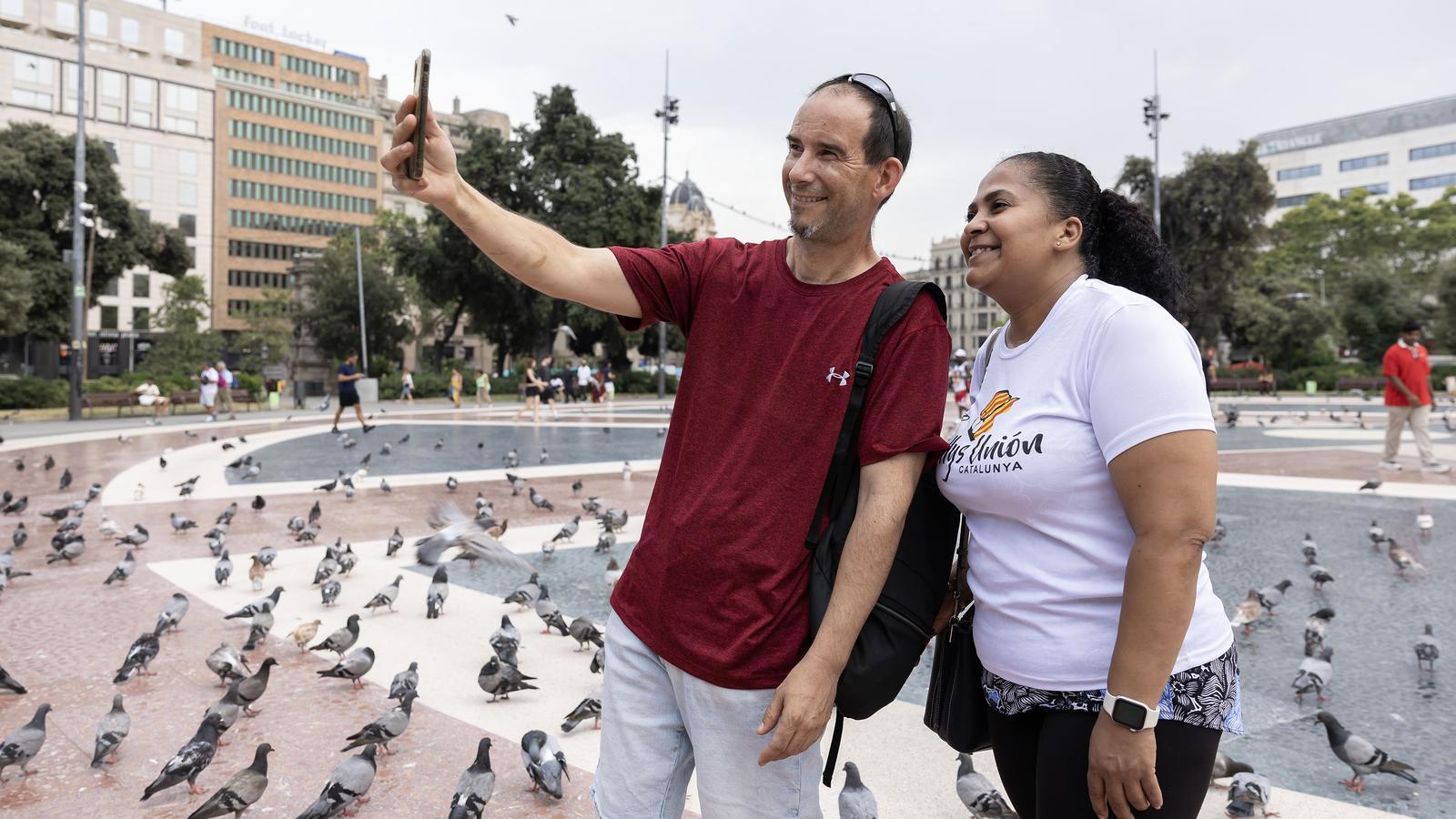
BarcelonaHéctor and Magnolia work in luxury hotel establishments. He holds a position of responsibility in the kitchen of a well-known hotel in Barcelona, and she cleans rooms in an exclusive tourist establishment near the city's beach. Despite living daily with tourism, Magnolia is part of the 28.8% of Catalans who, according to Idescat, cannot afford to take a week's vacation away from home, and until six or seven years ago, Héctor was also one of them.
Being able to enjoy a few days of leisure and rest away from home is one of the indicators that Idescat uses to assess the deprivations suffered by Catalan society. The affected population has varied slightly year after year, but in the last decade it has fluctuated between 26.8% and 30.6%.

In a bar near Plaça Catalunya, between tourists and Barcelonians going for sales at Portal de l'Àngel, Magnolia and Héctor recall the few occasions they have been on the other side of the scene, being themselves the ones who do tourism, despite working full-time for more than 25 years.
She talks about some isolated weekend on the coast with her husband, who works in maintenance at a hotel. She has "three children and a mortgage" and, as she explains, chambermaids in Barcelona earn 1,600 euros a month in twelve payments. To the question of when was the last time she went on a trip with the children, she replies: "None, because if the five of us go, it's impossible".
Héctor started going on vacation when his wife changed sectors and started working as a special education teacher: "Tourism is a luxury product," he assures. This year they will go with their two children to the Black Forest – precisely – for a week. Although he believes that "leaving routine is already resting", he warns that "if you stay at home, you never quite disconnect completely". He also argues that changing your environment "allows for a stronger bond with the family": "Throughout the year you don't see them as much as you'd like, and if you go on vacation, you have 24 hours a day with them".
Summer holidays when they were little
The summers of Héctor's adult life contrast with those he lived as a child: "I went on vacation with my parents every year. And for more than a week," he smiles. They used to go from apartment to places like Alicante, Roses, or Cadaqués. What has changed?
The answers overlap: salary, housing prices, or the supermarket basket. On the one hand, Héctor believes that "salaries have not grown enough compared to the cost of living." On the other hand, both agree that housing and food are the items that consume the most resources. According to data from the National Statistics Institute (INE) analyzed by ARA, low-income households have had to increase spending on these goods more than high-income households. "With fifty euros I used to buy things before, now I carry an empty plastic bag, almost," Héctor summarizes.
In defense of tourism
Héctor and Magnolia claim that tourism is "a necessary source of income for the country and a very important part of the economy" and recall that it "employs many people". According to the latest data from the Generalitat, this sector represents close to 12% of Catalonia's gross domestic product (GDP, the indicator that measures the size of an economy). It generates 16% of employment – creating more than 541,000 jobs – and has more than 126,000 companies. However, they also point out that it increases the price of housing and the cost of living in neighborhoods.
Regarding the concept of quality tourism, Héctor claims that the trip he will take is also one: "However, I am not going to a five-star hotel, I am going to an aparthotel". "I can go away for a week, but not to a hotel like the one I work in," he admits.
They argue that quality tourism is what "respects the place you visit, and creates wealth there," in Héctor's words. Magnolia believes that it "does not exist," because it is what distributes profits and offers good working conditions for employees. "For me, as a room attendant, it means a reduction in ratios," she exemplifies. Héctor, however, clarifies that "that no longer depends on the tourist."
Competitive tourism and social tourism
The founder of the Alba Sud critical tourism research center and researcher at the University of the Balearic Islands (UIB), Ernest Cañada, warns that "the rise in prices leads to a process of elitization in which people with higher purchasing power will be able to take holidays and enjoy the territory, and the rest will be left out".
In this scenario, Cañada calls for "a social tourism policy suitable for the Catalan population" that guarantees access to this type of leisure for everyone. It includes outings for families to colony houses and Imserso, among others.
On the other hand, for Esade professor and professor at the Pompeu Fabra University (UPF-BSM) business school Josep-Francesc Valls, quality tourism is what involves "less environmental expenditure and more expenditure on all products". In his opinion, "there are conditions to undoubtedly increase the wages of the weakest areas of tourism" – referring to hospitality and catering – but he warns that they do not represent the entirety of the sector.
"The tourism sector includes activity in the field of culture, congresses, universities, and technology and, as a whole, places it at a very similar level to other sectors in the country, absolutely competitive," he concludes.
