Half a million euros more per footballer: the difference between the premiums of the men's and women's national teams
The male squad players will receive a bonus of 750,000 euros compared to the 245,000 euros that the female squad players received

-
CAT -
CAST
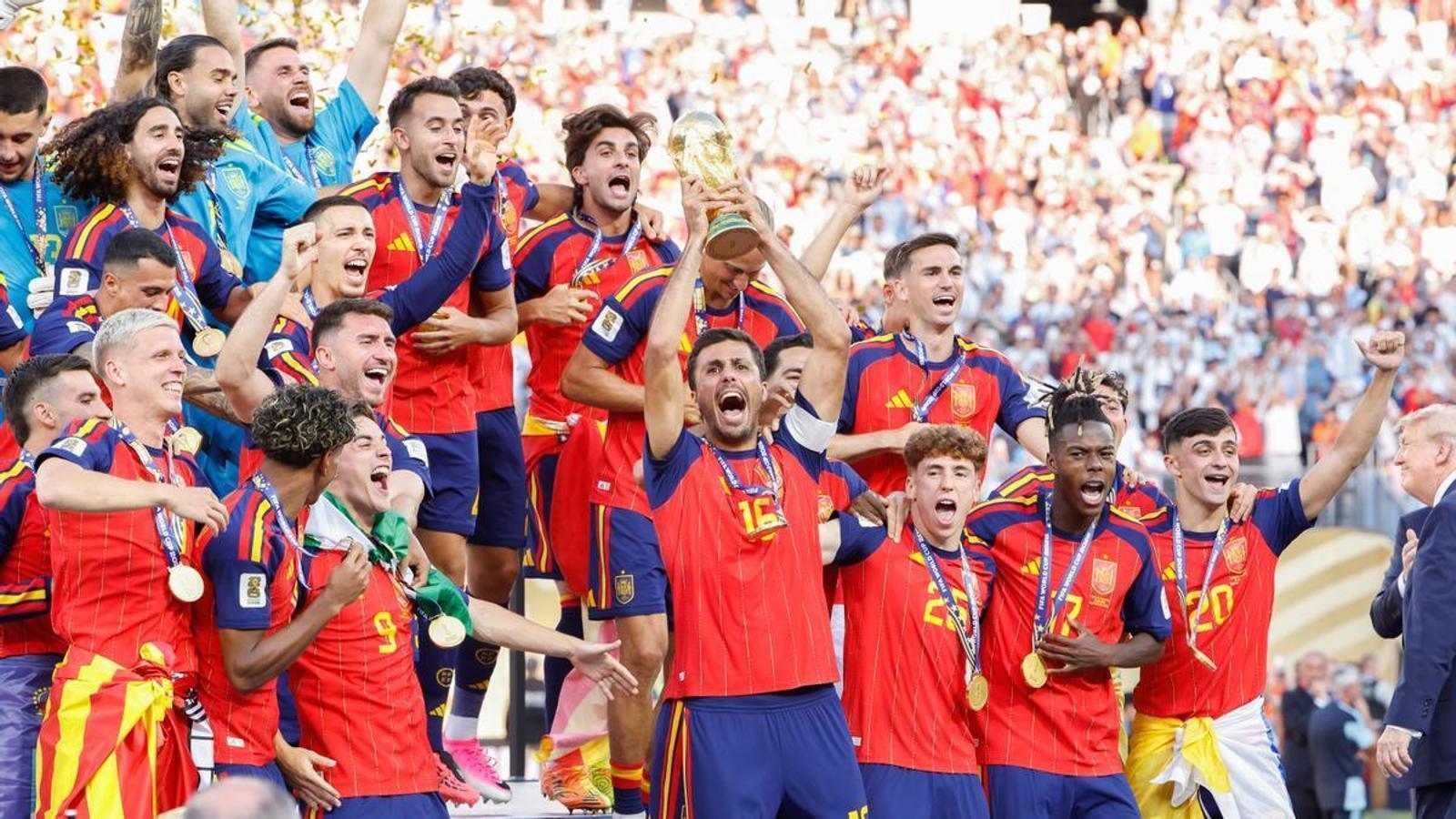
BarcelonaThe Spanish national team footballers will each receive a bonus of approximately 750,000 euros for winning the World Cup, a figure that is three times the 245,000 euros received by the players of the Spanish women's team. world champion in 2023. Thus, the difference between the extraordinary bonus between male and female players for winning the World Cup exceeds half a million euros.
This fact is not new and depends, in large part, on the awards distributed by FIFA, which systematically gives higher awards in men's competitions than in women's. The international federation's justification is simple: the revenue generated by men's football in sponsorships, ticket sales, merchandising, and television rights far exceeds that of women's. These same explanations are what UEFA, the European federation, alleges.
For example, in the 2024 Women's Nations League, UEFA allocated a total of 160,000 euros to the winning team, which was also Spain. The Spanish federation increased the figure to 500,000 euros to be distributed among all the players, far below the more than 10 million that had been distributed to the Spanish national team footballers for winning the men's version of this competition two years earlier, as reported by Relay.
Regarding the 2025 European Championship, the federation promised the players 40% of the prize money, which would have been over 100,000 euros per player (in the end it was less because Spain lost the final and received a lower prize). In the case of the men, each one pocketed over 430,000 euros when they won the European title two years ago.
The Treasury will keep almost half of the prize
In total, the 25 footballers called up to the championship with the men's national team negotiated to receive a higher percentage, 45%, of the more than 40 million euros that the RFEF will collect for winning the championship. This means that the specific amount each player of the national team will receive is approximately 754,701 euros gross, according to calculations by Gestha, the association of technicians from the Ministry of Finance, published last week.
Unlike the 2010 World Cup, which Spain also won, on this occasion there have been no discussions and the footballers will pay taxes on the money received in their place of residence. Sixteen years ago, the footballers managed to pay taxes on the bonus in South Africa, the country where the World Cup had been held and where the maximum rate to pay was 21%, less than half the rate they would have paid in Spain.
This year, however, players will have to declare the bonus as income from work and, therefore, the amount will be added to their salary in the IRPF declaration. This tax has a dual taxation, with a scale set by the Spanish government that ranges between 9.5% and 24.5% on all income exceeding 300,000 euros, and a second scale that varies according to each autonomous community. For example, in the case of Catalonia, it ranges between 10.5% and a maximum of 25.5%.
Given that the minimum annual salary for a La Liga footballer is 195,000 euros and the average salary exceeds one million, it can be assumed that all the national team footballers will exceed the income thresholds to pay the maximum rate this year. Thus, with the two tiers, the eight Barça players will pay taxes in Catalonia, where they will have to pay the tax agency approximately 50% of the 754,000 euros – that is, around 377,000 euros – while Borja Iglesias, the only one who pays IRPF in Galicia, will pay 47%. The three Atlético de Madrid players will pay 45%.
Regarding players residing in the 'foral' communities – the Basque Country and Navarre, with their own taxation – they will pay their treasuries approximately 39% of the bonus in the case of the Basques and 45% in the case of the Catalan winger for Osasuna, Víctor Muñoz. Despite having maximum rates of 49% in the case of Biscay and Gipuzkoa and 52% in Navarre, a reduction is applied in these territories for one-off payments.
Finally, the seven Spanish footballers playing in the English league will pay 45% tax on the bonus to the British treasury and the Valencian player from Bayer Leverkusen, Álex Grimaldo, 47% to the German state of North Rhine-Westphalia. The one who will pay the most will be Fabián Ruiz, from PSG, who will have to give up 55% of the bonus to the French tax agency.
