Sofia Andrukhóvitx: "With the war you feel a visceral need for connection with your land and with your people"
Ukrainian writer. Author of 'The story of Romana and Uliana. Amadoca'
-
CAT -
CAST
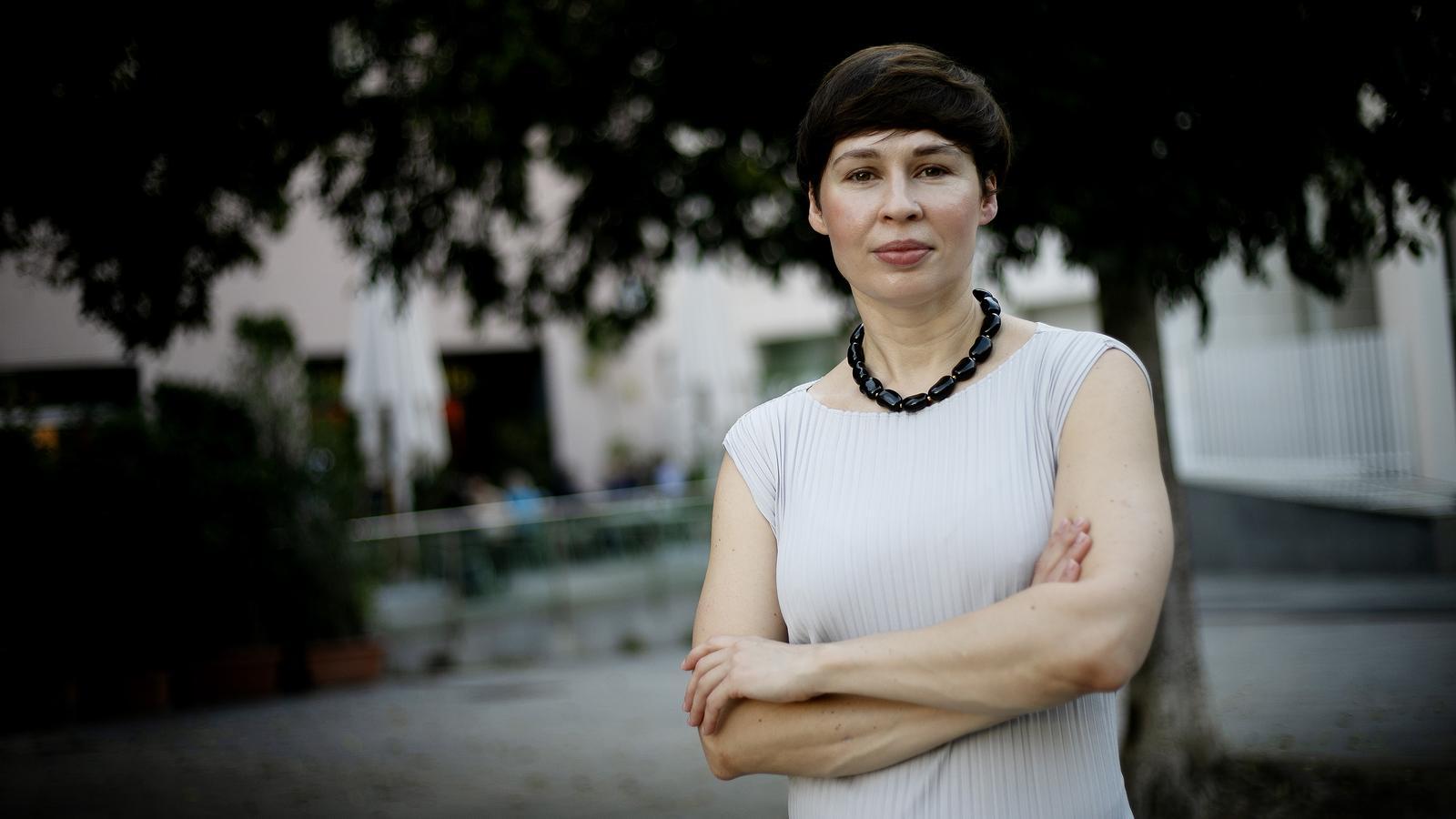
BarcelonaWriter Sofia Andrukhovych (Ukraine, 1982) continues to try, despite the war, to write from Kyiv. These days she is in Barcelona to talk about memory, trauma, and creation in times of conflict at the Biennial of Thought, and to present The story of Romana and Uliana. Amadoca (Salamandra), translated into Spanish by Olga Korobenko. Originally conceived in three interconnected parts (the story of Romana, the story of Uliana, and the story of Sofia), the Spanish edition includes only the first two books. Through family memories and intense love stories, the author, daughter of the writer Yuri Andrukhovych, covers the Stalinist repression, the Holocaust, and the war in the Donbas.
At the beginning of the book, Bogdan leaves a suitcase full of family photographs at the archive that ends up abandoned in a corner until Romana rescues it. To what extent are private and family accounts decisive for collective memory?
— In Ukraine, and especially in the countries that were occupied, there are many stories that remained silenced. On one hand, there was the official history, the one that was permitted; on the other, the private stories, silenced and even forgotten, because during the Soviet era it was very dangerous to speak about intimate experiences, traumatic memories, and war episodes. The novel itself deals with the act of telling stories. This did not arise from nothing: starting in 2014, in Ukrainian society, a very evident process of rescuing family accounts was experienced. People had an urgent need to share them, to unearth them, and to find out what had happened to their parents and grandparents.
Romana contemplates the photographs of patients disfigured by the war with the same feverish avidity with which Emma Bovary devoured romantic novels. What is she looking for in this visual voracity for shattered flesh?
— I think she is looking for someone who can share her sense of trauma, or who can understand and connect with the pain she herself is going through. And she also hopes to find someone vulnerable enough to be able to connect directly through the wound.
When Ukrainians began to look back at their tragic 20th century in 2014, which episode was the most difficult to face?
— It depended a lot on geography. In the westernmost part there was more knowledge of what had happened and they managed to better preserve family memories, albeit with great caution. In the eastern part, on the other hand, the influence of Russia was more powerful and the pressure led to repressing memories. The memory of the Second World War has more weight and is preserved, although often mythologized. As happens in many nations, the memories in which we appear as victims or heroes are preserved much better than the memories in which we are perpetrators. That is why I felt the need to talk about the Holocaust in Ukraine. It is a deeply painful subject that only some historians or young generations want to address, but it is extremely complex.
How has Ukraine managed the recognition of this responsibility in the extermination of the Jews?
— When the novel was published in Ukraine in 2019, I was surprised that many readers—especially from the younger generation—said that the Holocaust part, which is not at all flattering to Ukrainians, was their favorite and most important one. But the full-scale invasion of 2022 complicated everything. When people suffer under constant mortal danger, they lose the capacity to process such complex things. Everything is seen in black and white again and there are no emotional resources to go further. This process of reflection has slowed down again.
Could you write this same novel now, in the midst of the current war scenario?
— I don't think so. I was able to write Amadoca because there was a temporal distance from the Second World War, which is the central theme, and even from the beginning of the war in the Donbas, in 2014, which many people still did not perceive with all its gravity. This distance allows you to have a broad perspective. But when you are under continuous attack and you don't know when or how it will end, it is impossible to allow yourself the luxury of rationalizing or having the necessary mental space to imagine.
How does a writer face the task of writing fiction when reality is so overwhelming?
— I continue to do it, but now I write about the details and about everyday situations that I observe. It is crucial to be able to write, to describe, and to name what is happening; it is the only way that might help us overcome trauma. These last few years have been the most complicated of my life in terms of writing. To create a fictional world that is alive you need to feel a certain security. When you feel threatened and suffer for your children and for your loved ones, the mind fragments. However, the people of Ukraine teach me every day how to face it: it is vital to try to maintain a normal life within the possibilities.
You made the decision to stay in Kyiv instead of leaving the country. Why?
— We all live with an inner conflict. On one hand, you desire a security that is impossible to find in Ukraine, especially in Kyiv and in the cities of the east. But, on the other, you feel a visceral need for connection with your land, with your people, and with what is happening. As a writer, I need this connection: I doubt that I could write anywhere else. I write at the exact point where I can understand people and I listen to their voices with my mind and my body. This is my instrument, and I am very afraid of losing it.
In the novel, it is clear that women are the ones responsible for transmitting memory. Faced with the destruction of war and a public discourse dominated by the male military epic, what importance does recovering this female voice have?
— It is a crucial voice. The lack of female voices throughout human history is one of the reasons why there continue to be wars. Even so, my protagonists are not simple figures: the Roman woman may seem real, but she is also an allegorical figure representing the power of storytelling, even if her motivations are ambiguous. For me, it was a kind of revenge to have a female character behave in this way towards a man and force him to listen. It is not just a question of gender, but of victims and perpetrators: here the roles are reversed. The one who has lost their memory is forced to be attentive to the experience of the other; someone who usually made others suffer now has to listen to the suffering of others.
This way that Romana has of reconstructing the story borders on manipulation. Is there always a part of manipulation when a story is told?
— Yes, absolutely. This issue of manipulation comes directly from the Soviet and Russian practice of systematically rewriting the histories of others. What I did with Romana was to invert this dynamic. The only difference is that the story she tells is real in many respects, even though the way she imposes it on another person is questionable.
At one point in the plot, a real "rain of books" and Ukrainian authors falls on Bogdan. What does this avalanche of references represent?
— It is an allegory of the weight of Ukrainian culture and the importance of its authors for our continuity. This culture was quite unknown, not only abroad, but also to Ukrainians themselves, due to totalitarian repressions. I wanted Bogdan to physically feel in his own body the weight and heaviness of those books he ignored, everything that the Soviet system and Russian discourse said did not exist or had no value.
Why did you choose Amadoca, that legendary lake, as the title and axis of the novel?
— It is a metaphor with many dimensions. I found it by chance while researching Herodotus' Histories, to create the character of the Jewish boy. Upon seeing the description of the lake, I realized that, if it had existed, it would have had to be located exactly in the region of Ukraine where the second part of the novel takes place. It seemed to me a brilliant image to define human memory and consciousness: the water changes constantly, memories can disappear because they are too painful and, suddenly, a small detail makes everything reappear like water gushing from underground. It also raises the question of reality: does it matter if the lake really existed, or does the mark that its idea left on culture and on maps matter more? It is exactly the same as what the characters do with their own memories.
