Roc Bernadí: "I, who am so Catalan, missed doing my work in Catalan"
Actor and half of the group Svetlana

-
CAT -
CAST
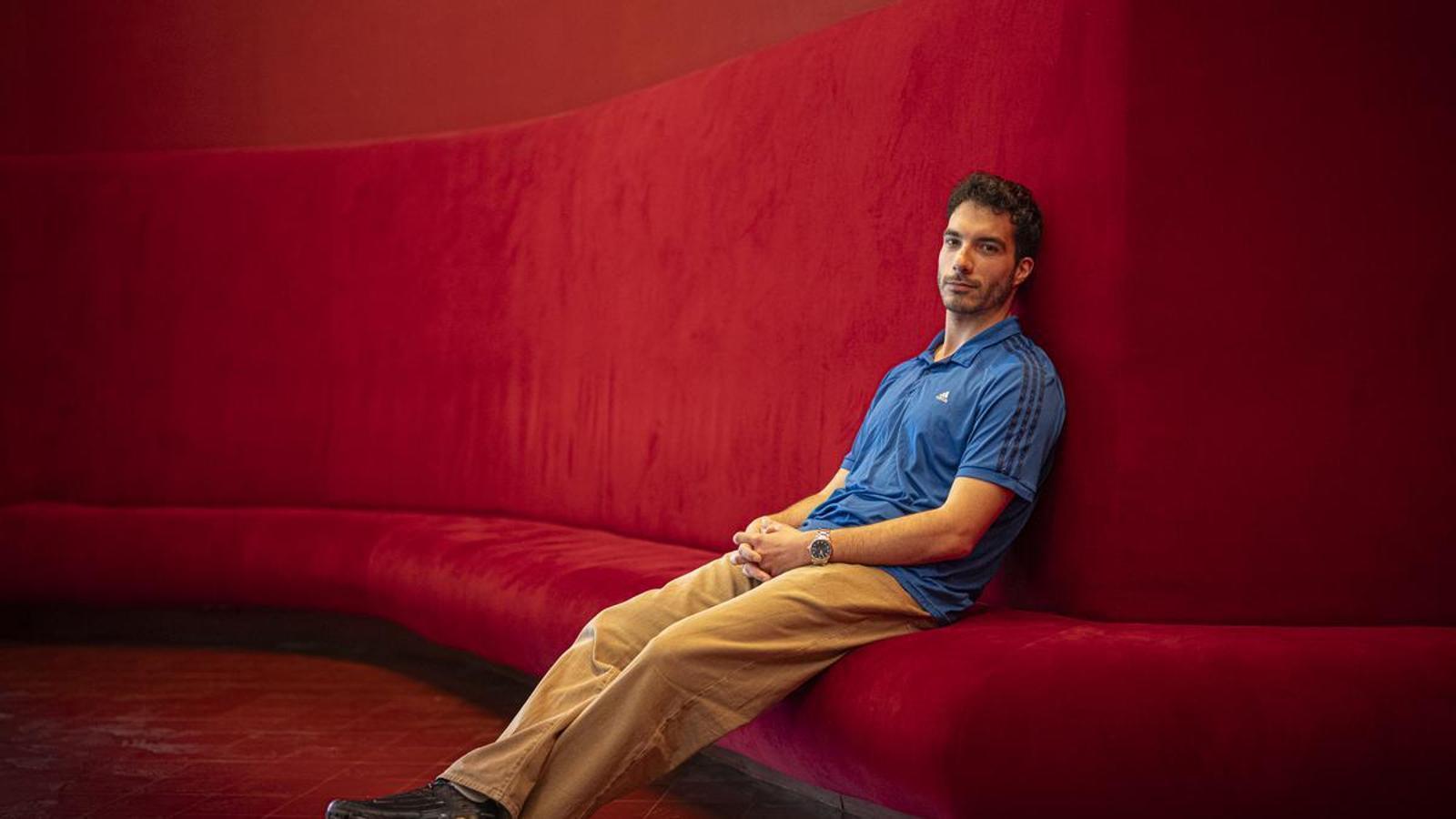
BarcelonaRoc Bernadí (Barcelona, 1997) has not yet reached 30 years of age and has already made a name for himself on the Catalan scene. As an actor, he has starred in large-format musicals, and as a musician, he is half of the duo , who will go on tour again this summer and will present a new album in 2027. We meet at Sala Beckett, a few streets from where he grew up. Until May 24th he will be performing his first monologue, Hold me until I fall asleep, an intimate and poetic coming of age written by Cesc Colomina and directed by Guillem Sánchez Garcia. Afterwards, he will be part of the dream team of The Threepenny Opera directed by Marta Pazos to premiere at the Grec Festival and inaugurate the Teatre Lliure season.Theatre lovers will know you from the roles in Groundhog Day and Blood Brothers. For Generation Z, you are half of Svetlana. Do you live dissociated between two very different facets?
— Absolutely. This is the word I use most with my friends lately: dissociated. I think it's also a very generational thing. And it's a bit of a double-edged sword, because it allows us to do many things at once and concentrate to the maximum, but sometimes you accumulate worries or concerns and, suddenly, you explode. But anyway, apart from being dissociated, I'm very happy doing things I love.
Do you live it as two sides that have no contact?
— They are two very different facets, but extremes sometimes meet. Everything is part of me: Svetlana, which is something more spectacular, of humor, irony, music; and this monologue, which is something much simpler, intimate, sober, and also challenges me a lot. The character I play in Svetlana is born from certain wounds, life experiences, and my identity, which correspond a lot with the show at the Beckett.
You are from Poblenou. With Svetlana, you started performing in places in the neighborhood, such as Can Felipa, and you did theater because near home you had the Aules school of Daniel Anglès. Did you have a kind of revelation?
— I had always loved music, dancing, singing. Since I was little I felt called to go on stage, I remember myself a lot notes, always wanting to be the center of attention, which is something I like a lot about myself, but it also imprisons me a bit. Why do I need so much appreciation, so much recognition? We are already working on that in therapy, as you can imagine. Entertainment and especially things that generate reflection on what the hell we have come to do here, in life, that is what gives me meaning. And at Aulas I felt much freer, more accompanied and I had the feeling of belonging to a group. When I went to school I was the only child who did dance and I wouldn't call it bullying as such, but I remember having a bad time, feeling very alone. I ended up quitting because I think it overwhelmed me.
You debuted with The Spring Awakening at 18 years old at the Teatre Gaudí Barcelona and entered La cage aux folles even before graduating from the Institut del Teatre in 2021. It feels like the entry into the professional world was very rapid...
— Yes, it was luck, and I knock on wood. I've also had moments of crisis, with covid, of not having work, of what the hell am I doing with my life. I was called for the casting of La jaula because they couldn't find the actor and when they hired me, I felt a great contradiction: an immense joy and also the feeling that I wanted to do real theater, and that was variety, a theater empty of content. This prejudice has followed me for a long time, and that's why we are now doing this interview at the Beckett.
Were you looking to do theater without the artifice of musicals?
— Real theater. I had the prejudice that in large-format musical theater there was no soul. My life's learning was meeting Àngel Llàcer and the whole company of La jaula de las locas, and understanding that you can be in a large-format, commercial, musical show explaining something from the heart. I broke a prejudice within myself and since then I've been an activist for musical theater: maybe you don't like it, but it's not just entertainment.
Do you empathize with the review made by the character of Hug Me Until I Sleep when they reach their thirties?
— Yes, I empathize a lot with that. It's a monologue that reflects on the life experience of a boy, practically without artifice, everything is content. I think it's a work by faggots and a work that can also appeal to people who are not faggots. Because it talks about the repression of desire in all its aspects, all the things that build you from a place outside the norm.
Is homosexuality still experienced from a place of trauma?
— I don't live it from trauma, but because I've done work. That's why we wanted to give it light and empowerment, not just talk from the wound, although sometimes it's inevitable, because there have indeed been traumatic stages and it's honest to give them visibility. Obviously, we're talking about a reality of privilege, first world, we're already aware, right?
Are you approaching your thirties at a sweet spot professionally, right? Do you feel like you're reaching maturity?
— Totally, until now it was a bit hee-hee-ha-ha, the great importance of friends, for example, and now the matter is getting serious. I have all four grandparents alive, but you see they will leave at some point and you will be taking your parents' place. And it seems that things are expected of you, like being a father, or having children, having a house, and having to abandon the dreams or things I thought I would do when I was 20 years old. It's a small grief. I really like being young and the lack of control but I also like growing and learning things.
Are you in a place you would have imagined?
— If I tell the 18-year-old Roc that I would go through what I have gone through, he would fall on his ass. I have also discovered that when I have had the most impact on a national scale, with Aladdin, it has surely not been the moment when I have been happiest or felt most fulfilled. I am discovering that creation is truly the engine that drives me.
You went to Madrid at 23 years old and at 25 years old you performed for two seasons Aladdin, a Disney franchise musical in Madrid in front of 1,300 people each night. What did you learn there?
— A lot. I felt the pressure and it was suffocating me a lot. It's also that I went alone, and I had almost never lived alone. But I learned a lot with the directors and with the artistic team from Broadway, from London, from the way they work, the discipline, also the love for what they do. What I dislike most about musicals is the repetition. I like to do something for 3 months and move on to something else.
At the moment of winning the award for Best Actor at the Musical Theatre Awards, the speech in which you asked for better working conditions went viral, and you listed situations such as unpaid vacations, nine performances a week, a single day of rest, having days deducted when you cannot work due to hoarseness...
— I owe a lot to that speech, a lot of visibility and opportunities. It was very genuine, because I was absolutely burnt out, just like all my colleagues. Also a bit from unawareness, because it wasn't the Goya awards, it was some local musical theater awards and I thought I could address the producers and tell them that it wasn't human. There was a naive part, because you also have to accept where you are: big musicals have 8 performances a week, and you do it or you don't do it.
Have you accepted unworthy conditions, in theatre or music?
— Yes, without any doubt, because you are also starting out, nobody knows you and they give you about 50 euros and thanks. With Aladdin I was earning a great salary as a protagonist but there were colleagues earning the minimum wage and working their fingers to the bone. With Svetlana we have also had to rely on free favors, on friends who are not paid what they should be, and five years later we try not to do it anymore, even though we are not a multinational company with millionaire income.
Then came Groundhog Day, for which you won the Critics' Award for Best Musical Actor. And the following Christmas, a classic likeBlood Brothers. Did you ever imagine you could star in large-scale musicals in Spanish?
— Critics' Award for Best Musical ActorAladdin I thought: I'm only valued in Madrid. On the radio, I heard them criticizing Catalan actors for moving to Madrid, and I thought: if I had no other choice!
Do you do many castings, here or in Madrid or by video? Why have you done few audiovisual projects...
— Yes, I keep doing it, when they arrive. I've only received one direct offer, and I won't be able to do it. I haven't had as much luck in audiovisual, and it's a world I'd like to get to know, hopefully. I've done a couple of sequences in Un altre home by David Moragues, a beautiful film that was recently released.
Do people recognize you on the street?
— Yes, but it happens to me rarely. Perhaps due to the Catalan idiosyncrasy, of looking and not saying anything. As the cartoonist Martí Melcion says in a comic strip, I have been recognized as a niche micro-celebrity. And it makes me very excited, honestly, this admiration. I was also a geek fan of Mariona Castillo, I used to play the songs from Mamma Mia on repeat in the car in the summer and now I've had the luck to work with her and with people I deeply admire.
Since you went to the Institut del Teatre and not to Esmuc, has music been a coincidence?
— Yes, surely. I studied violin, I trained, and I met Julia [Díaz, her duo in Svetlana] at music school. From a very young age we made songs together from the same point from where we make them now, to laugh at what surrounds us, at what angers us, and especially at ourselves. During the pandemic we broke the confinement, because we lived three blocks away, and we would go to Julia's rooftop and spend endless nights teaching each other songs.
Svetlana is a very political project, of social denunciation and queer defense, in Catalan, with a festive pop style. How does this turn out?
— Julia comes from the associative fabric of Poblenou, super-assertive, super-politicized, and she is also very explosive. And I come more from the more festive, pop, musical side, and I also really like to put politics at the center, because I believe it is the essence of life. Both of us have this amalgam, the two souls.
Do you think the musical character affects the theatrical actor?
— Yes, I think so, but it's a character that defines me so much that I'm not willing to let it go. That's why I also value that they've given me this opportunity at the Beckett, which is supposedly for a serious actor.
Your next production will be The Threepenny Opera, which will open the Grec Festival, along with a kind of dream team of the theater: director Marta Pazos, playwright Marc Rosich, musician Dani Espasa, and actors such as Nao Albet, Eduard Farelo, Júlia Truyol...
— It's a dream, a marvel. Every day you go to rehearsal worried and overwhelmed, with your insecurities, thinking how good your colleagues are, while you clock in at the Fabià Puigserver room at the Lliure. Who would have told you, when you were studying here? I looked around and thought: "Damn, what incredible luck, how great, how cool", amidst insecurities, a lot of happiness and a lot of learning. Especially to stop judging myself when proposing as an actor, when creating and when failing. Perhaps you will never reach the expectation you have of yourself, but only through this acceptance do you find freedom.
Now that you have ridden a magic carpet, tell me a dream...
— I have many, all linked to creation. I would love to write a musical with songs by Svetlana. I would love to create a series. I would love to form a company. And on a personal level, I would love to find a calm and acceptance, a peace with myself, with who I am and with what surrounds me.
