Countdown to the opening of RCR studio's great cultural complex in Paris
The Arts Point also includes a cinema with eight screens and 16,000 square meters of offices and spaces for companies and cultural industries

-
CAT -
CAST
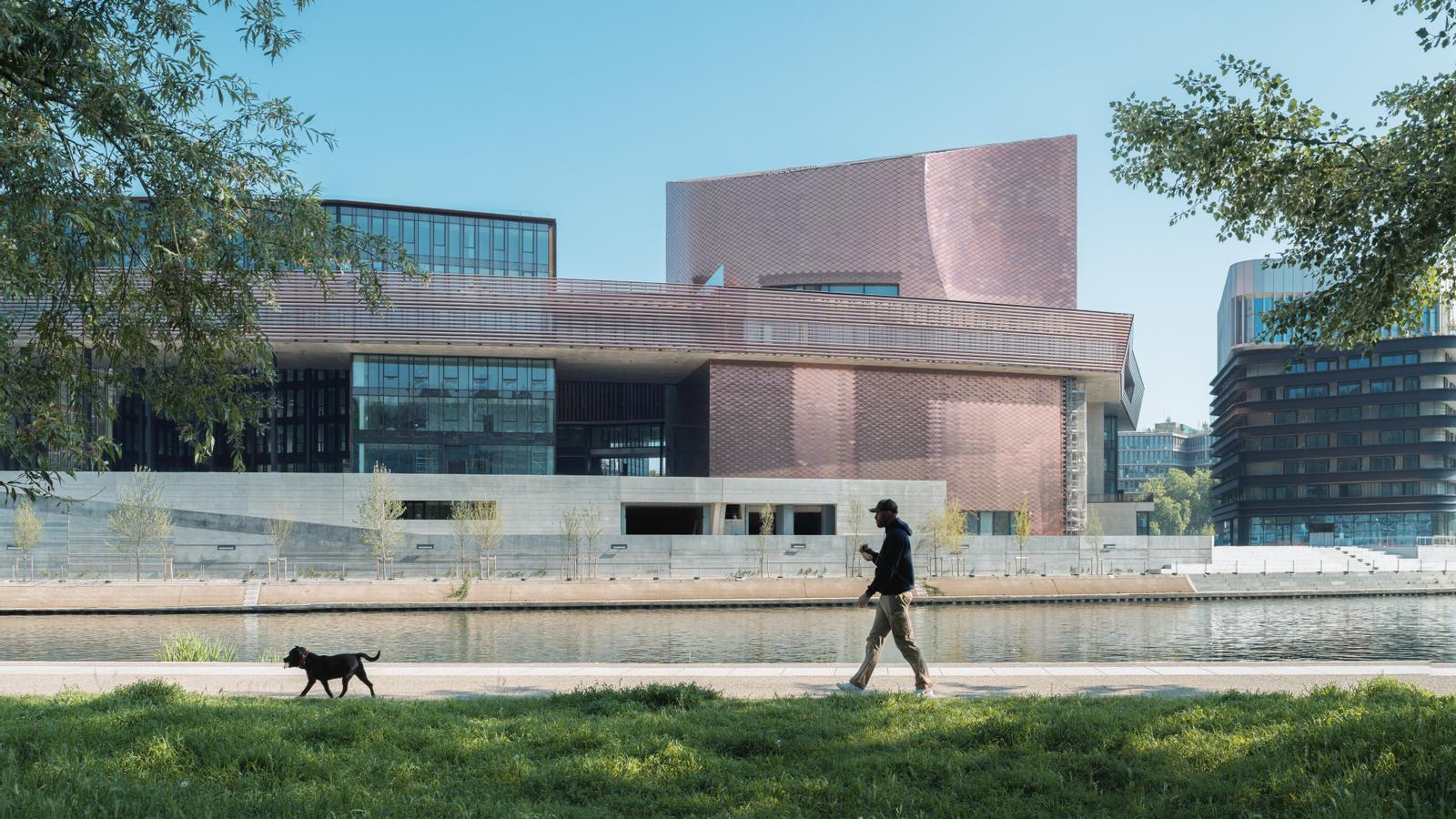
BarcelonaOn the Parisian Île Seguin, cars gave way to culture. Renault built its last cars on this island in the Seine in 1992. The factory was demolished twenty years ago, and since then the island has become a new urban center for Paris with culture as its protagonist. One of the first major works carried out there was an auditorium by the Japanese architect Shigeru Ban, and this evening it was announced that the art center designed by the RCR studio, called Le Large, will open its doors on October 17. Furthermore, the art center is part of a cultural macrocomplex also designed by Rafael Aranda, Carme Pigem, and Ramon Vilalta, which includes one of the largest cinemas in Paris, with 8 rooms, one of which is IMAX, and over 16,000 m2 of offices and spaces for companies and cultural industries.
The complex has cost over 400 million euros and is set to be one of France's major cultural facilities. "The project is the result of a holistic vision. It encompasses something that goes beyond architecture itself. It integrates landscape, design, art, and thought into a single unit," state the architects, who have also designed a new bridge to reach the island, the Seibert bridge, which will become operational coinciding with the opening of the art center.
The complex designed by RCR is located at the northern tip of the island, in the so-called Punta de les Arts (Arts Point). The emblem of the complex is the art center. The architects have conceived it as a "lighthouse." "The art center confers uniqueness, identity, and visibility to this new urbanity. This unprecedented concept, with almost poetic buildings where interior and exterior communicate, creates a unique experience, far from traditional complexes," say the architects, who summarize the symbolism of the art center with the image of a hand. "A hand, one that offers, collects, extends, points… As a large-scale landscape element, this hand is oriented towards the Eiffel Tower to dialogue with it. On a local scale, it creates the link between the banks of Meudon and those of Boulogne-Billancourt," explain Aranda, Pigem, and Vilalta.
Regarding the idea of this hand within the cultural complex, it becomes "an urban element, open to the upper terrace, and which covers the inner street on the ground floor, frames the view towards the square, the river and the Île Saint-Germain, and leads life at all levels". Furthermore, the project includes large green spaces and a panoramic terrace of 1,200 square meters, with the aim of relating the building to the natural and urban environment. In RCR's works, the site is key. Thus, the design of the facade and the materials, Corten steel and anodized aluminum sheet, recall the old Renault factory. Another distinctive feature is that the facade of the art center facing the river is covered with thousands of micro-perforated anodized aluminum scales.

The public's route will begin on the ground floor, in an atrium of 370 m² and 7 m in height. The first large exhibition hall, of 1,000 m², without pillars, is located on the fourth floor. A large glazed opening visually connects it with a wide garden terrace that surrounds the building, integrating the landscape into the route. To continue the visit, a long "hidden" staircase is taken which leads to two more exhibition halls, located on the fifth and sixth floors, each of 500 m².
On the other hand, the complex also includes a hotel in whose rooms there will be works by emerging artists, designed by the Baumschlager Eberle studio.

