It has not been explained enough that the second most important author of Spanish literature is gay
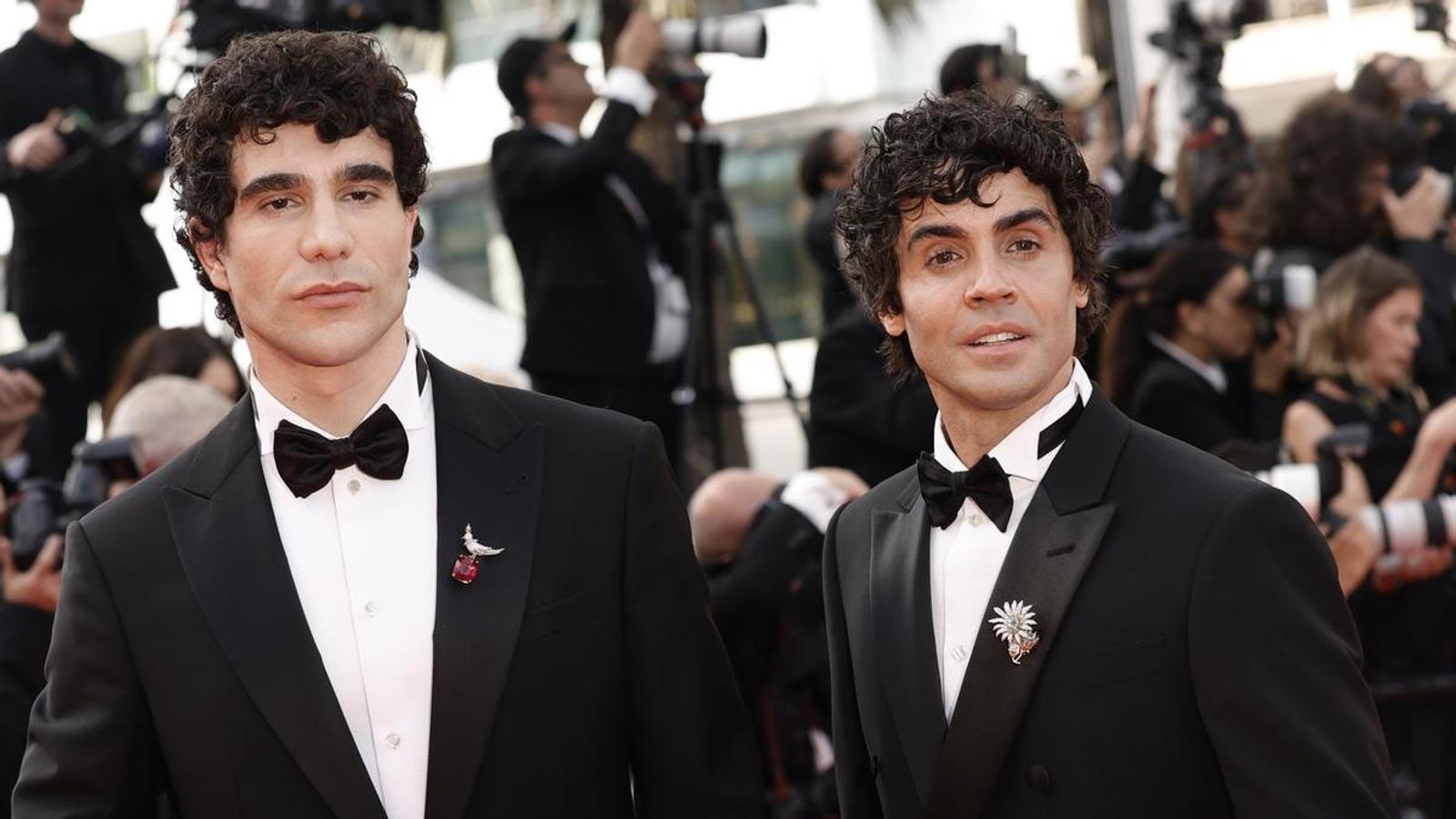
Javier Ambrosi and Javier Calvo premiere the three-act Lorquian melodrama 'The Black Ball' in Cannes

-
CAT -
CAST
Special correspondent to CannesIn the last poem of the Sonetos del amor oscuro, Federico García Lorca wrote: “Tú nunca entenderás lo que te quiero / porque duermes en mí y estás dormido”. To Javier Calvo, the upper half of the artistic duo known as els Javis, the letter o at the end of dormido particularly caught his attention. “I read it as an adolescent and thought it was a typo, but no, it said dormido, not dormida, and it referred to a man –he explains–. But in school textbooks, it was omitted that Lorca was gay, as if it were a shame or as if it were not important to explain who he was. And we must remember that he was murdered, among other things, for being homosexual. It has not been sufficiently explained that the second most important author in Spanish literature is gay, nor from what pain and what wound his work came from”.
Nor is it that the Javis are talking exactly about Lorca's homosexuality in the film they presented this Thursday at the Cannes Film Festival, or at least not directly. La bola negra is a song to the right to love freely that links three stories set in Spain in different eras: Granada in 1932, a Francoist military camp in Cantabria in 1937, and Madrid in 2017. Javier Ambrossi and Javier Calvo are behind their most ambitious film, a historical melodrama that starts from the Lorquian imaginary to build a transgenerational saga about dissident sexualities and repressed affections. With a more academic direction than in the series La mesías, the Javis approach the codes of European prestige cinema in a film conscious, sometimes too much so, of its own importance.
La bola negra was born from a play by the playwright Alberto Conejero, La piedra oscura, which stars a young soldier of the fascist side and the republican lieutenant Rafael Rodríguez Rapún, former lover of Federico García Lorca, who was executed by Franco's army a year after the poet's death. The soldier's story of repressed desire and self-discovery is the center of the Javis' film, which goes back and forth from this narrative to that of the soldier's grandson, and also to that of a young man from Granada who is denied his application to become a member of a casino due to his homosexuality; that is, Lorca's unpublished work La bola negra, of which only the first four pages are preserved, but which the Javis dare to continue. Lorca, in reality, only appears in one scene, where he and Rodríguez Rapún speak with concern about the future and, precisely, about La bola negra, a work that Lorca says he has written to help young homosexuals. “So they don't end up like you and me,” the poet concludes.
Two homosexual directors who will not be silenced
The Javis' film shares this vindicative nature. “We wanted to talk about different ways of facing being homosexual, from the impossibility of verbalizing it in 1932 to a present where we are already free –explains Ambrossi–. It is a very big leap, but there is a huge gap in between and a common construction of the collective gay narrative is missing. We have gone from being prohibited and threatened with death to absolute freedom without anyone asking for forgiveness or explaining what was happening before, who was to blame, and who supported us for things to change.” For the directors, premiering La bola negra in Cannes sends a clear political message. “To all those who want us to take a step back, I say that they will not silence us: tonight we are premiering in the competition of the Cannes Film Festival a film by two homosexual directors with three homosexual protagonists, and it is a big film, the biggest you can make in Spain and which appeals to the general public,” they say.
With the film, Álvaro Lafuente Calvo, Guitarricadelafuente for music, makes his debut as a simply correct actor playing a Francoist soldier, accompanied by Miguel Bernardeau, who plays Rodríguez Rapún with the usual gravity of historical dramas, which contrasts with the naturalism of Carlos González, an actor who had already collaborated with the Javis in Maricón perdido and Veneno and here brings freshness with his interpretation of Rodríguez Rapún's homosexual grandson; free, yes, but also lost and with a tempestuous relationship with the mother, played by a Lola Dueñas who is past her prime. “Carlos and Lola's characters are Spain, always blaming each other for everything and not agreeing on the past –says Ambrossi–. Their lack of communication has to do with inherited pain and hatred, the black ball they all carry inside, because what is unresolved is perpetuated, and only when they tell each other the truth do they understand that in that family no one was to blame for anything and everyone did what they could”.
From Penélope Cruz as a cabaret singer to Glenn Close as a Hispanist
Although in secondary roles, the work of two well-known actresses like Penélope Cruz and Glenn Close also stands out in La bola negra of Spanish in Germany to work with her while she was filming the new installment of Glenn Close's presence is even briefer, but she has the grace of seeing her speak in Spanish and play a Hispanist specialist in Lorca and clearly inspired by Ian Gibson. “Glenn was a big fan of La mesías and at the time she wrote us an email to tell us she had really liked it and wanted to work with us –says Calvo–. And since we were working on the script and this character appeared, we proposed that she play it, and she accepted on the condition that she do it in Spanish, to make it a challenge. So we sent her a Spanish coach to Germany to work with her while she was filming the new installment of The Hunger Games.”
