"No love is eternal, except that of the teacher"
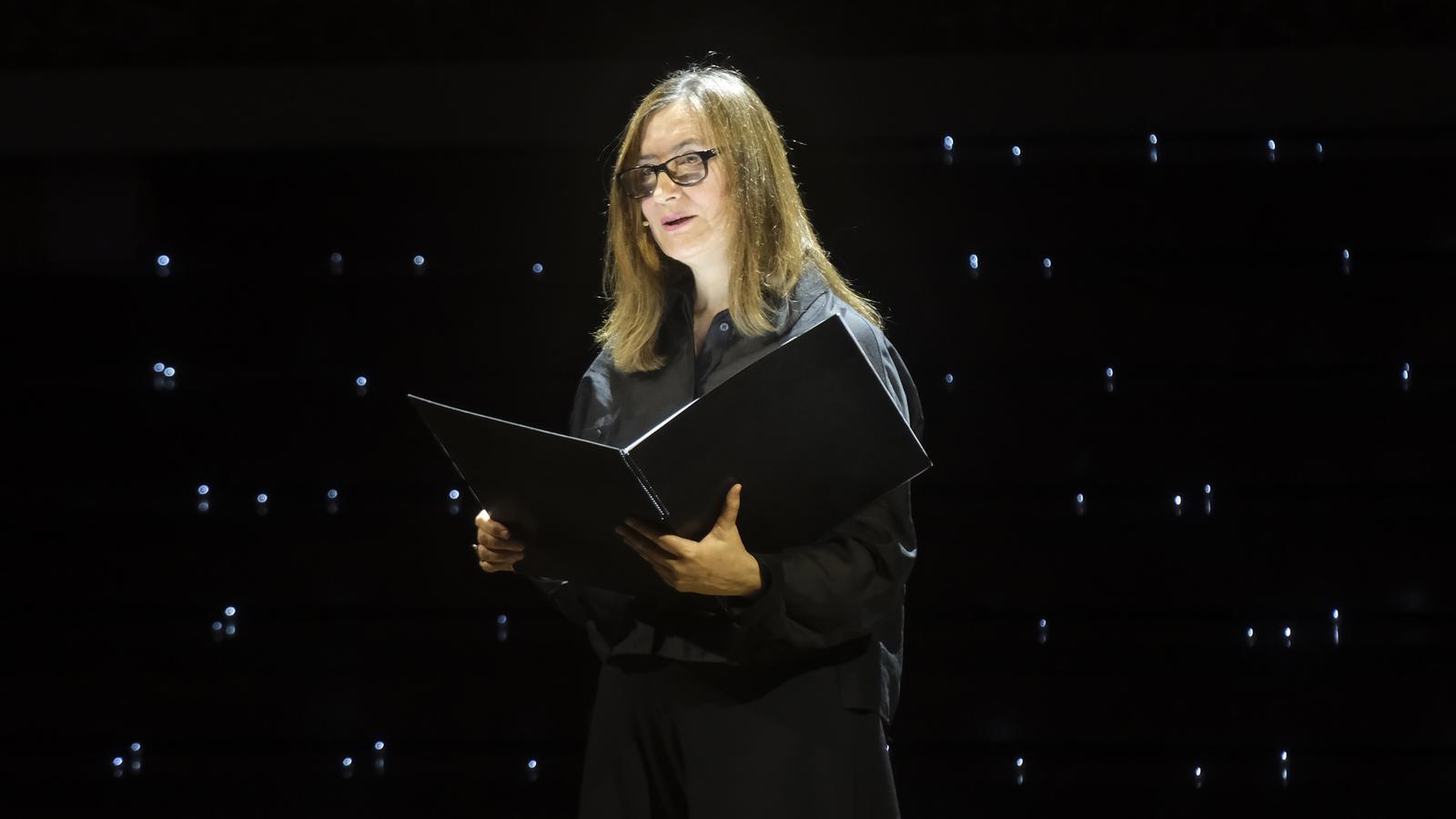
The Palau de la Música hosts the 41st International Poetry Festival, in which Susanna Rafart, Koleka Putuma and Eduard Sanahuja have participated

-
CAT -
CAST
Barcelona"As soon as the storm calms down, I will sacrifice myself," proclaimed this Thursday, with a serene voice, the Turk Adnan Özer (Tekirdag, 1957) at the beginning of the 41st International Poetry Festival of Barcelona in an almost full Palau de la Música.
Manuel Forcano and Anna Gual, the festival directors, have wanted to highlight this year "the capacity to look and to look at ourselves, to recognize ourselves, to interpret the world and to transform it through the word". They have done so by choosing seven voices from around the world with long careers or emerging ones. The most veteran was that of the Catalan Eduard Sanahuja (Barcelona, 1953). The youngest, that of the South African Koleka Putuma (Port Elizabeth, 1993), who read at the end of a recital that included the sound interventions of Alejandro da Rocha, the scenic effects of Cube.bz and the direction of Lucia del Greco.
Özer's verses, imbued with mysticism, reflective and a bit pessimistic, marked by that "dagger of sadness" that the author claims to carry stuck in his back, gave way to Miriam Reyes (Ourense, 1974), who managed to connect with the audience from the first poem. "Naked as a ribbon I offer you / the darkness of the knot", began Reyes, who recited from memory for ten minutes, with a hypnotic and self-aware diction of her strength.
The third poet of the night, Bewketu Seyoum (Mankusa, 1980), allowed the audience at the Palau to savor how Amharic – a language from Ethiopia – sounds. "I search for words, words to describe the suffering of my generation – he recited –. A generation so long forced to kneel that it has forgotten how to stand up". Although in his country he is also known for his comedic performances, Seyoum won over the spectators by setting aside irony. The elegant and delicate voice of Susanna Rafart (Ripoll, 1963) recited some of the best verses of the night, such as this quartet with which one of the poems from La llum constant (2012) begins: "Lord, do not abandon me to love / your law is strong and the dogs of fear carry me away among brambles. / I do not know the evils that so many dangers entail".
Beds, sepulchers, and large corporations
The ethereal sumptuousness of Rafart was followed by the intervention of Mama Sangar (Bangalore, 1966), from India. Intimately connected with both the present and nature –"the verses I wrote / rain again / flow again / drop by drop / word by word", she said–. And Sangar's playful voice contrasted with the powerful flow of Eduard Sanahuja, author of a dozen books, among which is Teories del no, winner of the Jocs Florals 2016. "All beds are shaped like a tomb –Mantres del llit begins –. When you enter them, you train to die". Sanahuja dedicated a poem, highly applauded, to teachers: "No love is eternal / except that of the teacher / who taught you the signs / to punctuate lament".
Koleka Putuma closed the recital with a taste of her forceful and political verses, collected in books such as Collective amnesia (2017). "Large corporations have learned very well / how to commemorate the graves / upon which they have been built", she said, with a notable stage presence, which earned her one of the most effusive ovations of the evening, along with those of Rafart, Sanahuja and Sangar.
