Alfons, the young king who conquered Menorca

-
CAT -
CAST
He ascended to the throne at 20 years old and only reigned until 1291, the date of his death. He was the Catalan monarch who conquered Menorca, “a conquest almost agreed upon,” writes Ernest Belenguer in The King Alfonso II the Liberal (Dalmau Editor). He is one of the least known kings of our dynasty: he had a promising future, he was a “young and surprisingly modern” ruler. But he passed away too soon. Since Ferran Soldevila (1963), he has not been studied much.
Born in Valencia in 1265, he was the grandson of James the Conqueror and Violant of Hungary, and the firstborn of Peter the Great and Constance of Sicily. He had a pedigree and was prepared. Alfonso was a child very close to his parents, something not so common at the time. At 12 years old, he was already recognized as heir at the moment his father, Peter, at 36 years old, accessed the crown upon the death of his grandfather James. Everything well controlled. Also very soon he was betrothed to Princess Eleanor, daughter of Edward I of England and Eleanor of Castile. They were married by proxy in 1282, when he was 18 years old and she had just turned 14. In fact, when Alfonso died, they had still never seen each other. Of course, they had no descendants.
At 14 years old, he was already a full-grown, sharp boy who faced on the battlefield the counts who dared to confront his father. In 1280, he stopped those from Urgell, Pallars, and Foix in their tracks. He locked all three of them in the royal castle of Lleida. During the conquest of Sicily (1282) by his father, he directed Catalan politics at home and was the one who defeated the Frenchman Philip the Bold at the Col de Panissars (1285) when the latter wanted to enter the Principality. In short, when he ascended to the throne, he already had momentum.
In the same year, 1285, he set course for Mallorca to seize the island from his uncle James, who had been disloyal to Peter by letting Philip the Bold pass through the lands of Roussillon. This issue of the unity of the Catalans has never gone very well. The young Alfonso embarked with a fleet of fifty galleys captained by Admiral Roger de Llúria. They besieged the city of Palma, which, just as Alfonso requested, on November 19th swore fidelity to Peter the Great, even though the son already knew that his father, at 45 years old, had died on November 11th: he was thus paying him homage. Yes, a good son. On his return to the Peninsula, he passed through Ibiza, incorporating it into the kingdom. Menorca would be left for later.
Menorca had between 5,000 and 6,000 inhabitants, the majority in Medina Manurqa (Ciutadella). For fifty years it had been governed by Abu-Uthman Saïd ibn al-Hakam, an enlightened man, a vassal of James I. He had died in 1282 and his son was not as skilled. Alfonso arrived with 8,000 almogavers and 400 knights. Thus, there was little fighting that January of 1287: the Muslim Abu-Umar was able to leave the island with his library and 200 relatives. Alfonso paid for the expenses of two galleys for them. Of the Islamic people who remained, some 630 paid departure taxes and the others were sold as slaves in foreign markets. “One can almost speak of an extermination,” says Belenguer. Menorca began to be populated by Christian Majorcans, Catalans, and Valencians.
Alfonso’s brief reign was intense. There was the discontent of the Aragonese, which went back a long way; there was the clash with the Frenchman Charles of Valois; there was the confrontation with the Papacy, especially over Sicily; there was the struggle never fully resolved with his uncle James; there was the rivalry with Castile... In short, very complicated. And in the midst of this puzzle, Alfonso, despite the precedents of his grandfather James, properly inaugurated parliamentarism with the Cortes of Monzón of 1289, as Peter the Ceremonious would acknowledge almost a century later.
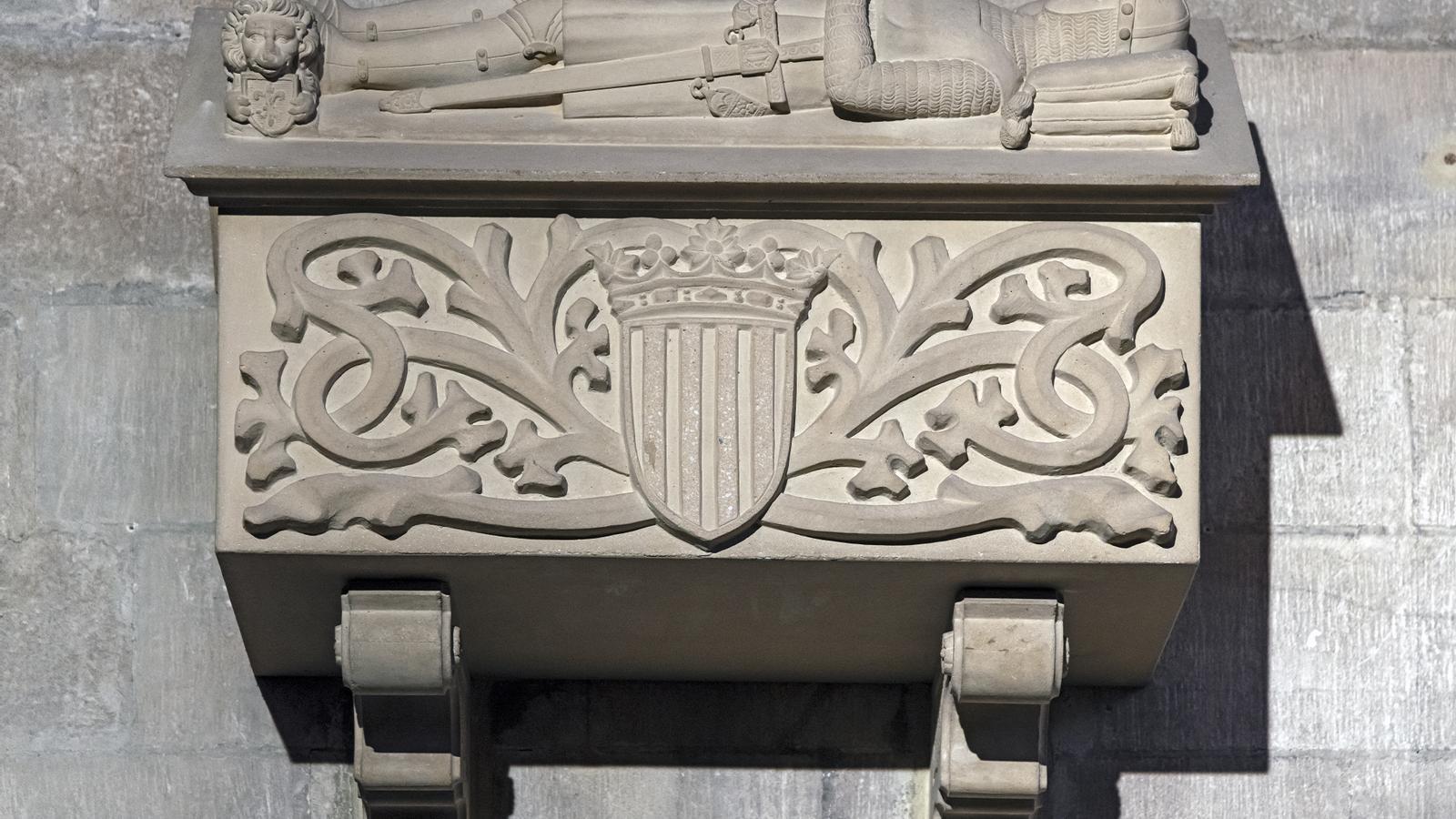
And why was he called the “liberal” or the “frank” (generous)? Well, because he was generous in his donations, favorable to justice and judges. In the section of the seventh canto of the Purgatory of the Divine Comedy, Dante dedicates a few verses to the giovenetto Alfonso: “And if the youth who sits behind him had reigned for a longer time, he would have passed the worth from vessel to vessel”. But no. He died at 26 years old from a sudden illness. His remains rest in the cathedral of Barcelona in an urn sculpted by Frederic Marès.
