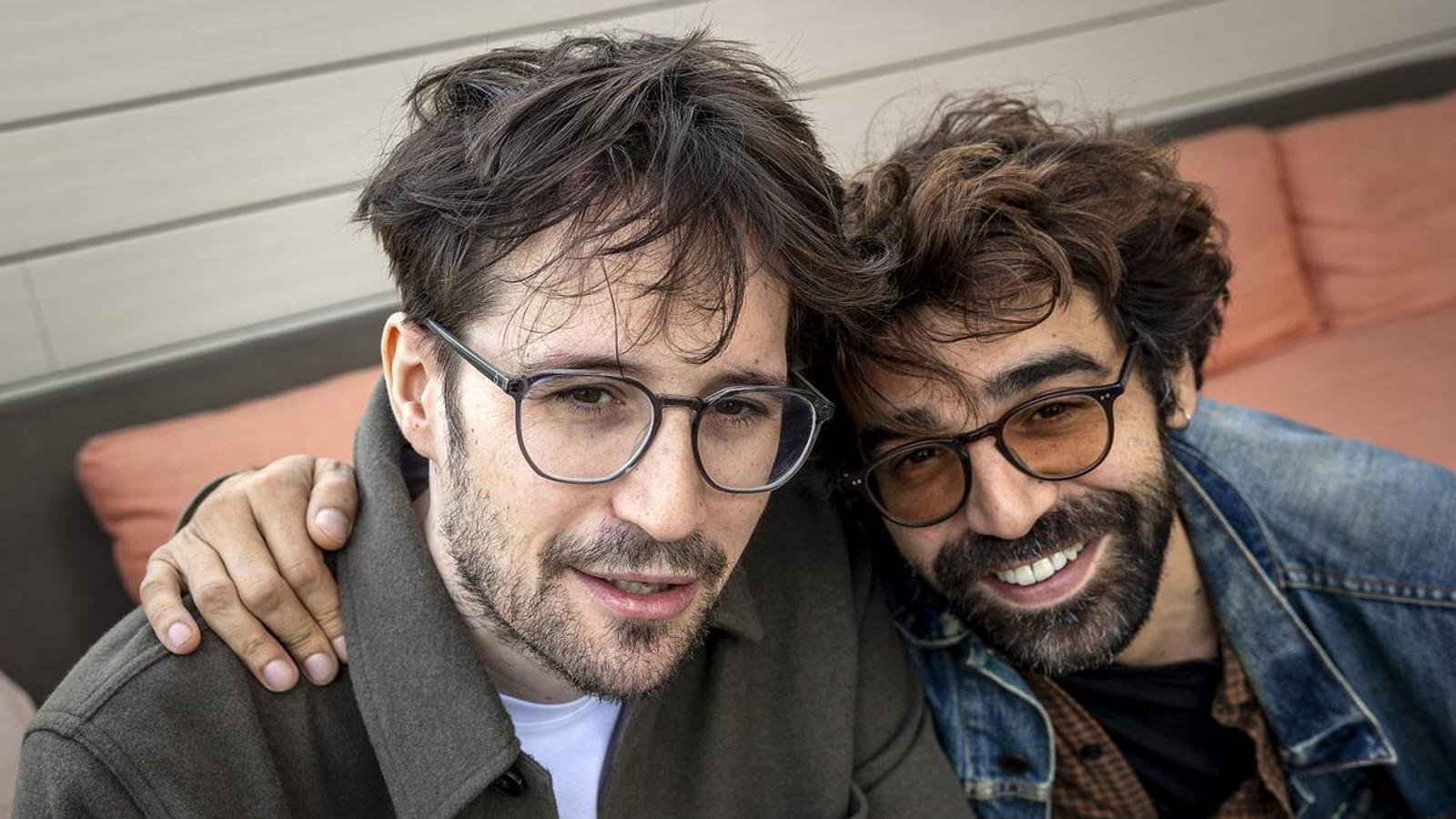
Dani de la Orden i David Verdaguer: "There were many people who did not want this film to be made"
Filmmaker and actor, premiere 'The director'
-
CAT -
CAST
BarcelonaA reporter who hasn't stepped into a newsroom in 18 years finds himself made director of the second most important newspaper in Spain in El director, which adapts to the screen the memoirs of journalist David Jiménez, who in 2015 directed El Mundo during a year in which he suffered firsthand the pressures of the political and business world that threaten the freedom of expression of journalism. In his most serious film to date, Dani de la Orden relies on David Verdaguer to lead this journalistic thriller of undeniable relevance that hits theaters a week before the elections.

Dani, this is your first film after Casa en flames. A phenomenon like that usually opens doors that were previously closed. Is that why you took the opportunity to direct a thriller?
— Dani de la Orden: No. I had read the book and proposed to the producers to adapt it. And they took a leap of faith by trusting me, because it was before Casa en flames. David Jiménez himself must have thought: “Who is this guy coming to direct my story... The director of El mejor verano de mi vida, with Leo Harlem?”. But when Casa en flames had such a good reception while we were preparing the project, I think David Jiménez himself thought: “Ah, he knows comedy, but he can also get serious”.
But do not abandon comedy altogether.
— D. O.: I have had to restrain myself, but the good thing about comedy is that it comes to me in the moment and that works well for the film; it allows for finding cracks of irony in a story that, at first, is very serious.
David Verdaguer also knows a thing or two about transitioning from comedy to drama.
— David Verdaguer: Yes, but I want to return to comedy now, because they don't offer it to me anymore. In fact, when Dani called me I thought: «Perfect, man, I was really looking forward to it», and Casa en flames blew my mind. And when I read the script I said: “Ok, this is not comedy, but, come on, let's do it”. But someday I will have to do a comedy with this man.
— D.O.: Yes, but it should be cheap, so that they let us make it. Something in the style of The drama, the one by Robert Pattinson and Zendaya. I am liking comedy based on dialogue and everyday life more and more.
Is David Verdaguer the Catalan Robert Pattinson?
— D.V.: Yes, of course, and James Bond. No, I want to be the Catalan Peter Sellers.
The director, like the book on which it is based, offers a very dark and surely fair vision of journalism in Spain. You did not want to make All the President's Men, but rather Ace in the Hole.
— D. O.: The book contains an intrinsic critique of current journalism, and I wanted to respect that. Above all, I wanted to respect the spirit of “Who watches the watchmen?”. There is a line that is said in the movie: “We journalists always like to tell a good story as long as it is not our own.”
— D. V.: What is beautiful about the film is that it does not focus on a specific case, but is almost a portrait of a profession. And it is set in 2015, but the cases of corruption explained in it could be from today, whoever is in government.

The fact that the book is a chronicle of a year packed with events must have been a challenge when it came to transforming it into a screenplay.
— D.O.: It was the most complicated part, but David [Verdaguer] helped me make a somewhat reduced version: he came to my house, took a pen, and started crossing out the script. “This isn’t needed, neither is this,” and he removed 80 pages. I really like working on the script with the actors; most of them are very creative. They might not master the terminology, but they know more about screenwriting than they think.
— D.V.: I removed many pages, but Dani did a brutal job. Every week he brought us new sequences. I had never had to learn so much text or speak as fast as in this movie.
David, you are once again playing a real-life character, as in Saben aquell, but, unlike Eugenio, David Jiménez is alive, and he is one of the producers of the film.
— D.V.: Yes, and it wasn’t easy. In Eugenio’s case, I had his son there from time to time, which always creates pressure, but here David [Jiménez] came to the set every day. And what I first thought would be a burden, a heavy backpack, ended up being a great help, because he didn’t act as an acting policeman. He only intervened when he detected journalistic issues or matters regarding how a newsroom operates.
In fact, you don't resemble him. Do not look for the resemblance.
— D.V.: No, and we also haven't tried to imitate the way he speaks.
— D.O.: David speaks in a slow manner and measures his words but I wanted the nerve of someone who talks very fast and who keeps four conversations going at once. Come on, the snappy tone that The newsroom has, the series by Aaron Sorkin.
— D.V.: I focused on the character's anguish, which is something I understand and it shows in the way they speak and move.
— D.O.: I remember that on the first day of shooting you were a bundle of nerves, very nervous and serious. There was an insecurity in you that is basically beautiful and that I also suffer from. In fact, I was much more confident when I was making Barcelona nit d’estiu. Now I approach every new film as if I had forgotten how to shoot. And it is fine to feel that the more you work, the less you understand.
— D.V.: They say that, when you have been in your career for many years, things turn around: you don't care about anything anymore and you go back to playing. But I have an increasingly harder time. I have a very bad time. I suppose it's because I have more responsibility.

Premiere a week before the general elections, in the middle of a political campaign...
— D.O.: Yes, when they did not approve the housing decree I called Pedro Sánchez and told him: “Pedro, do not call early elections now, we have the premiere scheduled”, but he told me he was sorry, that the priority was Spain.
A curious thing about the campaign, and which seems to be a consequence of what is discussed in the film, is that communicators and content creators are having more prominence than journalism.
— D.O.: Yes, the book already says that a day will come when a guy in pajamas talking from his house will have more communicative power than a journalist linked to a newspaper, because he is freer and is not at the service of anyone. And we are seeing it: Jordi Wild's interviews are revolutionizing the campaign and everyone wants to appear on his channel because it is the way to reach young people.
In any case, I suppose the PP cannot have been pleased that a film that talks primarily about their party's corruption cases is being released now. Have you received any pressure not to make it?
— D.O.: During filming no, but, if a low-budget film like this one has taken 8 years to be made, it is because there were many people who did not want it to be made. And during the promotion we have seen that for certain media the film does not exist. And it is easy to imagine which media.
The book uses nicknames for journalists while the film avoids mentioning politicians by name such as Soraya Sáenz de Santamaría or Jorge Fernández Díaz, as the book did. Why?
— D.V.: It is a very intelligent decision that frees the actor who has to play the character from having to do impressions and strange characterizations to resemble them. And it places the viewer in a more active position, inviting them to decipher things that, in reality, are quite obvious: everyone knows who “the treasurer” or “the vice president” is. And in this way, you make the film valid even for a viewer from another country, because you could be talking about any political party. It is not a cowardly option.
— D.O.: It was the most natural way not to link the film's narrative to the criticism of a certain political party or a specific ideology. The film aims to be a critique of the system. The struggle for control of the narrative is intrinsic to both the right and the left.
Your profession leads you to have a lot of contact with the press. Do you feel well treated?
— D.V.: Yes, of course. I have always encountered the kinder side of the press, because I dedicate myself to culture. It is true that sometimes there is some journalist who is looking for a headline and slips in strange questions about politics or your private life, but in general we coexist with the most beautiful part of this profession, I suppose because cultural journalism is the most vocational. In the film we have a gag and it is that the culture journalist never speaks, they don't let him. You are left to your own devices, but the good part is that you have less pressure.
There is a secondary character everyone is talking about: the lawyer played by Xavi Sáez in the last 15 minutes of the film. It smells like a Gaudí award for best supporting actor...
— D.O.: Yes, it is true. But we should have submitted him as a candidate, right? I don't know if we did it... [Consults a person from the production company who confirms that they didn't arrive in time to register him for the Gaudí Awards]. We realized too late that he was very well-liked. The truth is that he appears for a very short time, but he is very funny and in 15 minutes he steals the movie.
— D.V.: He is the supporting character you want to watch the whole time. Luckily, he appears very late, because otherwise the viewer wouldn't want to see Alberto San Juan, or me, or anyone else.
It is curious that, in the book, the character almost does not exist.
— D.O.: Yes, it is a pure creation of the film. David [Jiménez] had a lawyer who was a genius; he arrived the last week, he learned everything and won. And I told him: look, the one in the film will learn everything in a week, but he won't be a genius. To make it more interesting, we will put in a guy who is a disaster and doesn't even have money to pay for coffee. I have a tendency to get bored, and to avoid that, I need to improvise and change things.
