"The main battle is that they do not make us more bad people"
The Biennial of Thought debate fills La Model to reflect on how to face the far-right's narrative
-
CAT -
CAST
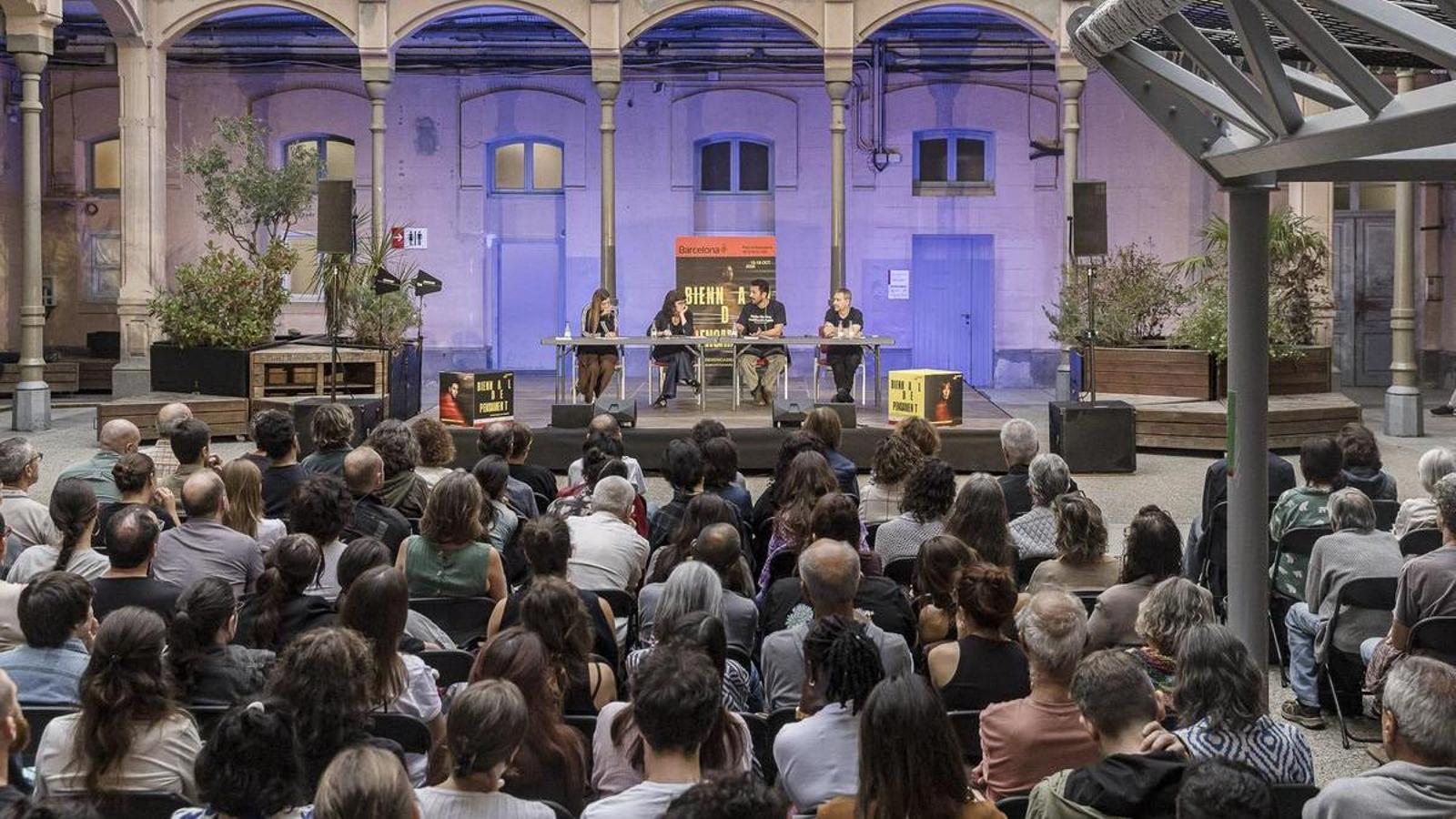
Barcelona"Challenging the narrative of the far right". This was the title of the debate organized on Thursday by the Biennal de Pensament and the CRÍTIC School of Thought, at the former La Model prison. It is clear that the public is not indifferent to everything surrounding this issue: the venue was at full capacity with more than 200 people, and about thirty attendees—mostly young people—were left outside.
How is the far-right narrative fueled? What are their objectives? Where have the left-wing parties failed, and with what tools can they be confronted? These were some of the questions in a debate that felt too short. One of the words that resonated most throughout the talk was empathy. "The far-right project has an almost obsessive interest in tearing down empathy. The moment they are able to get us to celebrate the torture of immigrants in Ceuta, police charges against students in Madrid, or Trump's display of cruelty, they will have won. Empathy is our containment wall," asserted journalist and researcher Miquel Ramos.
Researcher Youssef M. Ouled emphasized that the rise of these ideologies is not an isolated phenomenon, but is intimately linked to the capitalist system and the legal framework: "The dehumanization promoted by the far right is not anecdotal; it is part of the legal order. The immigration law, for example, forces people to live for years in hiding and in job insecurity. This is not just an ideological debate; there is a structure that makes it possible," he asserted.
Journalist Montse Santolino highlighted the far right's capacity for international organization, which has been studying how cultural hegemony works for years. "They know that half the population feels that social democracy has not guaranteed them rights or equality, and they use this resentment, amplifying it. They tell a part of the truth and many lies," stated the journalist, who described how the control of media and social networks ends up normalizing cruelty. "It is very easy to reach millions of people and make them believe that theirs is the social majority. People start to move, and we end up normalizing nonsense until our common sense changes," she said.
Where has the left failed?
Analyzing the weaknesses of the left, Ramos remarked that many voters look for "safe spaces" and emotional responses in the face of uncertainty. The far right appeals to belonging (national pride, religion, or masculinity). To challenge the narrative, according to Ramos, the left must once again know how to move people and reconnect with people's experiences, and he recalled the collective mobilization surrounding the eviction of Maricarmen Abascal.
At this point, Ouled claimed that the left must put racism at the center of the focus, while Santolino appealed directly to grassroots organization: "You can inspire the working classes and offer them hope, but what you cannot do is betray them, and there have been many betrayals. The problem has been not acknowledging what could not be done. Many left-wing groups play at sporadic mobilization, but not at real organization, mainly because we have a left that has become middle-classed.", he asserted.
Miquel Ramos deepened his analysis by criticizing institutional hypocrisy in the face of human tragedies like that of Ceuta: "The problem with Ceuta is that they arrived alive; if they had arrived dead, there would not be the same political problem. The left tends to treat racism as a matter of moral deviation and not as a structural problem", he criticized. For the journalist, one of the priority objectives of the far right is to deactivate the human capacity for empathy, turning cruelty into an active value: "They have managed to make concepts like solidarity or human rights be labeled as naivety or progressive dictatorship. Evil now sells and is an asset. The main battle is that they do not make us worse people", he reiterated.
Ramos reminded that, even though social media "are a pit of hate", one must be present there, but he valued above all "looking each other in the eyes": "The best social network is the street, the civic center, the town groups, the families' association, or the neighborhood assemblies. Any space where there is human communication. And let's stop focusing only on the fascist youth: if adults normalize these discourses, the youth receive them", he asserted. Santolino emphasized the educational shortcomings, the role of the media, and its funding. He criticized the existence of a journalistic class disconnected from reality and recalled the role of many women from neighborhoods and working classes who lead and have led mobilizations and organizations.
