"That you like the work is a trap"
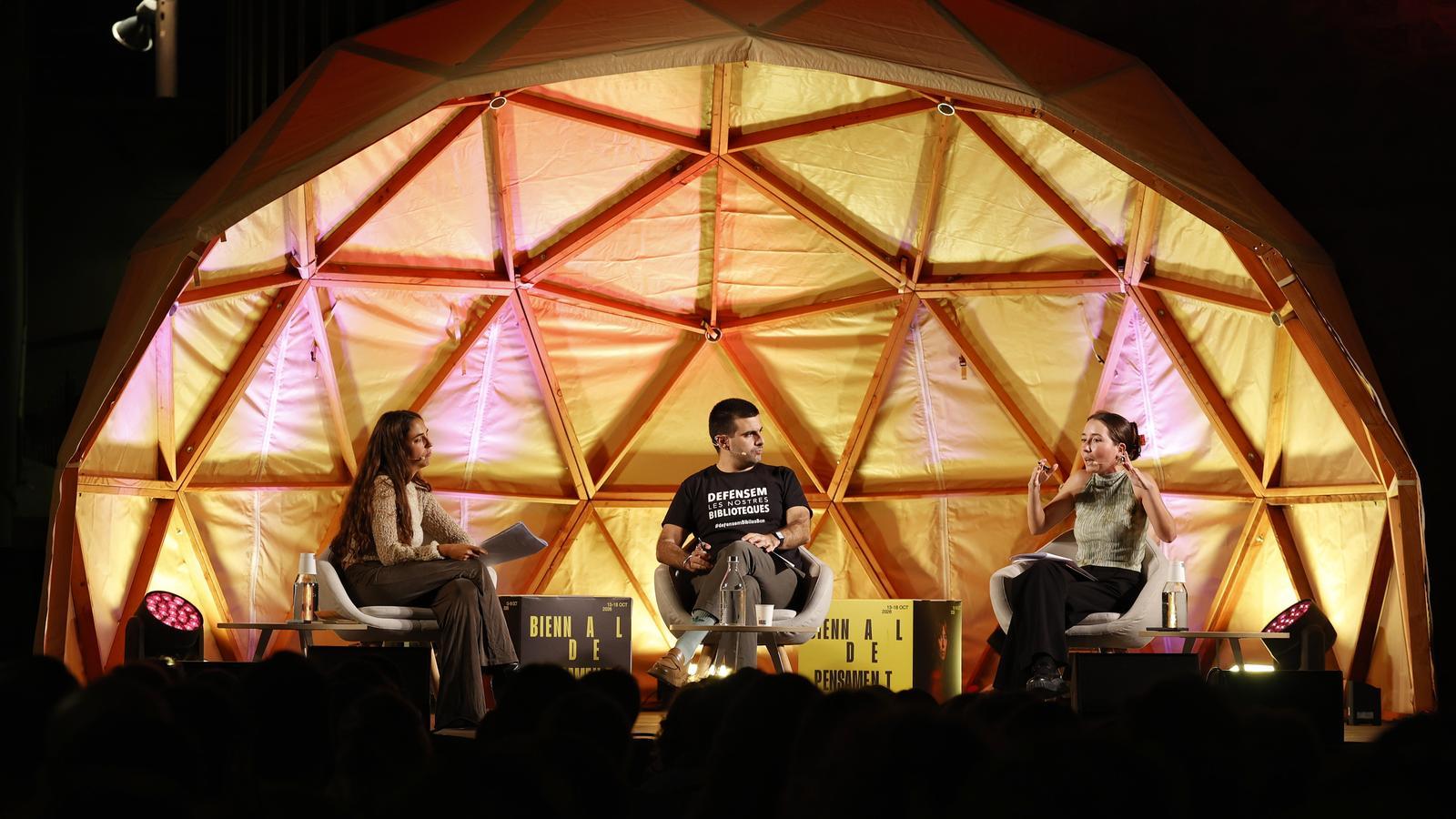
Juan Evaristo Valls Boix and Anna Pacheco debate about the work ethic and the unfulfilled promises at the Biennial of Thought

-
CAT -
CAST
BarcelonaI acknowledge that it is contradictory to go cover for work the Biennial of Thought debate about why we live only to work, especially at half past eight in the evening, the time to put the kids to sleep or meet up with friends. But the fact is that two of the young essayists who have thought most about work, the philosopher Juan Evaristo Valls Boix and the journalist Anna Pacheco, were debating this Wednesday about the dangers of identifying with your trade, the trap of personal fulfillment, how work structures our lives and colonizes all spaces, and how it conditions our physical and mental health, but does not always improve our status. I was going for a friend, ahem.
At Joan Coromines square there were 900 people doing therapy, trying to understand how far they must commit to their profession and from what point on we should get it checked out. Valls begins with a slap in the face: "That you like your job is a trap –and later he adds–. The other trap is thinking that passion for work is a condition for happiness regardless of material conditions". He recommends keeping your distance from your trade, that is to say, sex without falling in love, so that the passion does not end up being toxic. Pacheco, furthermore, lowers the appeal of the lover: "Most jobs are gray and boring in essence, due to their repetitive and sustained component over time. The repetition is atrocious", says the author of two titles about class and work (Listas, guapas, limpias and Estuve aquí y me acordé de nosotros).
Making the revolution with the 'cryptobros'
The conversation goes beyond personal experience and hits the theoretical core: the consolidation of the neoliberal system and labor precariousness, especially after the pandemic, have broken the promises of the welfare state. Valls says that, for the majority, the maxim that if you work at what you are passionate about, you will have a good life; or that if you study for a degree you will have a house, is no longer true. "Now work asks for the maximum from us and deprives us of the minimums," he says, referring to the difficulties of accessing housing. Pacheco adds that the crisis is structural and intergenerational, as we see with the general strike call for November 11th: it is not about millennials against boomers, nor about wage earners against ultraliberals. "The cryptobros are asking for nothing other than the abolition of wage labor, deep down the malaise is the same," he states. "We are talking about class struggle," summarizes the philosopher, author of Jomo and El derecho a las cosas bellas. In the square there is a deathly silence, broken only by an orchestra of barking dogs. The audience looks at the giant screen, as if the speakers were rock stars or in a Teams chat.
From the explosion of labor unrest, sparks fly in all directions, like a pyrotechnic palm tree. One effect is the new work ethic of centennials, much less involved. Or the new passion for civil service work, because it is one of the few that allows for work-life balance. Or directly tradwifism. And there is even a suggestion of a paradigm shift, which seems more like a wish than a possibility to me, because it is easier to imagine the end of the world than vulture funds without wings. "When the mirage breaks, there is disobedience to the mandate to work," trusts Pacheco, who does not deny the need to work, but does question "under what logic and what productive system."
"When we fall out of love with our work, we free up love and desire towards other things, people, networks, life," says Valls. The right to rest and the defense of other alternative ways of working and community occupy the final stretch of the debate, guided by Alba Riera. In the end, she makes them land their main transformative bets: he would opt for a universal basic income and she for the reduction of the working day. It sounds good, let's not fool ourselves, I think while I head home. I enter stealthily: the kids are already asleep.
