Respect for traditional techniques and housing as a right: the axes of the Barcelona Declaration
The World Congress of Architects ends with the handover of the UIA flag to Beijing

-
CAT -
CAST
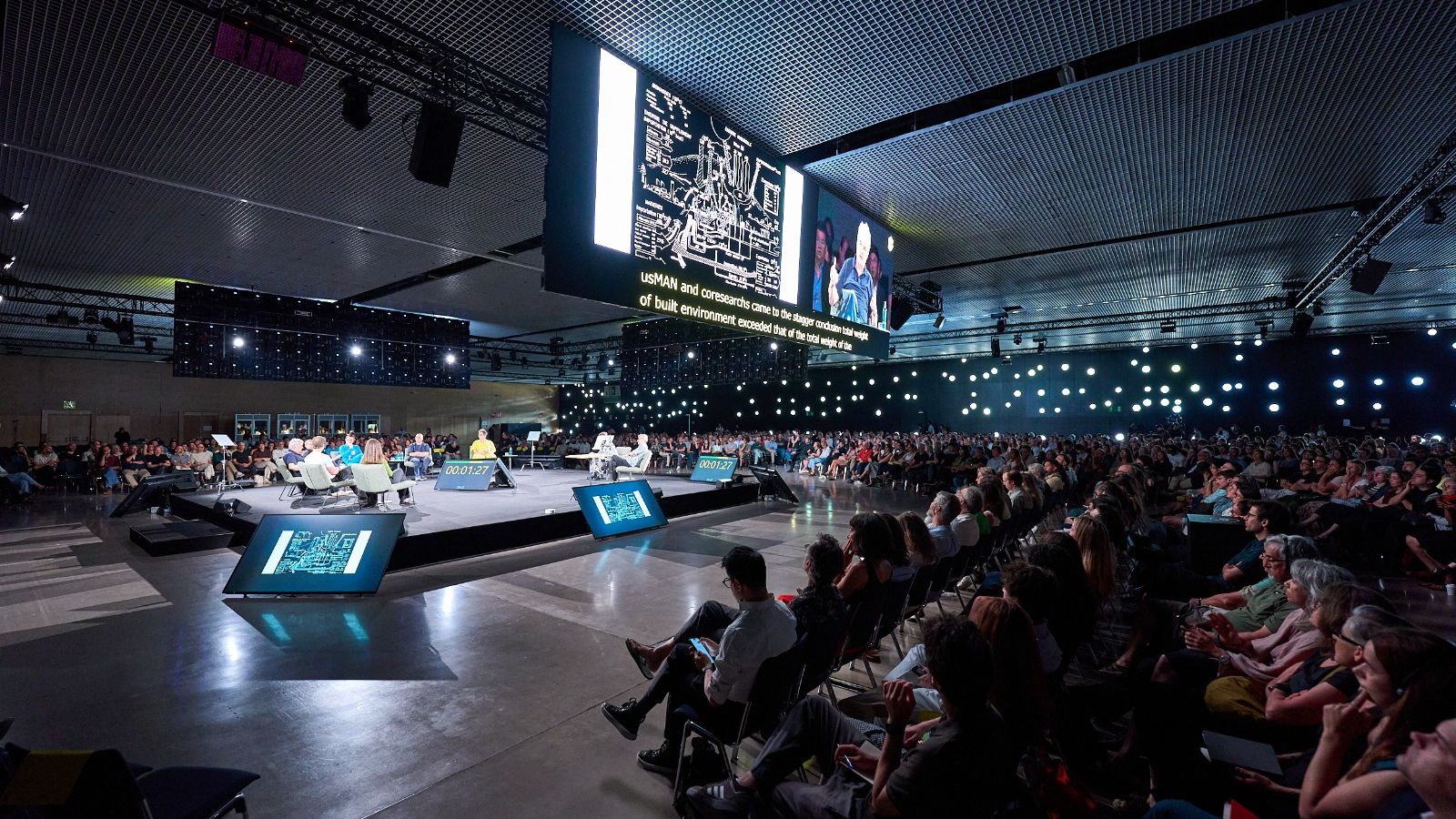
Barcelona"The planet does not negotiate. Climate collapse, war, displacement, and a technological acceleration that outpaces the profession are not topics for a congress. They are the conditions within which architecture works today": thus begins the Barcelona Declaration of the UIA Architects Congress, which concludes this Thursday at the Palau de Congressos de Barcelona (CCIB). "Every formal decision leaves a measurable trace. A material is already a carbon figure. A housing typology is already a statistic of who will survive the next heatwave. A footprint is already territory taken, or left, from another species," says the text read by the president of the Superior Council of Colleges of Architects of Spain, Marta Vall-llosera.
The declaration includes six "positions," one for each thematic line of the congress. "We sign them as a profession that has decided to stop describing the crisis and start responding to it," says Vall-llosera. "Every act of construction must intelligently employ technology and traditional knowledge," states the point related to time and the future. Regarding circularity, the position is this: "We declare that what already exists is the first material. Every act of construction must be responsible for the global cost." The manifesto also calls for abandoning anthropocentrism, and in the field of housing, they declare that "housing is a right, not the return on an investment." "This right is non-negotiable," they insist.
Another of the congress's lines has been planetary awareness. "We declare that every act of building has consequences beyond its own walls. Local acts also have planetary consequences," warned Vall-llosera, who concluded her intervention by saying: "We declare that quality and beauty are not privileges, but what the profession owes to everyone. History will not ask what we drafted in Barcelona. It will ask what we built from it."
Reflection to develop new forms of governance
The honorary president of the congress, architect and urban planner Joan Busquets, also spoke at the event. "In relation to the 1996 congress, this one has shown the great changes in the objectives and needs of architecture that we face," said Busquets. "The nine challenges of today are already shared by the media and citizens. The general spirit of this congress has been to show how architects can contribute to stopping carbon dioxide emissions and improving our cities by finding transition processes instead of just major transformations," he explained, before speaking about the need to improve housing conditions in the Global South, protection against rising sea levels, changes in urban mobility, and water management as "key elements" of architects' interventions. "We have seen that solutions cannot be generic, they must attend to local tradition and different forms of governance to make them effective and beneficial for the local population. But there is common ground. The solutions already exist and we need to apply them immediately," he concluded.
For Busquets, architects are well prepared to "solve complex issues over time." "And our desire is to regain collective pride in a profession and in a broad field of research that has the power to imagine and build a more humane and beautiful urban society," concluded Busquets. Regarding audience figures, the congress concluded with more than 10,000 participants and approximately 30,000 attendees at the various conferences.
The president of the UIA, Regina Gonthier, praised the organizers and commissioners. "It has been exceptional, we will never forget it - Gonthier said -. I want to thank the commissioners, young people, who have brought fresh air and a new way of thinking and seeing things. The congress felt too short for me. I haven't been able to process everything that has been said here yet. I only have a personal impression: now I am much more aware that we are not alone on this planet, that we cannot act in isolation, and that there are leaderships we must respect, and this should be part of the points to consider. The level has been very high, I am convinced that Beijing will have an excellent reference point".
The ceremony concluded with the handover of the UIA flag by the mayor of Barcelona, Jaume Collboni, to the vice-mayor of Beijing. "We are in a transition between an old world that has not died and a new world that has not yet been born, and you have participated these days in the construction of this new world, a better world," said Collboni.
