Olivia Wilde: "Relationships are impossible in all languages"
The North American director presents at the Locarno Festival 'The Invite', her successful and box-office hit adaptation of Cesc Gay's 'Sentimental'
-
CAT -
CAST
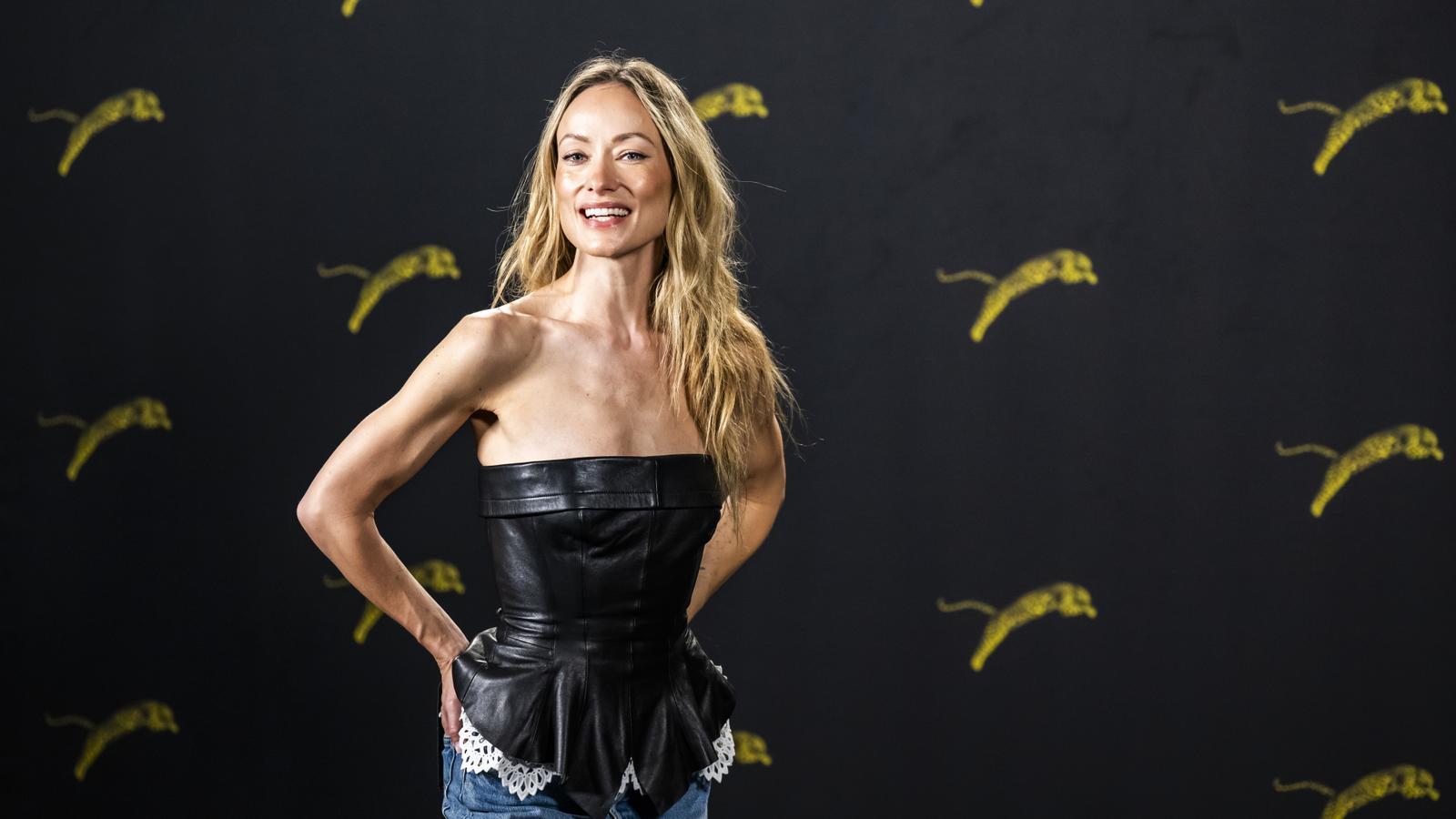
LocarnoWhen the English adaptation of Sentimental (2020) fell into Olivia Wilde's hands, several international versions of this Cesc Gay film had already been released. The filmmaker read the script convinced that there had to be a universal component in a story that interested so many cultures. "And I thought", she explained this Saturday at the Locarno Film Festival during the presentation of "The Invite, the North American remake she directs and stars in, "it's clear, it turns out that relationships are impossible in all languages. And that everyone faces the same question: how do you live with another person? Is it possible to grow next to someone you may have ended up disconnecting from? I think it's a very moving observation, and I loved that in "Sentimental was explained with so much humor".
The Invite is being a great success in the United States and this Sunday evening it premieres at the Swiss festival out of competition in Piazza Grande, in front of an audience of 8,000 people outdoors. Based on the film by Cesc Gay, Olivia Wilde has managed to make a comedy work again as a blockbuster summer. The filmmaker had to fight to shoot the film on celluloid, "because comedies also have the right to shine visually", and release it in theaters. "In a way they bribe you to release it in streaming, because they pay you much more. But the good performance of the film at Sundance allowed us to have A24's offer to distribute it in theaters. And it's working as a shared experience, it generates a collective catharsis that would be impossible in a viewing on platforms.
The director stated that the uniqueness of her version lies in the casting. Without a doubt, The Invite emanates that aura that only stars like Edward Norton, Penélope Cruz, Seth Rogen, and Wilde herself can bestow, enriching the original roles with their charisma and the nuances they bring. "We were lucky that the cast got very involved, so the filming was very collaborative. We were like a jazz quartet where each person plays their instrument. And since we filmed in chronological order, it almost worked like a play where the evolution of the characters and the changes in register happen organically."
The actress, who rose to fame for her role as Thirteen in the series House, did not direct her first film, Booksmart, until she was 35: "It took me a long time to gain the confidence to get behind the camera. But this is the best job in the world. For me, directing is like being multilingual: you have to speak to each actor in the interpretive language they have been trained in. Furthermore, being an actress as well as a director allows me to see other performances from a perspective you don't have behind the camera." As a performer, Wilde allows herself in The Invite a more uninhibited register than we have usually seen from her. "When I was younger, I wasn't allowed to be so intense because it wasn't considered "pretty," in the most superficial sense of the word, for an actress to be too expressive. So it's a liberty I've allowed myself as a director, and that age has also given me."
With her performance, Wilde clearly pays homage, even in her hairstyle, to the late Diane Keaton, to whom she dedicates the film. And she has cited directors like Woody Allen, Nora Ephron, Mike Nichols, and Agnès Varda as influences. The film clearly falls within a tradition of American independent dramatic comedy that was not so long ago a hit at the box office and which, as Wilde has lamented, the industry seems to have wanted to sideline.
Although she speaks of titles like Who's Afraid of Virginia Woolf? (1966) as models, and that a quote from Oscar Wilde, "We should always be in love, which is why we should never marry," opens the film, The Invite is more comedic and less cynical than Cesc Gay's original that inspires it. That said, the ending, which is a little different, can be read more ambiguously. "My first idea was that the film was about how you end a relationship with someone you still love. But the audience's reactions have made me rethink that, in essence, it's a film about how you can have different relationships with the same person, restarting the bond with someone." Contrary to what might be expected, the bulk of The Invite's audience in the United States is under 35 years old. "They see the film from a place of hope, not bitterness. And they have made me much more optimistic about the future of cinema in theaters."
