Nacho Vegas revolutionizes Vic with a concert off-script
The Asturian musician does a special performance with the Coral Sant Medir at the Mercat de Música Viva

-
CAT -
CAST
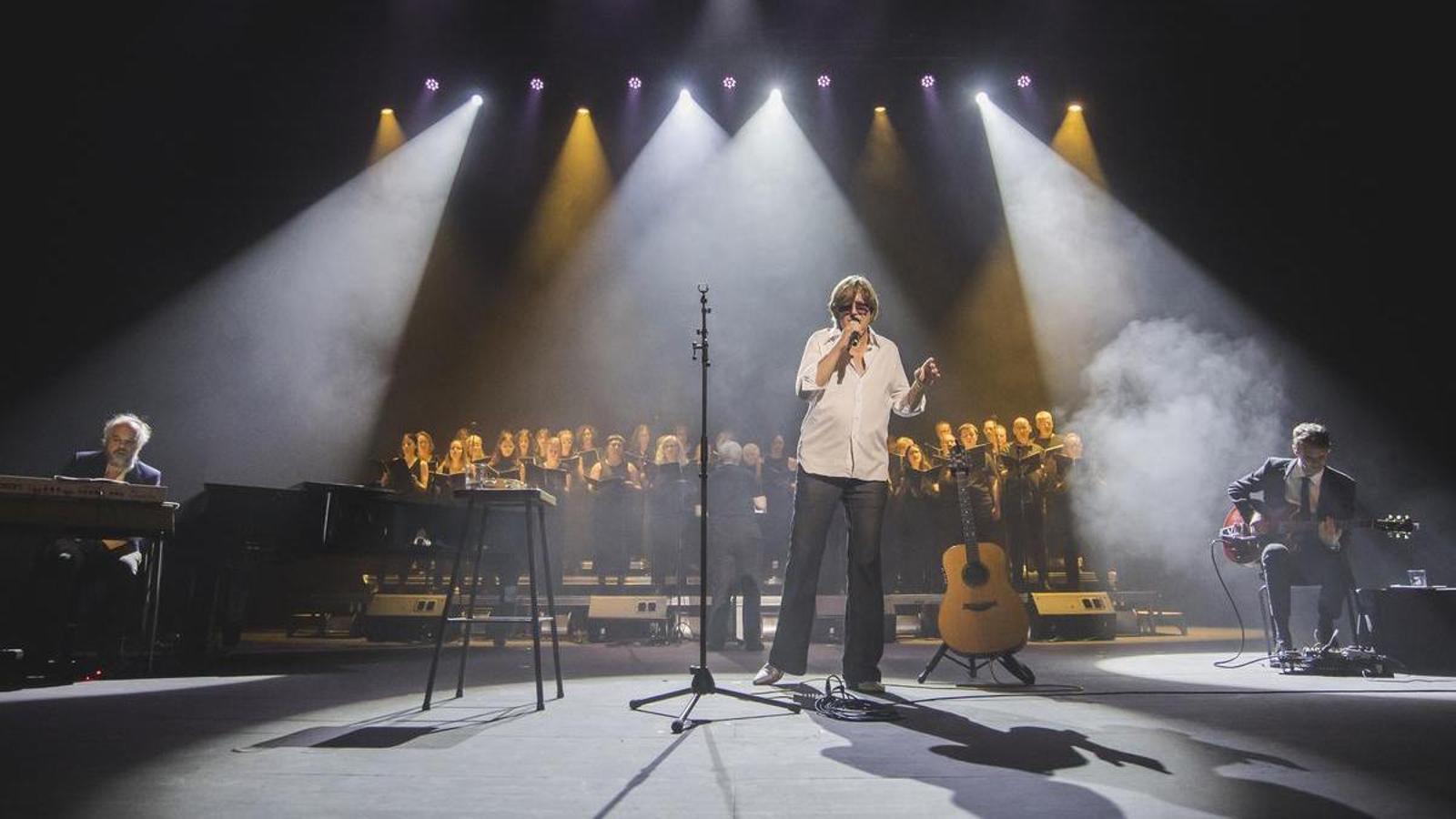
VicThe narcotic majesty of Arctic Nights closed Nacho Vegas's concert at the Mercat de Música Viva de Vic on Friday. It is the song that contains the title of the Asturian musician's second album, Music boxes that are hard to stop (2003). And it played at the Teatre l'Atlàntida in a very special format: as a trio of piano, two guitars, and vocals, with the imposing contribution of the Sant Medir Choir, about fifty voices at the service of a dozen songs, a conjunction of art, emotion, love, and politics. As Vegas said, the insistence of the Mercat's management convinced him to prepare a performance outside the script of the tour for the album the album Semi-precious lives (2026), which passed through the Sala Apolo in Barcelona. And also outside the script of the Mercat itself, which prioritizes previews of proposals so that music programmers know what is on offer before hiring them. Or perhaps not so outside the script. The inaugural show on Wednesday wondered about what live music is. And these days there have been all kinds of comments that have enriched the debate opened by that Non-concert. But one element was missing. "Without you, concerts and music would not exist," said Vegas, addressing the audience filling the theater.
Without an audience there is no live music, of course, and the Vic audience applauded a memorable performance. With guitarist Hans Laguna, keyboardist Ferran Resines, and the choir, the Asturian singer-songwriter unfolded an anthological selection that could be read as an almost perfect self-portrait. Thematically, because it included the most intense melodrama of When you get tired of me, the need for historical memory culminated with a Long live the revolution! from Aida (dedicated to the Asturian revolutionary Aida de la Fuente, who died in the 1934 revolution), the explicit politics of The buzz –from Resituation (2014), Vegas's most choral album–, the protest against evictions in Song for the PAH, the love in flames of Perplexity, the commitment to tradition and the Asturian language in The Carmín de la Pola, the irony of I have something to tell you to denounce the violence of power... And, of course, the artistic and political vindication of collective singing.
The selection of songs, played in generous versions, was also faithful to the musical portrait. Although without the electric storms of the rock format, it did manage to achieve volcanic tension. For example, when Hans Laguna's guitar, Vegas's tambourine, and the choir joined forces to highlight the drama at the end of Aida. Or when the guitars and the choir led the western of I have something to tell you towards catharsis, rewarded with a decompression ovation.
Throughout almost an hour, he maintained the commitment to the format, favored by the magnificent interpretation of the choir, dramatic and serious when called for, more playful when necessary, as in Perplexity. The final impact of the choral Arctic Nights proves the Mercat right: it is also important to convince artists to bring off-script concerts to Vic like this choral revolution by Nacho Vegas.

Mar Pujol and Lluki Valverde
Previewing repertoires shortly before the release of an album and promoting artistic alliances are two characteristics of the Mercat de Música Viva de Vic. As examples of the former, the concerts by Mar Pujol and Lluki Valverde (the saxophonist from La Ludwig Band) on Thursday. And as examples of collaborations, that of Amaro Freitas with Momi Maiga, that of Magalí Datzira with Xabier Badiola, and that of Duot with Barbara Togander.

Mar Pujol filled L'Atlàntida at the presentation of I will not drink from this water, the album that the label Hidden Track will release on October 16th. Given what she performed live, the album promises to be one of the highlights of the year and an extraordinary successor to the remarkable Pantry songs (2024). The singer and guitarist from Prats de Lluçanès shared the stage and her art with cellist Bruna González, who was impressive as always in managing the expressiveness of the instrument, both by bowing the strings and plucking them, and providing a second voice that helped communicate the depth of songs that live within folk with the same mystery and sensitivity that Irene Solà pours into her novels.
The audience's silence, which was admirable, accompanied songs such as Half a life and I don't know if I know. It was a sign of respect but also proof of the moving power of this predominantly acoustic format. And the roar of the subsequent applause confirmed the warm reception. One of the new pieces, Light kilometers, was preceded by a call from Mar Pujol to live time in a way that is "more intuitive, less productive, less capitalist, more wild". She was defining her own music. An ally of the performance was the lighting design, which seemed to reproduce the passing of a day. The foggy twilight at the beginning gave way to the light of a winter sun that gradually disappeared into dusk. And in the end, the twilight returned, only challenged by a spotlight that illuminated Pujol while she played I am. One of the collaborators on the new album, singer-songwriter Carmen Acíar, participated in the concert, especially in a final part where they also performed old pieces such as For each one and Angel hair.

At the tent located outside the Atlàntida and in a more relaxed atmosphere, also because it was midnight, Lluki Valverde presented his personal project to society, parallel to his activity as a saxophonist for La Ludwig Band. A bandmate, guitarist Gabriel Bosch, accompanies him on this adventure of rebellious spirit, with rumba, pop, rock, and a happily unhinged queer cabaret. By the way, among the audience there were also other members of La Ludwig Band.
Valverde, with angel wings and a nocturnal gaze, combined songs from the album that Primavera Labels will release on October 2nd, such as the Laietana ballad I don't want to go home alone, with others from before like The barracks of the stowaways, that jewel that walks like Sisa and ends up highlighting the verse "a judge, a prosecutor and a guard". There will be those who will indeed find Sisa, Pau Riba and Gato Pérez in Lluki Valverde's proposal. Others might relate his theatrical charisma and mischievous whisper to that of the early Albert Pla. And everyone will be right, even those who think of Marc Almond walking down an alley in the Raval of the 80s. The profile is completed with an attitude that is both playful and combative: he can celebrate that he came to this world to spread love and immediately spread anger against the police who executed the eviction of two women who, before being expelled from their home, preferred to jump off the balcony. That is what he sings in 248 Navas Street.
There is a lot of power in Lluki Valverde's proposal, which in Vic went from less to more. He started a bit out of place, as if the stage persona was not comfortable, and with some sound problems, but as soon as he found a more visceral tone, he gained confidence and the five musicians accompanying him also gave the impression that they were enjoying themselves more than at the beginning.
The atmosphere that Lluki Valverde generates live is very connected with the Adoberies Fest, the off-Mercat that every night programs a dozen concerts on two stages, by groups and artists such as Andris el Sardo (a project by Andreu Galofré, the bassist of La Ludwig Band), Grup de Ties, Les Creuet, Jordi Matas and Roko Banana. The Occitan artist Rodín (formerly of the group Lo Còr de la Plana) also performed there, offering an exciting rap-punk show taking advantage of the space on Adoberies street.

Piano and kora
Regarding artistic alliances, at the Mercat de Música Viva de Vic there have been different formats and styles. In co-production with La Marfà in Girona, where they will hold an artistic residency, the Brazilian Amaro Freitas and the Senegalese musician based in Catalonia Momi Maiga linked piano and kora with an enviable harmony and a pleasant margin for improvisation. Freitas' free jazz and the magic of Maiga's strings (who recently collaborated with Youssou N'Dour) converged at the Atlàntida in a dazzling music committed to its own realities: that of the threatened Amazon and that of an African continent which, as the kora player said, it is time for it to make its own decisions.
A jazz without god, master, or sheet music is the context embraced by drummer Ramon Prats and saxophonist Albert Cirera, who are celebrating the twentieth anniversary of the Duot project. One of the ways they have found to celebrate the anniversary is by collaborating with Barbara Togander, turntablist and equally free vocalist. At the Jazz Cava, they chained together improvisations that as soon as they hijack the audience in rhythmic storms, they shake them with unexpected turns and silences.
