Isaki Lacuesta: “Catalonia is part of the origin of flamenco from the first minute”
The history of flamenco and its representation in cinema forms the backbone of the magnificent documentary ‘Jaleos’
-
CAT -
CAST
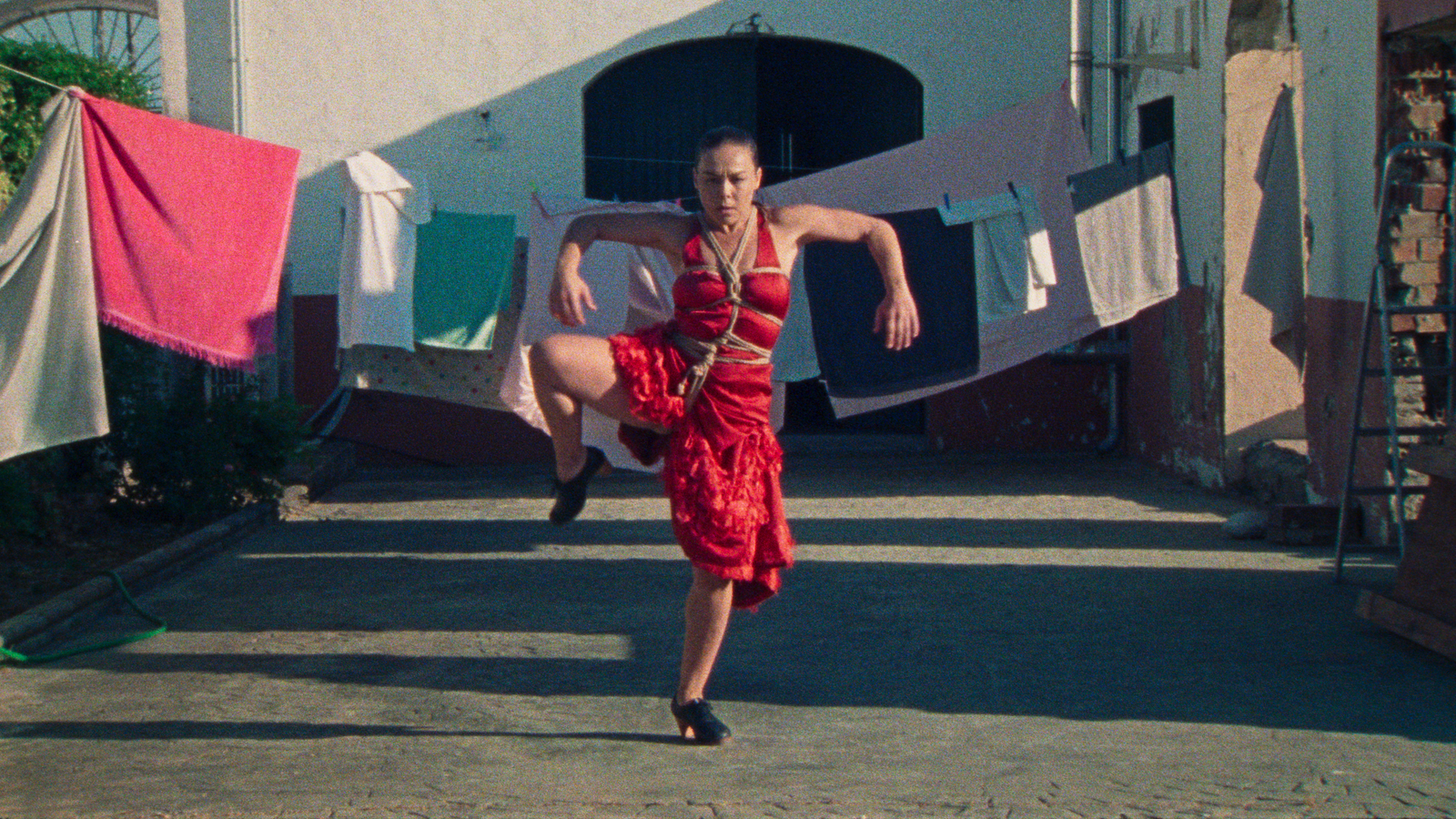
BarcelonaLeni Riefenstahl, Hitler's trusted filmmaker, wearing a bailaora (flamenco dancer) dress and performing a choreography with vaguely flamenco airs to the rhythm of a Spanish guitar in a canteen packed with men in Mexican hats who stare at her fixedly. The unsettling image that opens the new documentary by Isaki Lacuesta, Jaleos, belongs to Terra baixa, the adaptation of the classic by Àngel Guimerà that Riefenstahl directed during the Second World War, a work marked by infamy: to provide realism to scenes like the one Lacuesta collects and analyzes, the German director used Romani extras from Nazi labor camps, some of whom later ended up in Auschwitz.
“On the one hand, the Roma are persecuted and exterminated, and on the other, they are consumed as an artistic manifestation,” points out Pastora Filigrana in Jaleos, the magnificent and revealing documentary that Lacuesta premieres this Friday, a film essay in the tradition of Chris Marker or Jean-Luc Godard that traces in a very personal and free way the prolific historical relationship between flamenco and cinema, two twin arts that, as Lacuesta highlights, were born almost at the same time. “For me, it was surprising to discover, thanks to Pedro G. Romero, that flamenco and cinema are contemporary –confesses Lacuesta–. I thought flamenco was much older. How could I not know that? Or not know that the first woman Edison filmed with the kinetoscope was Carmencita, a famous bailaora of the era?”.
Jaleos not only illuminates the dark points of flamenco in cinema through an extraordinary montage of archival images allergic to academicism and chronology, but it also unfolds an original and engaging narrative device: gathering a group of informed voices with auctoritas to comment on the ideas and images of the documentary, just as if it were a flamenco social gathering. We don't see them, but we do hear such powerful figures as C. Tangana, Alba Flores, Soleá Morente, Rocío Molina, the philosopher Georges Didi-Huberman and the flamencologist Pedro G. Romero, true ideologue and starting point of Jaleos. “Pedro explains that flamenco has always been approached from the sociology of lyrics, but that leaves aside all the iconography and staging, which is constitutive of flamenco,” points out Lacuesta.
The narrative strategy of Jaleos is to explore the different tensions that have defined flamenco throughout history, such as the one that has continuously pitted the purists against the revolutionaries of this music. “Flamenco evolves in parallel with technology –states Lacuesta–, and in this sense, when in the 1920s music began to be recorded on shellac discs, many people felt they were losing something very ancient. And it is at this moment that the famous cante jondo competition of 1922 takes place”. Lacuesta stresses that this was not a phenomenon exclusive to flamenco: it also happened with the blues in the United States, fado in Portugal, rebetiko in Greece... And, even a few decades earlier, in our own country: “During the Noucentisme movement in Catalonia, it was decided to standardize the cobles and sardanas, and Cesc Gelabert always used to say that it was a pity that the same thing had not happened as with flamenco or jazz, where the music was never fully fixed and variations on standards could be made, because this brings a very inspiring tension between tradition and innovation”.
Flamenco, avant-garde and Catalonia
One of the historical misconceptions that Jaleos questions is the idea that flamenco is a music linked to the most stale and retrograde culture. The documentary highlights the connections between flamenco and artistic avant-gardes, for example, that of the bailaor Vicente Escudero with Man Ray and Duchamp. “It struck me a lot to discover that the parallel editing of cinema and that of the bulerías arise at the same time –explains Lacuesta, who admits that, in his youth, he too was full of prejudices–. As someone from Girona and Banyoles, I thought that flamenco was something stale and Francoist, but later I realized that it is full of punk-rock, intensity, avant-garde, and novelty. And in all flamenco cinema there are always formally very interesting moments: flamenco has always been associated with people who lived on the edge and on the margins: Roma, Black people, slaves, anarchists... So in flamenco films there are often moments that invite representing altered perception”.
Regarding the relationship of Catalans with flamenco, Lacuesta gives as a revealing example a project of the Filmoteca on archive material in which he collaborated. “Pau Casals was categorized as culture, but Carmen Amaya was folklore, because she was seen as something alien, foreign –he laments–. Even when talking about the birth of flamenco in Catalonia, it is explained as if it were some kind of invading plague that arrives very late. But, in fact, Catalonia has been part of the origin of flamenco from the very first minute”. At the same time, he stresses, what happens in Catalonia also happens in many other places. “Making Jaleos I have learned that what is supposedly most national and ultra-local is in reality made up of things from everywhere: from America, from Africa and yes, also from Andalusia and the Roma”. In fact, the documentary points out how the culture of folklore was created in the mid-19th century to give shape to the national identity of European states. “This is stated literally in the statutes of folklore societies, which are born to reinforce the social cohesion that has blown up after decapitating the kings”, says the director.
