Kallas claims the role of interlocutor with Russia: “The treaties are clear”
Zelensky warns that the Kremlin wants to redesign the European security architecture

-
CAT -
CAST
Dublin“For Europe to manage to identify a person to speak on its behalf would be a greater success than getting the Russians to include them in the negotiations,” joked the son-in-law of Donald Trump and member of the United States team at the Abu Dhabi talks this Wednesday. Jared Kushner's barb hit a sore spot on a thorny issue that divides European leaders: at the Abu Dhabi talks. Jared Kushner's barb hit a sore spot on a thorny issue that divides European leaders: finding a single voice to manage to have a role in the Ukraine negotiations.
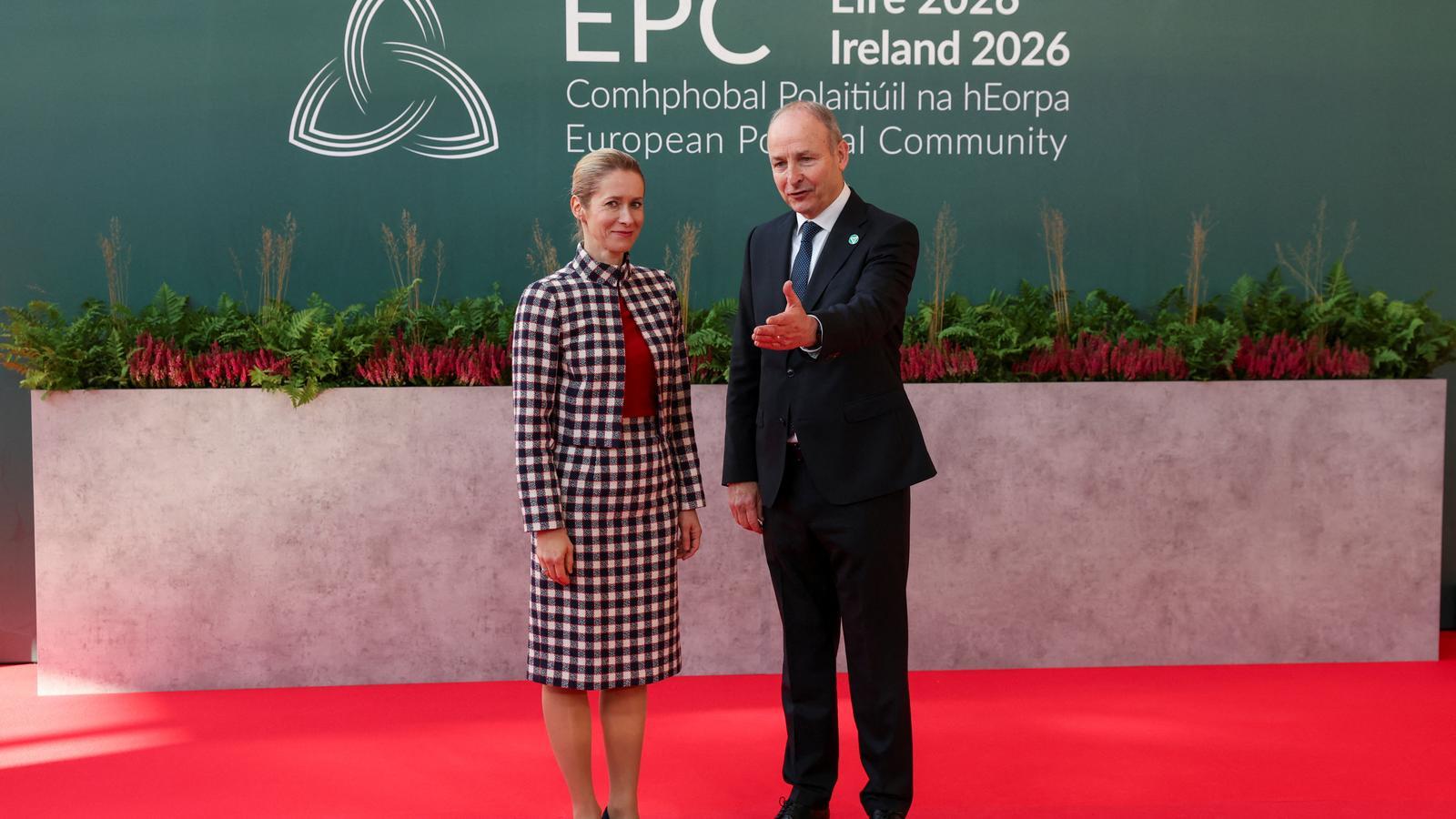
Faced with this scenario, the head of European diplomacy, Kaja Kallas, has proposed herself, from the leaders' summit in Dublin, to adopt this role. “We already had this discussion in June 2024,” she asserted, recalling that at that time it was already foreseen that the chosen names—which were Ursula von der Leyen, António Costa, and herself—could participate in future talks with Russia. The Estonian leader has claimed that those responsible for security matters are the President of the European Council (Costa) and the High Representative, that is, herself. “The treaties are very clear,” she added. Thus, she indicated that leaders have two options: either choose another name and reopen this “difficult” debate, or “stick to the commitments we already reached in 2024”.
Until now, Germany, France, and the United Kingdom, together with community representatives, have been present in the parallel talks to the negotiations to coordinate with the teams from Kyiv, Washington, and NATO. But in recent weeks, voices have grown pressing for a single name to be chosen to represent the entire continent before the end of the month. Kushner's statements join the request of the Ukrainian president, Volodymyr Zelenskyy, that European partners determine their representatives before the end of November, and the letter that Giorgia Meloni sent last week asking for a consensus voice.
Among the candidates to lead the European side is also Costa, whose figure various leaders have defended this Thursday from Dublin. But within the European Union itself, there are governments that believe his profile and that of Kallas—very forceful against the Kremlin—could hinder a direct channel with Moscow. Thus, recently, the President of Finland, Alexander Stubb, and the Prime Minister of Norway, Jonas Gahr Støre, who personally called Vladimir Putin last month, have also been proposed as negotiators.
Reluctance from France and Germany
In contrast, the major community powers, France and Germany, claim their role as interlocutors. Emmanuel Macron has defended that the E3 format (the triad of France, Germany and the United Kingdom) is the framework “relevant in terms of security”. In the opinion of the French president, it was Paris that took the “initiative” of the Coalition of Volunteers, and decided to include the British and German partners “because we had a project”.
Friedrich Merz has also cooled the debate on the appointment of a single envoy for the European bloc: “I see no problem with it continuing to be this way –he said in reference to the current format–. The most important thing is that Russia sits at the table and is willing to negotiate. The rest can be resolved later”. In any case, Merz’s main challenge at the leaders' meeting will be to face the standoff he has with Slovakia and the Czech Republic over aid to Kyiv. The German chancellor has demanded that all partners assume the financing of the 90 billion euro loan to Ukraine within the community budget and has warned —in allusion to these two countries and Hungary— that he will not accept any more “exceptions”. Words that the Slovak prime minister, Robert Fico, has labeled as “blackmail”.
Europe’s security architecture, at stake
The day also served to inform European allies about the progress of the peace talks. Zelensky, who is also participating in the summit, warned that the debate on "security guarantees" taking place with the Russian and American teams is heading towards the design of a new global security framework between Europe and Russia, beyond the strict protection of Ukraine. That is, he warned that what is being discussed is not only the deployment of troops in Ukraine or the country's future alliances, but the military logic of the entire continent, and whether one must return to the old logic of spheres of influence that the Kremlin has been demanding since before the invasion.
The Ukrainian president, who will meet this evening with Jared Kushner and the other United States envoy, Steve Witkoff, in the capital of Ireland, recalled that Europe maintained good trade relations with Moscow for the 30 years following the fall of the USSR. For Zelensky, the root of the conflict is not a flaw in the European architecture that needs to be redone to appease the Kremlin, but the imperial ambition of Vladimir Putin. "Europe must be very attentive," he warned.
António Costa picked up Zelensky's gauntlet and insisted that any attempt to redesign the continent's security is a red line. Costa recalled that the European security architecture was already working "until Russia undermined and destroyed it with the invasion of Ukraine." "There is no need to reinvent the wheel," said the President of the European Council, arguing that any future debate must be based on rebuilding the principles of the 1975 Helsinki Final Act: equality among European nations, abstention from the threat or use of force, the inviolability of borders, and the peaceful resolution of conflicts. "One cannot talk about security on the continent without a European voice at the table," he stressed.
