The keys to an unprecedented general strike
Wednesday's strike has been the first in which the main demand was housing
-
CAT -
CAST
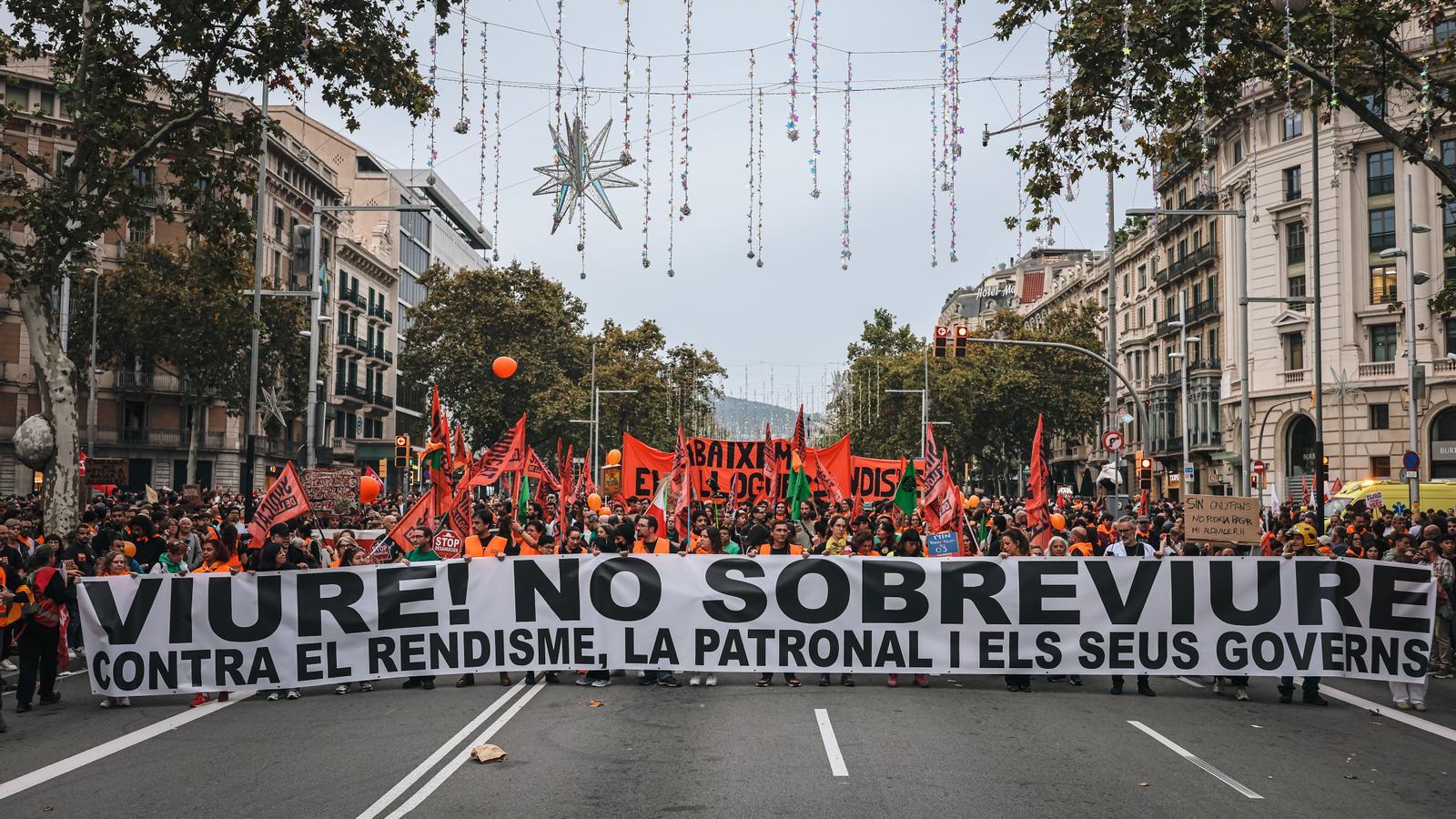
BarcelonaFourteen years after the last major general strike held in the State, a good part of the economic activity came to a standstill again this Wednesday on a day that the organizers have classified as a "flagrant victory." After a morning marked by mobility disruptions and pickets at large Catalan industrial companies, the strike ended with massive mobilizations throughout Catalonia. The main one was in Barcelona, where according to the organizers, 400,000 people were mobilized. The Guàrdia Urbana, however, lowers the count to 55,000.
The level of participation in the stoppage at workplaces also contrasts depending on who provides the figures: CCOO and UGT speak of an 84% turnout, while the employers' associations Pimec and Cecot claim it was 8% and 6.7%, respectively. The general strike, under the slogan Living costs us our lives, has been unprecedented for different reasons, such as the fact that the main demand was regarding housing, or also the high transversality of the organizers, which ranged from organizations such as the Tenants' Union (Sindicat de Llogateres) to the trade union board –CGT, IAC, Co.bas, CNT, COS, SO– and the majority unions –CCOO and UGT–. These are some of the keys to a day that may mark the beginning of the electoral campaign.
A message at the doors of the campaign
Some political interpretations had pointed out that this was a strike against the opposition (PP and Vox) and not against the Spanish government –from the PSOE to the Broad Front have taken advantage of it to make a banner of it–. This Wednesday, however, the Confederation of Tenants' Unions corrected this reading at the end of the day of protest: “Whoever governs, we will not stop. We will continue to defend the universal right to housing,” warned the spokesperson for the Confederation, Aldo Reverte. The Tenants' Unions did not hesitate to point to the PSOE as responsible for the current housing crisis, especially for not having been more ambitious with the measures that have been promoted. While it is true that CCOO and UGT have also pointed to Pedro Sánchez's government, they have not done so with as much harshness compared to the alternative unions.
“This strike and the demands are against the employers and against the rentiers. Against all governments of all colors that by omission or action have defended the interests of rentierism. Not only have they not solved the main problem of the State, but they have also attacked those of us who defended the right to housing with police violence,” denounced the Tenants' Union this Wednesday in reference to the actions of the National Police at demonstrations in cities like Madrid. This morning, the general secretary of CCOO of Catalonia, Belén López, and her counterpart from UGT of Catalonia, Camil Ros, also focused their criticisms on the employers and the political majority.
Be that as it may, all organizations read this Wednesday's day as a “turning point,” and it is asserted that it has meant a “historic” mobilization and strike for the right to housing. In terms of the election, the day also coincided with several attacks by the PP on the unions: Ayuso spoke of “union trash,” while the X account of the Popular Party attacked the majority unions by referring to seafood feasts.
Some new protagonists
The transversality of this Wednesday's protest was also evident when it came to leading the different events of the day. Apart from CCOO and UGT, the Tenants' Union and the CGT, the third largest union in Catalonia, were very present in the various picket lines that took place during the early morning and throughout the day. This role is no coincidence: the CGT is currently the fastest-growing union in terms of membership in the country, thanks, according to sources within the organization, to the conflict-based approach they have been proposing for some time. For its part, the Tenants' Union, which despite its name is not officially considered a union, has for years been an organization with significant social impact that is also immersed in a cycle of conflict.
And, as these same actors have pointed out, they are not expected to let up in the coming months. In fact, the Confederation of Tenants' Unions warns that this strike is "only the beginning" and cautions of a wave of mobilizations, including possible rent strikes, if the administrations, and in particular the future State government, do not adopt measures to guarantee access to decent housing. "We reject the crumbs," they warn, and they demand a constitutional reform so that the right to housing prevails over the right to freedom of enterprise. Some of their demands include: recovering empty apartments, putting an end to tourist apartments and speculative buying, increasing public housing stock, and ending evictions, among other issues. Furthermore, the Tenants' Union asks to be officially considered as a union.
The strike of a new generation
In recent years in Catalonia there have been different general strikes: the country-wide stoppage of October 3rd, the March 8th strikes, or the one in support of Palestine. Some minority unions called for 24-hour strikes for these protests, although the majority ones called for partial stoppages to provide coverage for the mobilizations. For this reason, this Wednesday's stoppage has been the first major general strike in the State in 14 years. Since the Transition there had not been such a long period without general strikes. This situation has meant that for many young workers this has been their first major general strike.
In fact, in the mobilizations that took place throughout Catalonia during the afternoon, a large youth presence could be observed. As ARA explained last Sunday, the evolution of housing prices or the shopping basket are causing a great loss of purchasing power among the lowest incomes. The professor emeritus of applied economics at the Autonomous University of Barcelona (UAB) Josep Oliver, stressed that, “for the first time”, the “children of the middle class” are also suffering the loss of purchasing power, which until now had remained with the “most subordinate classes”.
Major industries and mobility, brought to a halt
Since Tuesday night, the main Catalan industries stopped their production lines. As the majority unions reported, it was possible to stop production at centers such as Ficosa (Viladecavalls), Nestlé (Girona), Repsol Fuels (La Pobla de Mafumet), Grifols (Parets del Vallès) or Seat (Martorell). Furthermore, the delivery of Amazon packages and various companies in the 22@ district, among others, were also stopped, as stated by the CGT and the Sindicat de Llogateres. Many of the country's main roads were also blocked, which affected mobility throughout Catalonia for many hours.
However, it is also worth noting that this general strike has been the first major stoppage that has had to coexist with teleworking. The possibility that a large number of workers could connect to work from home has meant that road blocks and pickets at service sector companies have been less effective. In fact, Camil Ros accused companies that made their employees work remotely of "digital scabbing." This variant also distorts the calculation of energy use in the country, which is traditionally used to measure the turnout for strikes.

