'Gaudí Code': virtual reality makes Antoni Gaudí more brilliant
'Gaudí Code' inaugurates Mediapro's Espai Imagina and provides novelties about the architect's unrealized projects

-
CAT -
CAST
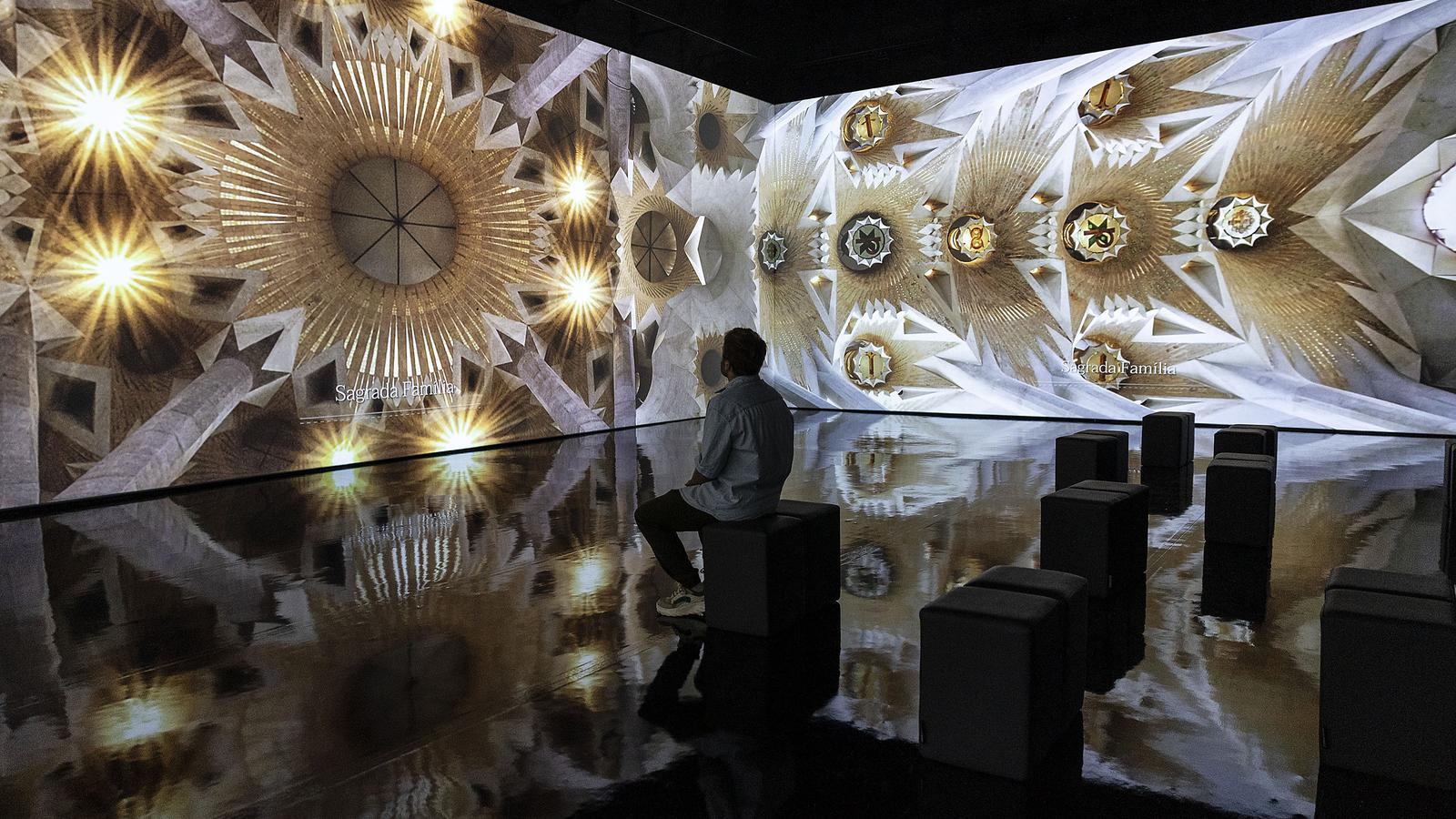
BarcelonaA cry of admiration and wonder is heard. "Wow!", exclaims a person wearing mixed reality glasses. "How amazing", they insist. They have just entered the so-called XR Workshop of the exhibition Gaudí Code. An unprecedented experience, which can be visited until January 8 at the new Espai Imagina by Mediapro, at number 177 Diagonal in Barcelona. Before the cry, they had been browsing and virtually touching a tool that reproduces one of the techniques Antoni Gaudí (1852-1926) used to design the structure of the Sagrada Família... and then virtual reality shows them a dizzying fall through the temple's nave. Wow!, indeed. Theory and practice in two movements. It is, without a doubt, one of the most spectacular moments of an exhibition curated by Galdric Santana, director of the Gaudí Chair at the Polytechnic University of Catalonia (UPC), and developed by Mediapro Xperiences, which has invested three million euros to create the exhibition and launch this new exhibition space in Barcelona. Tickets for Gaudí Code cost 17.50 euros (Wednesday, Thursday, and Friday), 23 euros (Saturday and Sunday), and 12.50 euros (Monday). Those for children aged 4 to 12: 13.50, 18.50, and 12.50 euros. Children up to 3 years old enter for free.

"Now everyone knows who Gaudí is, but they don't know him. This exhibition will allow people to get to know him," says Santana. Well, they will learn in a very didactic and understandable way about the working method of the architect from Reus, "a method based on observation and on the science and technology of the time." Or in more commercial terms, "a code." The title of the exhibition does not hide the influence of the novel The Da Vinci Code, by Dan Brown, but instead of esoteric games, legendary lineages, and literary self-indulgence, Santana proposes spectacle and science to build an exhibition that is well aware of an overwhelming reality. "Barcelona is the best exhibition hall for Gaudí's work," he says. That is why Gaudí Code must necessarily be something different, and it includes the results of the curator's own latest research on four projects that Gaudí never managed to build: the Hotel Attraction in New York, the Franciscan missions in Tangier, the paranymph of the University of Barcelona, and the fountain in Plaça Catalunya.
In the exhibition, the scientific explanation is displayed visually, with well-chosen details of the works (the arches, for example), and recalling the technological innovations, such as photography, that Gaudí incorporated into his workshop. "Geometry, functionality, and the beauty of symbolism are the three plot lines," says the curator, both of the exhibition and of Gaudí's work. All three concepts guide the visit from start to finish. According to Santana, the method is especially relevant for understanding Gaudí, an architect who "never varied his methodology," which would explain a genius associated with technical and scientific rigor. Obviously, Santana does not put aside the aesthetic impact and the Gaudian imagination, but he relates them to functionality. And sometimes he stretches the thesis perhaps too far, such as when regarding the fountain in Plaça Catalunya —conceived as a walkable monument, not merely contemplative—, Santana considers Gaudí "a precursor of sustainability." "It is a project that today would be a magnificent climate refuge," he says.
Hands in the workshop
Gaudí Code rewards curiosity, and it is not strange to spend more than an hour on the visit. The tour through the Espai Imagina, of 1,200 m2, begins with a very pertinent and well-resolved historical context, with a timeline that includes milestones in Gaudí's biography, scientific advances (the invention of the Periodic Table) and technical ones (the first cinematographic projection) and cultural events (the premiere of the opera Parsifal, by Richard Wagner). The second area, The Fountain of Creation, functions as a theoretical synthesis of what will come later, but it does so from practice, such as with a set of mirrors that allows one to understand the geometry of light, with a box that shows relief images of Barcelona at the end of the 19th and beginning of the 20th century, and with photographs of elements such as the pinnacles, "the true architectural signature of Gaudí".
Next comes the jewel in the crown: Taller XR, a magnificent demonstration of the benefits of mixed reality, because it is visited with glasses that combine virtual and real reality. That is to say, the glasses do not isolate you from the environment. It involves walking around the room and stopping, without any previously set order, in front of tables where there are objects with which one can interact virtually. There is one that allows you to understand how Gaudí used the catenary, funicular, elliptical, and parabolic arch, and at the end, it shows specific examples. There are also maps that generate, virtually, the geography of Gaudí's work... It is a fascinating room for both adults and children. "Technology is not the basis of the exhibition, but rather it is at the service of the exhibition, which is something I find missing in other immersive experiences," says Santana. Indeed, mixed reality makes Gaudí even more brilliant. And it makes you exclaim "Wow!" several times.
After a more artistic room, Gaudí through the elements, there is the more conventional virtual reality space which, mind you, provides new information about unbuilt projects. The formal drawback is the usual one in immersive experiences regarding architecture: reality imposes a narrative, a way of experiencing space, that does not allow for the contemplation from different perspectives that a physical 3D model facilitates, or a virtual one that offers more than one perspective or visual approach. In this area, the information revealed by Santana has to do above all with the dimensions and use of the Franciscan missions of Tangier and the Hotel Attraction of New York, constructions of which only a photograph of a drawing and some plans remain, respectively. In the first case, the UPC study on the planimetry, ruled geometry, and the angle of the shadows of the drawing offers a virtual reconstruction and asserts that one of the figures crowning a pinnacle is Saint Francis. As for the hotel, Santana explains that it was not as tall as had been said and proposes the theory according to which it was much more than a hotel, because it was also intended as an exhibition space. "Forty years before the Guggenheim in New York, designed by Frank Lloyd Wright, Gaudí was already proposing a spiral navigation," says Santana with enthusiasm.
