Victoria Luengo: "From 20 to 29 years old, the image I had of myself was that of someone hitting a wall"
Actress. Premiere of 'The Loved One'
-
CAT -
CAST
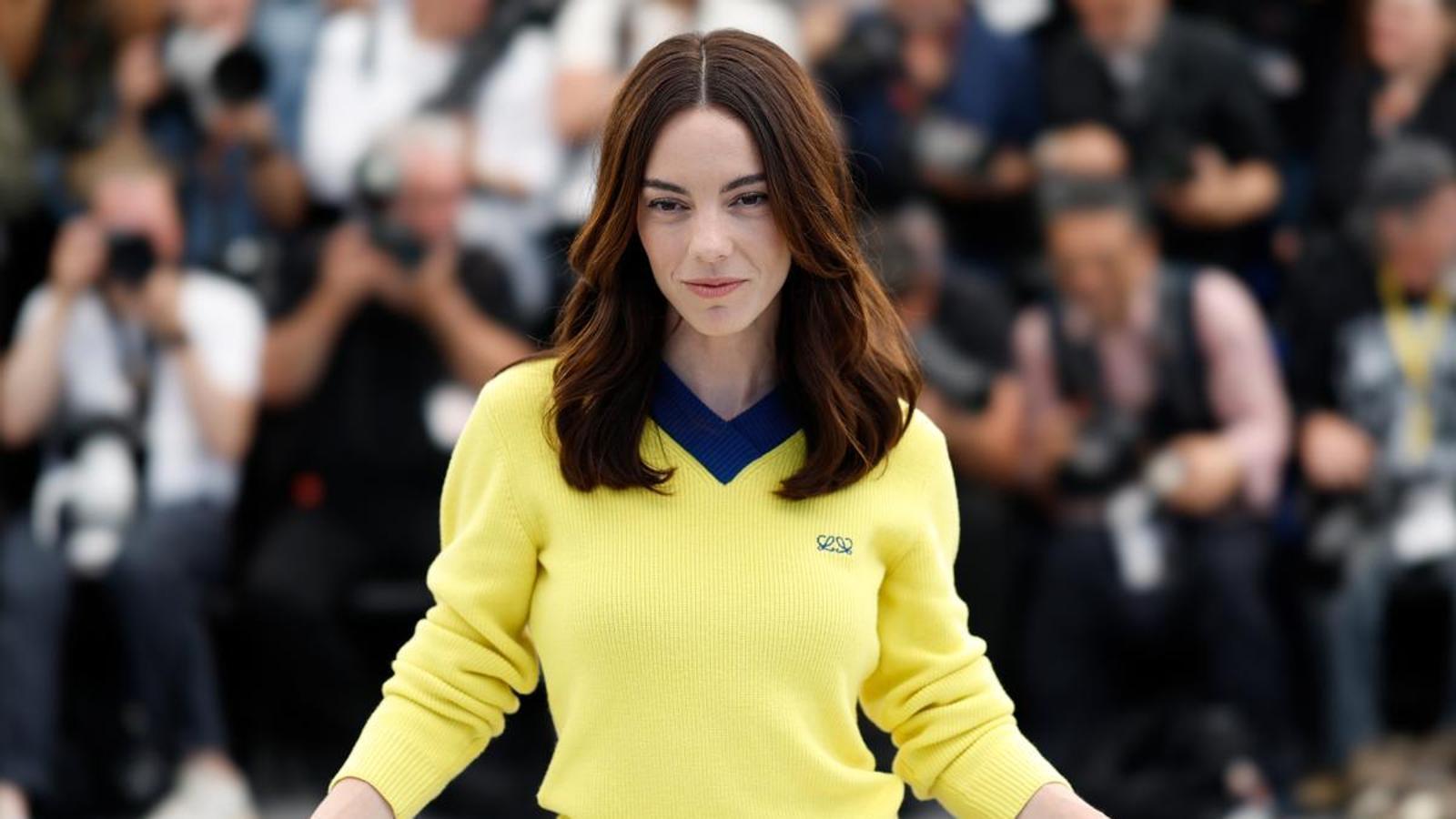
Barcelona2026 is by Victoria Luengo (Palma, 1990). After her first important role with Almodóvar (Amarga Navidad), came the premiere at Cannes of El ser querido, by Rodrigo Sorogoyen, where she plays Emilia, an actress the daughter of a famous director (Javier Bardem), who returns to Spain after many years in Hollywood and offers her a role in his new film. It is a meta-cinematographic drama with many moral twists that arrives in cinemas this Wednesday, August 26, a few weeks before the premiere in San Sebastian of Sants, Luengo's reunion with Mikel Gurrea, who already directed her in Suro.
A few months ago, when he presented El ser querido and Amarga Navidad at the Cannes Film Festival, he must have been asked a hundred times how he felt about having two films in the official competition. Now that he has been able to savor the experience, what did that moment really mean?
— I don't have a very different feeling, because I lived the experience in a quite honest way with what I was feeling, both the good and the bad. They were days of great joy that I will remember all my life, but it was also exhausting. At that moment, with the nerves and excitement you don't realize it, but it required a great level of commitment. And when I returned, I realized that the exhibition had been brutal, much more than I am used to. For eight days I was everywhere. But this has already opened some doors for me and has placed my name in a different place.
As an actress, does this level of exposure worry you? The more famous you are, the easier it will be for the viewer to be aware that they are seeing Victoria Luengo, the actress, and not the character.
— Yes. One of the best qualities an actor can have is mystery, because if you lose that patina of doubt and people know who you are and how you live... We live in an era of so much exposure and so many Instagram photos that it's difficult to keep your personal side hidden. I would like to maintain a certain distance. Firstly, because it's healthier for me, the best way to deal with this exposure. But also because, as an actress, it's interesting for the viewer to have as little information about me as possible.
The first time I remember noticing his work was in Born (2014), a rather interesting film that was hardly talked about. To have his films eagerly awaited twelve years later, with many people watching them and talking a lot about them, must be very gratifying, especially after having worked so hard.
— Yes, it's very nice, because this job is sometimes very unmeritocratic, and very unobjective. In the end, qualifying a work of art as good or bad is so subjective... It's very frustrating to do a project that you know is very good and that no one sees. I myself kept asking myself why it wasn't working... From 20 to 29 years old, the image I had of myself in this profession was that of a person hitting a wall. The wall didn't break, but the blow made a small crack. And then I went back: boom! And it didn't break. Again: boom! And it didn't break...
When did it break?
— With Riot Squad. It's true that before I had the luck to do theater in Barcelona, things that I really liked like A Bitch in a Vacant Lot or A Catalan Story, and that helped me learn the trade and know what kind of actress I wanted to be.
I feel that sensation of hitting a wall.
— Exactly. The wall has a lot to do with the audiovisual, where many factors come into play. It was very difficult for me to break it, but when you break it, something is activated. The thing is that it doesn't depend on you. It doesn't depend on being a very good actress, or on your training. It depends on having the luck to go to a casting like the one for Antidisturbios, a project where, suddenly, I had a good character, a very good director, a very good script, and good actors by my side. The cherry on top was that people saw it and it was well received. But it's a lottery; the most normal thing is that, even if you're good, no one sees you. Your work has the same value, but if no one sees you, you don't move to the next square. You have to start over, until one day the wall breaks and, then, you have a few years to gain momentum. But in a few years we'll talk again and I'll surely tell you that the impulse is ending and I'm hitting a wall again, because that's what happens to many people.
I would bet not. One of the projects that have emerged after breaking the wall is The Beloved, with the same team from Riot: director Rodrigo Sorogoyen and screenwriter Isabel Peña. Is it true that the idea for the film arose, precisely, at a lunch among the three of them?
— Yes. We had lunch five years ago in Bilbao, where I was doing a play by Andrés Lima. And we talked about our families, about parents... For me, that's a topic that touches me deeply. And talking about the possibility of doing something about the paternal figure, the idea of combining it with a film about the world of cinema that they already wanted to make came up. And thus the seed was sown. That same day we said: "Can you imagine if we could do it with Javier Bardem?" And five years later I'm here talking about the film. I feel very fortunate. It's wonderful to have been there at the initial moment with two people with so much talent like Rodrigo and Isabel, who are now my friends forever. With them, I have the feeling of being part of a theater company, of a group of people who understand each other while working and who come together to tell stories for many years.
Playing an actress seems, at first glance, an advantage, but watching the movie I thought the opposite, in the sense that the character is a very different actress, who is not clear about her vocation and for whom, depending on how you look at it, acting is a way of being looked at by her father. And with all this in mind, playing her when she acts must also have been a challenge.
— That's right. I had a more or less clear idea of where Emilia was going, but when she plays Gabriela, who is the fictional character she plays in her father's film, I didn't know if I should do it very differently or not, and I thought about it a lot, a lot. On a film set, I am exactly the same, I don't do anything different. And it occurred to me exactly what you said, that when I was Gabriela, I was being watched by my father. She has wanted him to look at her all her life, and on this set, when she hears "Action", she knows her father is watching her. This served as my motivation, and the action to work on was the desire to please him. I always work with actions, because that's what we do in life. Now I'm here wanting to have a speech that is interesting, a conversation that is interesting to read, wanting to please you, that the interview works. In life, we always take action, and that's what I do in every scene: choose what the action is. And when Emilia plays Gabriela, what she wants is to seduce her father.
As they say, nobody chooses their parents. But in The Beloved you have been able to choose him: none other than Javier Bardem.
— Let's see, Rodrigo and Isabel chose him more, but yes, it's amazing. In the last two years, two very big things have happened to me: working with Javier Bardem and working with Pedro Almodóvar. How can it be that I am working with people who have been my lifelong reference? It has been beautiful. Javier is an extraordinary man, a great colleague and, I don't need to say it, a great actor. And it makes me very happy to discover that the best are also the best people.
The first scene, a nearly twenty-minute face-to-face between the two, has been much discussed. They shot it in real-time, without rehearsal, and it was practically the first time they had seen each other. To what extent do these cinema vérité devices help?
— A lot. Javier and I had only met once, eight months ago, at a work meeting. And between the characters there were years of distancing and fear. Thanks to the device, the fear and the distance were real. Let's see, we are actors and we can do and redo a scene a thousand times, but there is one thing that cannot be acted, and that is surprise. And on a shoot, the more accidents happen, the better the job. When something unexpected happens and the camera is there to record you, it's wonderful. And by shooting the initial scene that way, Rodrigo gave us the possibility of having many accidents and many things happening that I didn't know would happen.
Is it your favorite sequence?
— I like one that was very difficult for me more, the one with the mirror, when I imitate my father. The scene was written in a comedic key, but on the day of filming something magical happened, an accident. Rodrigo wanted to try something and asked me to look in the mirror for something on my body that would make me say: “I am him. He is inside me”. And, suddenly, I saw something on my body that I related to my real father. These are things you can't control but they happen, because we are human and we are alive. And an emotion invaded me... When I see that scene, the last shot, I see myself at 5 years old and it's beautiful. That sequence is now Emilia looking for her father in herself. And it's so powerful and took on so much meaning that the film was rewritten to put it more towards the end.
Another very powerful and commented moment is the scene of the filming of a meal in which the director played by Bardem loses his temper and behaves abusively and violently towards the crew. During your career, have you experienced similar moments on a film set?
— I have been fortunate enough not to suffer abuses of power with this level of violence. Scenes like the one seen in El ser querido, with a director shouting, insulting, and threatening the rest of the crew, I have never experienced, fortunately. I have encountered directors who did not know how to read my vulnerability. Sometimes I have felt humiliated on a set. And I have felt little cared for in the way of addressing me or being addressed, at times when my vulnerability was non-existent, as if I didn't matter. But I have been fortunate enough not to encounter anyone who shouted at or insulted me.
If I had to explain how a Mallorcan girl growing up in Barcelona becomes a great film and theatre actress, what would be the first scene of the story?
— To answer I would first have to know why I got into this, and I don't know. I don't remember the day I first wanted to be an actress. I feel like it's a desire that was born with me. If I were to be a screenwriter, and to be very honest, the first scene would be me as a child doing something at home to be seen by my family. And I would mix it with another scene in a theater class feeling a lot of happiness. I had a blast in class, I was 8 years old and it was the place where I felt happiest. When at 10 years old I was enrolled in Memory, the musical theater school, I lived with my grandparents and my mother. And the first Saturday I had class I woke up my grandfather. "You have to take me to class, Grandpa!" And he said: "It's not today, Victoria. It's next week." And I was so persistent that he took me, but, obviously, the place was closed. I've always been very stubborn and persistent in all things.
And do you remember the first time you stood in front of a camera?
— Professionally, it was in El cor de la ciutat, where I had one or two scenes at the exit of a nightclub, smoking a cigar. I had never smoked, and my mother taught me how to. But I was very ashamed, because in the scene I had to say: “Do you want me to teach you to smoke?” And it was very noticeable that I didn't know how to smoke.
