Ramon Solsona: "I feel like an expired yogurt"
Writer. Trajectòria Award of the Setmana del Llibre en Català

-
CAT -
CAST
BarcelonaThe solid, versatile and successful literary journey of Ramon Solsona (Barcelona, 1950) has been recognized this year with the 30th Trajectòria award from the Setmana del Llibre en Català, which will be held at the Passeig Lluís Companys in Barcelona from September 18 to 27. The author of Les hores detingudes (Quaderns Crema, 1993), L'home de la maleta (Proa, 2011) and Allò que va passar a Cardós (Proa, 2016) will collect the award and take stock of his creative life in one of the central events of the fair and literary festival on September 23, at 7 p.m.
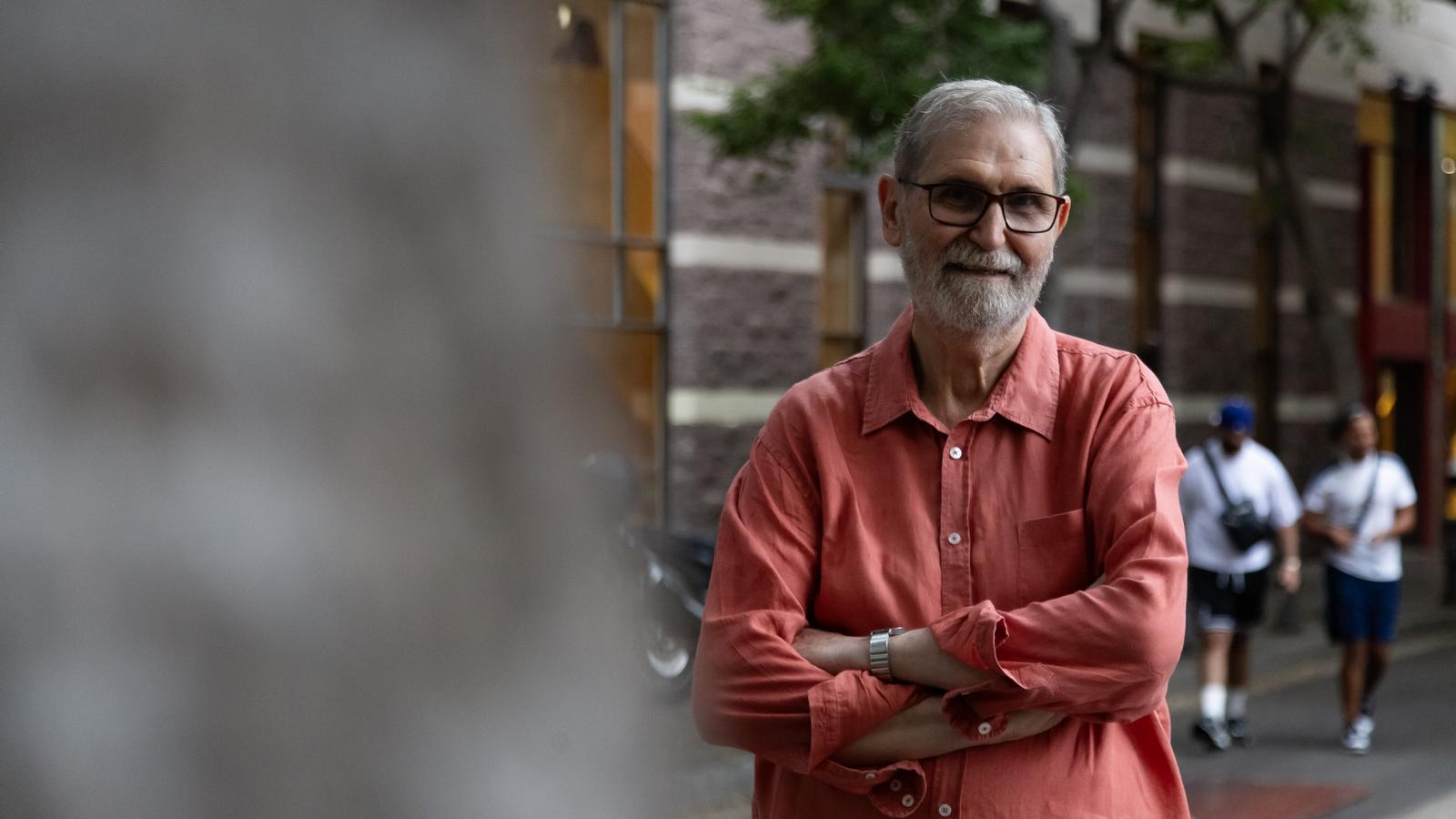
The day of the interview with ARA, Solsona appears without an umbrella despite the heavy rain forecast for that afternoon. The drops, dense and large, that begin to fall during the photo session do not manage to ruin his smile. The writer met us on a Wednesday early in the afternoon to be able to arrive in time at the Camp Nou: he did not want to miss Barça's debut in the Champions League, but the downpour will force him to change his plans.
He is one of those authors who in each book tries different ways of telling the story he has in mind. In Temps enrere (Proa, 2022), he started at the end and went backwards to the childhood of the two protagonists. He narrated Allò que va passar a Cardós (2016) as the choral story of the construction of the hydroelectric power plants in the Pyrenees. Before starting El carrer de la xocolata (2025) he gave a notebook to his three siblings so they could write down memories and anecdotes from when they were little.
— We grew up in Gràcia, on Carrer de Bellver, which had the Cola Cao factory right next door. If there was one thing I did not want to do, it was the youth memoirs of a writer. The street served me to talk about how people lived in the Barcelona of the 50s and also to reconstruct the popular Catalan that we spoke. I had been dedicating myself for some time to collecting memories and anecdotes and I asked my siblings if they wanted to give me a hand. We would meet to discuss each other's notes. Sometimes we remembered different versions of the same events, and that is how I ended up stating it in the book. Memory is not one-dimensional.
How are your siblings taking the fact that you've become a writer?
— Quite recently I learned that one of the brothers was commenting to the others, while I was writing The Chocolate Street: "Do you think this that Ramon is doing has any interest?". He said it because I intended to explain our little everyday things: like so many other people of the time, we still didn't have a shower, we went to get ice for the fridge, we listened to the Tambor on the radio and we entertained ourselves with the Juegos reunidos.
Surely many people have shared their memories with you during the presentations and book clubs for this book. I myself could tell you that, of the Juegos reunidos, one I could not stand was La Escalera, because at any moment you would end up on the cursed square that made you go back to the start.
— They were very fun, the Juegos reunidos. And sometimes also politically incorrect. There was one that was called Merienda de negros in which the black people put the white people into the pot. The game followed, in this case, the cliché of the era.
He dedicated El carrer de la xocolata to his generation.
— Despite everything, my generation has turned out quite normal. The change in life between those 50s and 60s in which we grew up and now is radical.
In the Catalan of that time, the "passi-ho bé" (goodbye/have a good one), which he regrets has been lost, coexisted with the Catalanized pronunciation of words such as "pasillo", "botiquín"...
— There were many. Bleach was called lejía. My mother-in-law distinguished between the tuna she went to buy at the market and the atún that was eaten in a can.
His readers know the work he has done with popular Catalan through other emblematic characters, such as the retired orchestra musician from L'home de la maleta.
— The popular and non-normative Catalan he speaks forced me to do a tremendous amount of work, but I had to take it on, because it was part of the place and the moment I wanted to explain, in addition to helping to better define the character.
Each of his novels proposes a different way of reading the events it intends to explain, but it also faces them with a changing language.
— If a significant part of the characters come from the Priorat, as happened in Temps enrere, I had to show the particularities of the Catalan they spoke. The same happened with the Pallares characters in Allò que va passar a Cardós. Or, if we return to Temps enrere, when one of the characters emigrates to Germany, they have to undergo a linguistic immersion in that language which from then on will be so important in their life. One of the great differences between Catalan and languages like Spanish, English, French, or German is that they can all make characters speak with the language of the street without fear. For us, depending on what we put in, it seems to endanger the normative building of Catalan, with all that it has cost.
Has it taken a toll on you, when you have transgressed the rules, in any of your novels?
— The protagonist of L'home de la maleta spoke without any normative filter. To build that voice, I did a lot of research into colloquial Catalan, which is not studied at all. When the novel was published, I thought some readers would protest. I only read one critical article in this regard, published in Llengua Nacional: the columnist asked the Generalitat that it should have intervened so that novels with such broken Catalan as this one would not be published.
The novel had won the Sant Jordi.
— There were comments in the opposite direction of what I wanted. They said: if Solsona, who knows what he is doing, allows himself to include barbarisms in the novel, green light!
You can always notice a lot of work in your books. Have you worked with the awareness of having to toil so much on every project?
— I have become increasingly aware of this for a reason, and that is that as I have grown older and have been publishing, I have demanded more and more of myself. Maria Barbal and I have been discussing this. Now it is harder for me to write, but it is not because I do not know what I want to do, but rather that I tell myself I can do it better. I think: not that, that is a cliché. Not that other thing either, that is repetitive. And if you do that, you are treating the reader as undemanding. You have to work on it more, Ramon. If there is one thing I have learned over the years, it is to distrust myself more. Thanks to that, I raise the level of demand. Whether I get it right or not is another matter.Maria Barbal we have been commenting on it. Now it is harder for me to write, but it is not because I do not know what I want to do, but that I tell myself I can do it better. I think: not this, that is a cliché. Not that either, that is repetitive. And if you do that, you are treating the reader as undemanding. You have to work harder, Ramon. If there is one thing I have learned over the years, it is to be more suspicious of myself. Thanks to that, I increase my level of demand. Whether I get it right or not is another thing.
Although it may seem far away, he dedicated twenty years of his professional life to teaching. When he made the decision to leave it, he was about to turn 40 years old.
— I had no plan laid out. I wrote Figures de calidoscopi [Quaderns Crema, 1989], my first novel, because I needed to. I did it in a practically clandestine way. I would get up early in the morning to write, because at that time I had very young children. I did not foresee that the book could have repercussions, that they would call me to write articles and scripts or to collaborate on the radio. When we speak of a career, I can boast, if you can call it that, of having made a living from writing in Catalan. This does not mean that I have earned my living only with novels but, rather, it has been thanks to the usual supplements: press, radio, and television.
He was part of the writing team for a much-missed series, Estació d'enllaç.
— I joined to replace Piti Español. It must have been around chapter 40. We did a hundred more. I remember fantastic colleagues like Dolors Portes, Carmen Fernández, Manel Bonany, and Andreu Martín. Our boss was Jaume Cabré. When we finished the season, we would meet to have a farewell, and we believed it would be final, because in the series we had left everything closed, but after a couple of months they would call us again to tell us that we were continuing.
The world of the subway has interested him not only as a screenwriter. Also as a narrator. He dedicated Blue Line (2004) to it, the first novel he published with Columna.
— The world of the subway is closed in on itself. You don't know if it's raining or sunny outside. While I was writing Blue Line I went to see the head of public relations for the Barcelona metro to explain that I was writing a book in which each chapter took place at a metro station on line 5. When I had finished, he said to me: "Wait a moment". He went to another table and brought me a folder. "Look, in here there is a novel that talks about the red line and that dedicates a chapter to each station". I was completely stunned.
But he did not throw in the towel.
— The public relations manager encouraged me: "Do you think someone who writes well would send their novel to the subway company, instead of taking it to a publisher?".
Before publishing at Columna, I had spent 15 years at Quaderns Crema. How did you get there?
— I had submitted to the Prudenci Bertrana prize with Figures de calidoscopi. When I found out that they declared it void and that they said ugly things about those who had submitted to it, I was very upset. I was very clear that my novel was publishable and I sent it to several places. Jaume Vallcorba was interested in it right away.
He/She was part of the publishing house during the years when authors like Quim Monzó, Sergi Pàmies and, a little later, Empar Moliner were triumphant.
— Jaume was a unique person, with a modern, European and contemporary vision. He had an obsession with publishing books in Catalan as if it were, and now I will quote him, "a normal culture." Since Quaderns Crema was a sole proprietorship, sometimes he would do things that would bewilder you. In my case, everything went well until the day I brought him No tornarem mai més [1999] and announced that it was the last book I was giving him. I was about to turn 50, I wanted to have a literary agent and finish professionalizing myself. He did not take it well at all.
Did you team up with the authors of Quaderns Crema during the years you published there?
— The relationship with colleagues has always been very satisfactory. Surely in this world there is envy and backstabbing, but I have been treated well. I have gotten along with authors my own age, with authors of older generations, and also of younger generations. Even so, the job of a writer is very lonely. You spend the day locked at home writing. You doubt a lot. Inspiration does not exist. You make decisions without anyone by your side. With luck, when you finish the book you give it to your editor and it ends up being published.
Although by year of birth he is part of the generation of the 70s, which includes authors such as Jordi Coca, Carme Riera, Miquel de Palol and Valentí Puig, he did not debut until the late 80s. Do you feel that, as a senior of Catalan literature, he is treated with less interest, as other authors have commented?
— Current events are always very hot and want new faces. There are a series of writers who are expired yogurts. We notice this a lot, every time we publish a new book. I feel like an expired yogurt. I can't do anything about it: I already said it a couple of years ago at the inaugural lecture of the Bertrana awards, which I agreed to give because I am very Bertrana-philic.
Writers expire faster and faster. A novelist approaching 50 years old told me this.
— If he looks like that at this age, imagine at mine. I am a dinosaur.
I would say that one of the secrets of the youthfulness of his books is that they resemble each other very little. He is 76 years old, but he remains curious to explore different forms and themes.
— I am forbidden from repeating myself. And I work hard on every book, as I was telling you before. Since I retired from writing articles, I have more time, so it takes me less time to finish each project. In the same year as El carrer de la xocolata I also published Dones migpartides [Pòrtic, 2025], where I spoke about the life and work of about thirty female writers from the 30s who I think we should know better. The first one I started reading was Maria Dolors Orriols. I found El riu i els inconscients to be very good, which Montserrat Bacardí recovered in 2022 at Adesiara after dedicating a biography to her, Viure i escriure [Eumo, 2019]. The first edition of the novel came out with Columna in 1990 and went unnoticed. Orriols had written it decades earlier and tried, without success, to publish it in exile. Based on Orriols' case, I started reading authors who have been published, such as Rosa Maria Arquimbau and Cèlia Suñol, and others that we don't have much in mind, like Laura Masip, Maria Àngels Vayreda and Roser Cardús. Did you know that Marina Ginestà, known for the photo of the militiawoman with a rifle taken during the Civil War, published a novel that is very good in the 70s?
No.
— We will have news about it soon.
Will we have editorial news from Ramon Solsona soon, too?
— I am preparing a collection of short stories that I had left aside. There are two that I am salvaging from my first book of short stories [Llibreta de vacances, 1991]. The other seven or eight are unpublished. I also have an idea for a new novel, but I do not know when I will get to it. I am in no hurry.
In 2026 are we closer to being a normal culture, even though the social use of Catalan is declining year after year?
— When I release a book and I am interviewed, I always ask Xavier Gafarot, head of press at my publishing house, to ask journalists not to ask me what I think about the situation of the Catalan language. It costs nothing to ask a question like that. You throw it like a bomb without having to prepare it. I, on the other hand, could spend three hours giving you very verbose explanations. My responsibility is to write in Catalan as well as I know how and with great care. I can tell you, because your question is more precise than others I have been asked regarding this topic, that I notice that right now there is a great difference between the sociolinguistic context and the literary context. We are in a good creative moment. The spoken and colloquial reality is another matter.
