Does it make sense to consider abolishing the family?
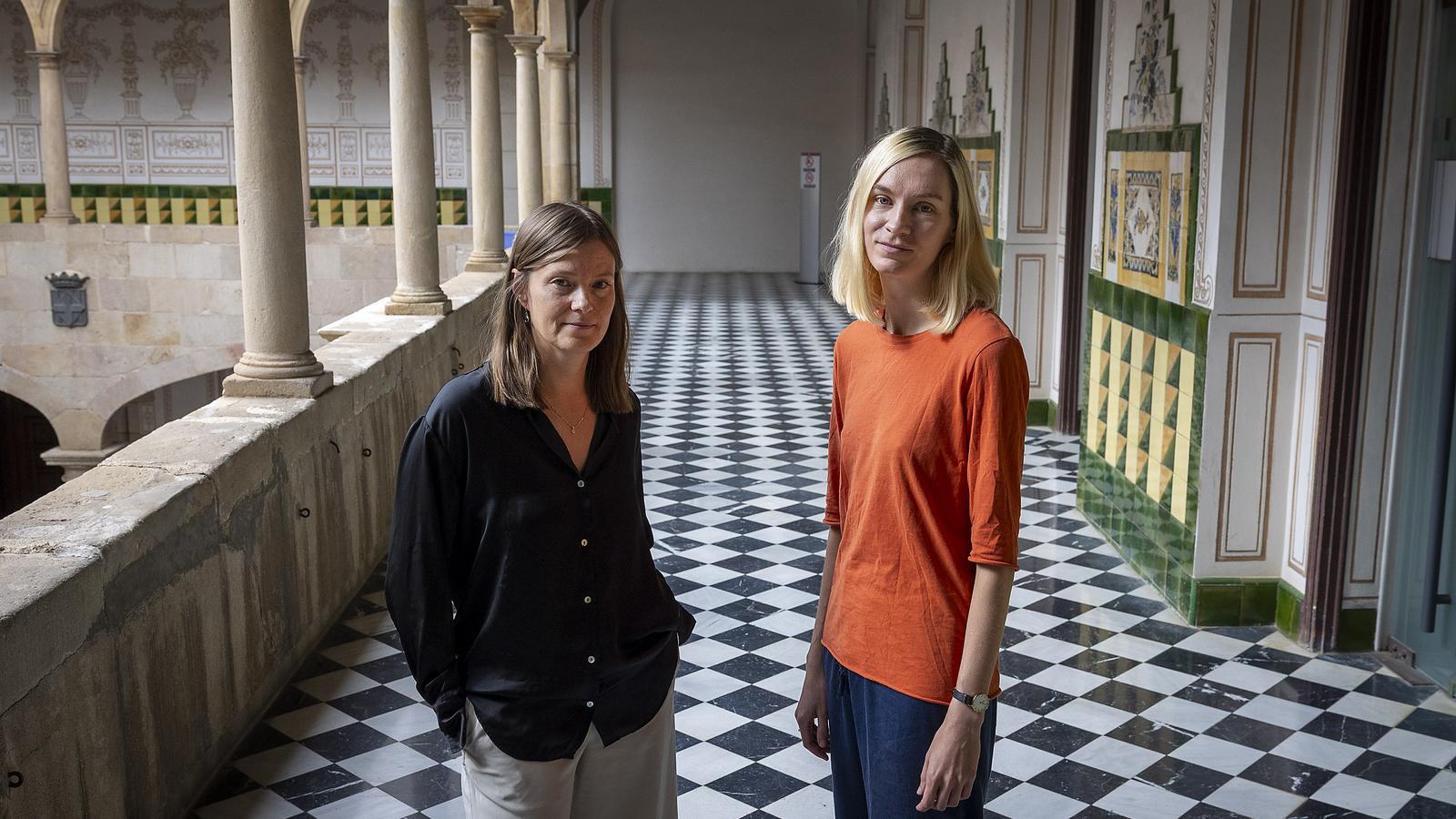
Researchers Evelina Johansson and Alva Gotby reflect at the Read Festival on family overload and propose what alternatives exist
-
CAT -
CAST
BarcelonaAfter having two children very close together and finding herself locked at home with COVID-19, Evelina Johansson, a professor of gender studies at Örebro University (Sweden) and a specialist in Marxism and feminist theory, reached her breaking point. "I was having a very hard time, overwhelmed and very tired," she recalls. Looking for a way out of the tunnel, she began reading and researching the role of the home in society and delving into literature on the abolition of the family. This school of thought does not advocate ending love, affection, or cohabitation, but rather opposes the privatization of care and the dependency, sometimes somewhat forced, on a small unit, the family, in order to survive. It advocates for a world where everyone has access to an unconditional and collective network of support, food, and shelter, regardless of who you were born to.
This personal exhaustion of Johansson's is shared by many women. In this sense, the professor cites a Swedish study in which stress hormone levels were measured in mothers and fathers upon returning from work: while in men stress levels calmed down upon crossing the threshold of the home, in women they skyrocketed. This shows that the home continues to be the second shift of work for the majority of women," she notes, and points out that globally they assume 75% of unpaid domestic and care work. It is a situation that is not on the path to improvement, because the pressure does not stop growing due to state cuts in healthcare, schools, and public services. "Current policy, even though it talks a lot about the family, in reality does not support it; it is anti-family, even though it never stops using it as an ideological banner," the professor asserts.
Both Johansson and the British Alva Gotby, a writer and researcher who works on feminist theory, social reproduction, and housing, and who will soon publish in Spanish Like at Home (Verso), have been in Barcelona to participate in the Festival Read. Both spoke with ARA hours before the debate Abolish the family? The question of the debate, however, does not have an easy answer.Furthermore, the family is not just the place that many people have as a refuge, but the one that allows them to survive. "The pressure exerted on families is colossal," states Gotby. If caregivers are at their limit, they cannot offer the care they would like or that the people in their charge need. On the other hand, for people who are outside the family sphere, it is much more difficult to access any form of care. "Whoever has a stable and well-off family has security and a guarantee of owning property through inheritance, while whoever is excluded from it is left helpless," adds Gotby.
The mental load
Beyond physical tasks, Gotby focuses on the invisible weight of mental load. That is, being the person who has the ultimate responsibility for ensuring that things get done, the one who keeps the list in their head so that children have everything they need or everything runs smoothly at home. "In Sweden, where equality policies have been applied for fifty years, mental load is the hardest part to change, because it is taken for granted and is part of how we understand ourselves as men or women. For me, this is the great unfinished business," she asserts.
It is not about eliminating love, care, education, or child-rearing, but rather redistributing them so that they do not fall upon such a small unit, she explains. "There is the idea that feminists critical of the family want to outsource everything to the State or depersonalize it, and eliminate love and care from family life. I totally disagree with that," Gotby defends. "What we are trying to do is, for example, for work to be distributed more equitably. It is difficult to do that with the closed family unit. Work can be redistributed so that fathers do more, but, at the end of the day, a lot of responsibility is placed on the family: children, the elderly, people with disabilities or illness... We should consider ways to open it up," she reflects.
And it is at this point that a very important element enters: space. Gotby works mainly in the field of housing, where apartments are designed for small family units, which makes it difficult to cook with neighbors or share the care of children. The trend toward privatization has made it worse. "We should be able to imagine how to share the right to care, facilities, or food, but also aspects of leisure and community, such as watching a movie or having children play together. However, the current housing model makes this difficult," she says.
The conservative reaction
In the recent elections in Sweden, as is also the case in Spain, a gender polarization has been observed: women and young girls are more feminist, while young men are more conservative. Faced with the emergence of conservative currents and social media movements that idealize the figure of the traditional housewife, both Gotby and Johansson interpret that this unease responds to the pressure of the current model. For Gotby, there are young women who reject the promise of liberal feminism to have to have a career and a family at the same time, and they perceive it not as a freedom, but as an exhaustive obligation: being a successful worker and then taking care of children and parents. Some prefer to renounce this world of self-demand and capitalist competitiveness to take refuge in the home and love, idealizing the traditional family. It is a reactionary response to dissatisfaction.
"The reaction of these young people responds to a real unease, even though they draw the wrong conclusions from it. The same happens with masculinity among young men: they feel that the promise of masculinity has not been learned and they channel their frustration against feminism instead of against the class system," asserts Johansson. "We must unmask the false promise of freedom of the far-right project, which in reality cuts women's rights, abortion, and sexual freedom. We must point out what is the central conflict of society: the problem is not between men and women, but of an economic and class nature," she adds.
For Johansson, the underlying problem, therefore, is the lack of real freedom. In the family abolitionist literature, there is a debate about whether the family must be destroyed to end capitalism or if it is the other way around. "I would not bet everything on the family card; I would prefer to change the conditions surrounding housing and work to give people real freedom to choose how and with whom they want to live," the professor states. "Nowadays the birth rate is falling and people are forced to stay in family structures not by choice, but because of the impossibility of accessing housing," she concludes.
