Distortion day with Carolina Durante
The Madrid group makes the Barcelona public explode at the Palau Sant Jordi

-
CAT -
CAST
- Palau Sant Jordi. November 28, 2026
Saturday, a night of reflection, the Palau Sant Jordi was preparing to welcome one of the bands of the moment: Carolina Durante, the Madrid pop-punk group that in recent years has gone from making Razzmatazz vibrate to carving out a place for themselves at the Coachella festival. Minutes before the appointment, the queues were full of groups of friends and, above all, couples, who were discussing their favorite lyrics. It could be said that Carolina Durante's style is one of punk romanticism, but not only because of the themes of heartbreak, nor because of the self-flagellating customs. It is, also, because there is something romantic in making music out of a gesture of rage, from the kick, the scream, the distorted scratch.
Carolina Durante is leading a growing murmur: a trend where pop music—meaning popular—is leaning more and more towards guitars and distortion, the punk gesture, and raw lyrics, from the inside out. We have seen this in the success of bands like Fontaines D.C. or Geese, as well as the unstoppable Remei de Ca la Fresca. The Fin de la aventura tour was supposed to be the closing of the Elige tu propia aventura era, the album that finally solidified them, but, as they say, it would also be a new beginning. Just a few weeks earlier, Carolina Durante played an acoustic surprise set at Plaça Universitat to present a preview of what will be their new album.
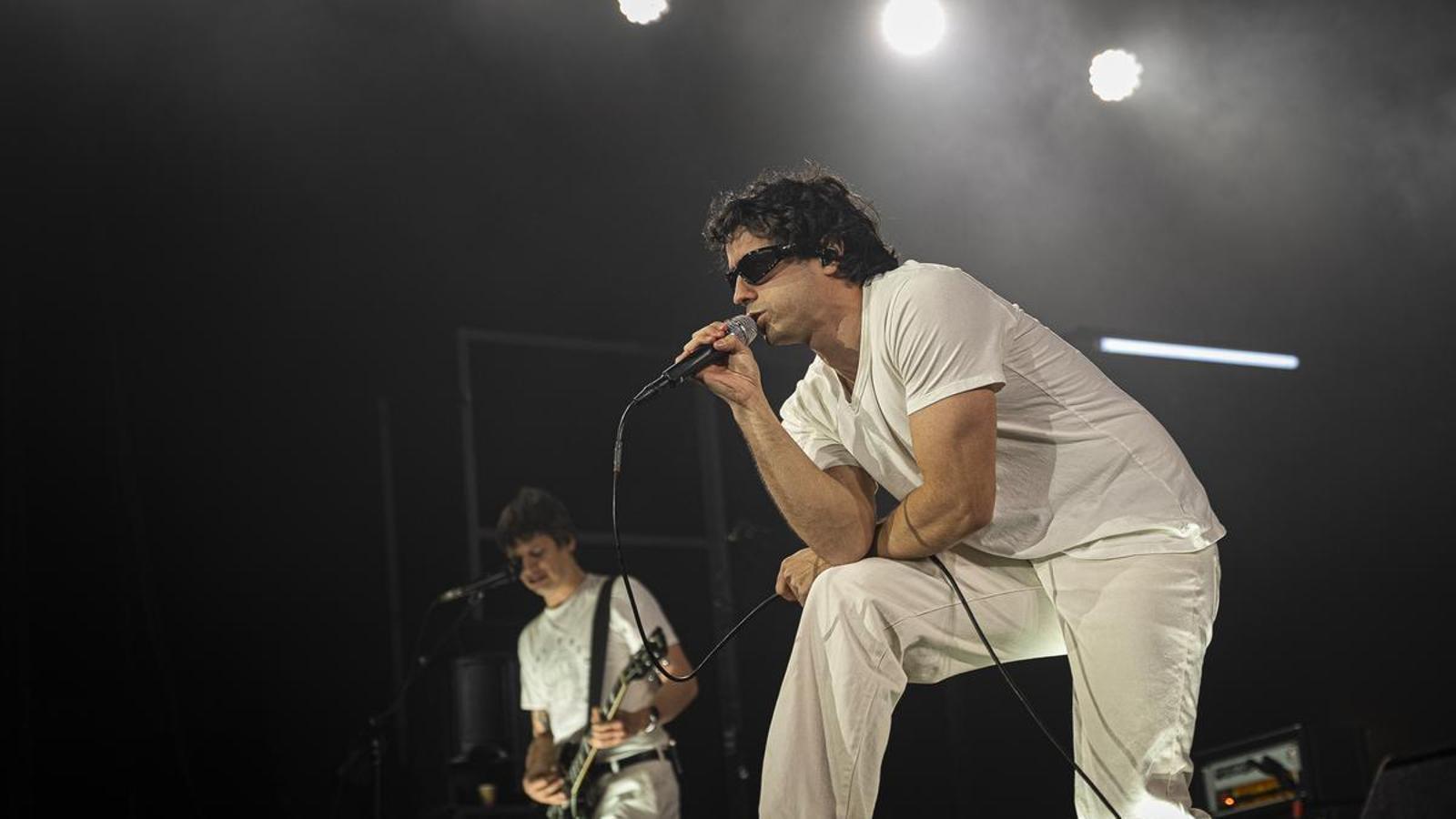
The group started exactly on time to dive headfirst into a frantic rhythm that would barely leave room to breathe between songs. The band, all in white, played on a black stage loaded with amps and crates, stairs, a kind of very dark musical office. The frontman Diego Ibáñez dashed from one side to the other with sunglasses and red footballer sneakers, shaking the microphone, facing the audience, and dancing grotesquely to the rhythm of those screams of his that in a couple or three tracks reached the level of screamo ; if from hardcore the midwestern emo emerged, here could we speak of meseta emo?
The audience had also come out to play, and every time a track started, the thousands of bodies in the pavilion stirred in whirlpools looking for the umpteenth pogo of the night. From time to time, among the first rows, a couple of red estelades waved, and at one point the audience roared “fucking Real Madrid”, wild, to tease the singer, who is a declared Madridista. The audience’s love for the band was made evident when, song after song, they chanted choruses and finished the verses for the singer, like the cheering section at a football stadium.
If the first half of the concert had been a frenzy of distortion and energy culminating in Tomé café, even faster and noisier, as much as it did not seem possible, the second half knew how to take the space that their more emotional tracks need. A string quartet and a trumpet were added to nestle them: San Juan and Elige tu propia aventura, which were received by a Sant Jordi filled with mobile phone flashlights.

A plush Tió
Towards the end, the day of reflection made its presence felt. With the song Las canciones de Juanita, the group's mascot—a monster made of post-its—devoted itself to destroying papers with the words “nazi” and “fascist” on them, just before pressing a big red button to explode white confetti over an already frenzied audience. The euphoria was such that Ibáñez left the microphone to climb the fences and swim, rather than surf, over the Barcelona crowd, only to return to the stage later with a Tió plush toy, which drove the audience even wilder.
To introduce Cayetano, the hit that makes fun of the Madrid preppy, Ibáñez said "Reflection day," between guitar chords: "My father told me the other day that building things is very difficult, but that it is very easy to break them. Tomorrow, at the polls, think about it." The night ended by transforming rage and melancholy into a cry of optimistic energy, leaving Hamburguesas for the end, a chorus that says that "my friends add up to more than my demons." With the band still waving and the audience starting to stir to leave, the Palau Sant Jordi played Cher to make it clear that it was time to go home: "Do you believe in life after love?." Leaving the venue, a group of very young boys, red and sweaty, commented that Madrid had lost.
