Can artificial intelligence make us better writers?
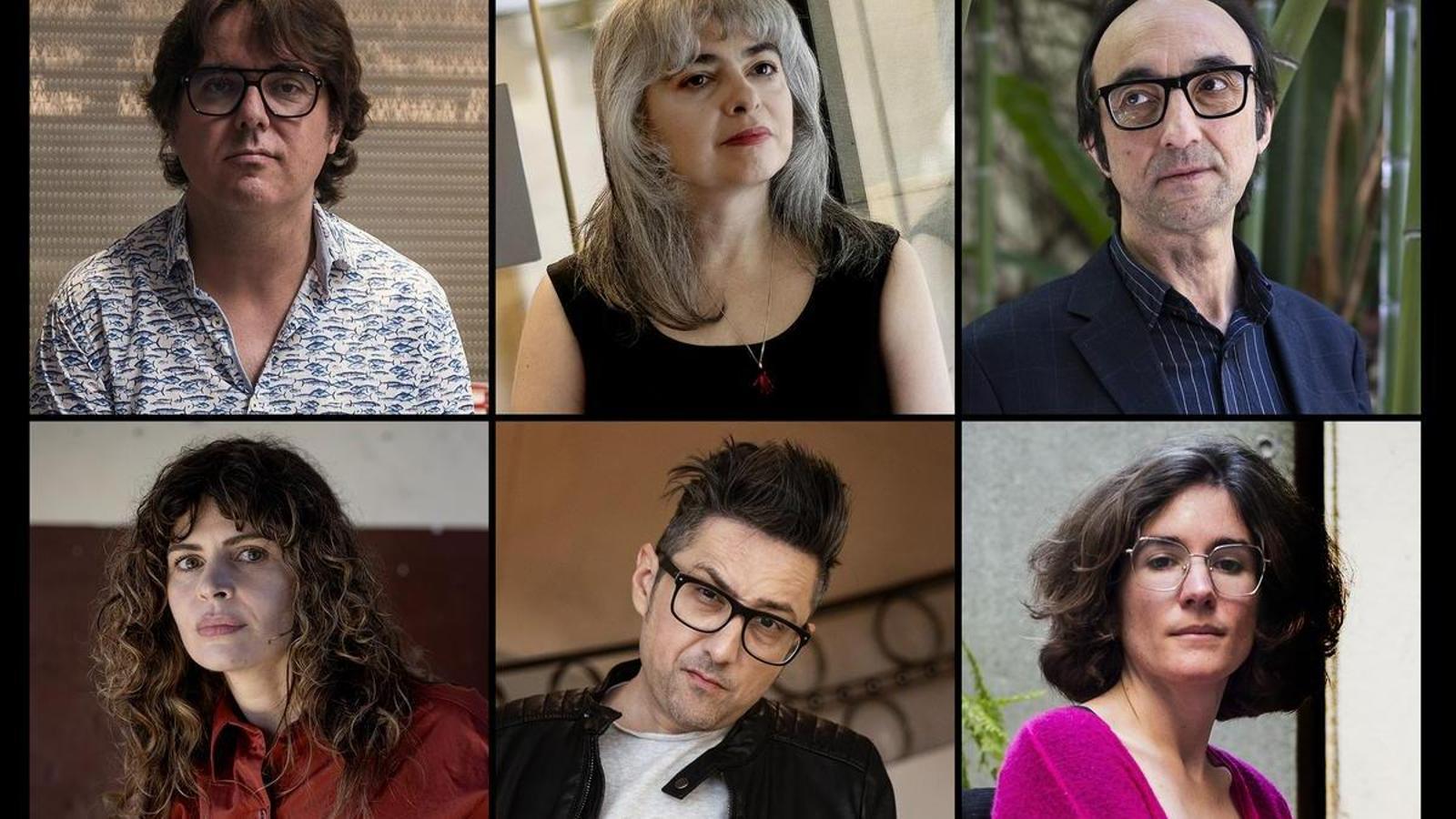
The recent controversy following the publication of two novels written in collaboration with artificial intelligence without attributing it opens a debate about the use of this technology for creative purposes. We ask authors such as Melcior Comes, Mariana Enriquez, Agustín Fernández Mallo, Alicia Kopf, Patricio Pron and Irene Pujadas about their relationship with this new tool.
-
CAT -
CAST
BarcelonaA few days ago, two well-known authors, suspicious of the creative abilities of generative artificial intelligence, put it to the test and the result was not what they expected. "We asked it to write a one-paragraph story in a baroque style with the sole premise that it had to feature a dog walker, and the story was coherent and not bad at all, but then we asked it if it could rewrite it with our particularities as authors, without giving it any other clue, and it did it even better," comments Irene Pujadas, winner of the latest Finestres prize with La intrusa (L'Altra, 2025) and one of the participants in this experiment. The other was Mariana Enriquez. "We weren't satisfied with what the AI achieved and we wanted to know how it had decided what choices it made in each case –continues Pujadas–. It replied that, in Mariana's case, it had set out to write a story with a touch of mystery that was not found in the characters, but rather related to the spaces where it took place, as she usually does in her fiction. In my case, connecting it to my literary world, the dogs in the story were taking an emotional management course and everything ended up having an absurd bureaucratic touch".
The result of this test has not changed the opinion of either of the two writers. The "very few times" that Pujadas has approached it, she has done so "as if I were a very conservative 80-year-old who doesn't want novelty". Enriquez, who has visited Barcelona to present the essay on her literary foundations, Conversación con la oscuridad (Páginas de Espuma, 2026), has a similar view regarding the use of generative artificial intelligence. "When I write I like to find limits, and I constantly look for challenges. I don't care so much that the text works and ends up being published as I do about the creative act –she explains–. I like struggling with words. I don't want a machine to solve things for me quickly. Before using the machine when we work on a novel or a story, we should ask ourselves why we write and if we are really willing to surrender our soul to a robot".
Despite these legitimate precautions, the use of AI through chatbots like Gemini, Claude, and ChatGPT is becoming increasingly common in various stages of the creative and editorial process of a literary text. "AI has entered the sector to revolutionize it from top to bottom", as consultant Isabel Fernández remarked a few weeks ago at the Liber fair. "The problem is not so much that AI is used, but that there is an attempt to make it believed that it did not intervene in a text", comments Melcior Comes, who has not stopped experimenting with this tool since the end of 2022, when the first version of ChatGPT was released. Comes refers to the recent report that the novel Donde el agua trabaja, by David Silva Rojas, published this autumn by Almadía and winner of a 20,000 euro literary prize, had been written with the intervention of AI in 99% of the entire text. "In this case we are talking about dishonesty, just as if it were plagiarism, because the author tried to pass off as his own something he had not written by himself alone", adds Comes.
Virtues and limitations of the machine
The case of David Silva Rojas, who waited five days to make a statement and claimed to have "conceived, written, and revised the novel," has been added to that of C'était ça ou mourir (Grasset, 2026), one of the phenomena of the French rentrée, signed by Thélyson Orelien, until an anonymous X account reported that the work had been written almost entirely through an AI, as it had been able to verify through the Pangram program, the same one used to analyze Donde el agua trabaja. "It would be as if, in a marathon, the person running is not the runner but their coach, and once they have finished first, the coach collects the medal instead of the runner –says Alicia Kopf, author of novels such as Memòria d'Eco (L'Altra, 2026) and professor of creative writing at Pompeu Fabra University–. Interrogating AI in a creative process can be interesting, but it must be made explicit and be transparent." Kopf herself used an AI to create the cover of her latest book, but she did it "against the grain, not to imitate what already exists, but trying to use it by trying to make it dream and evidence how it thinks".

"In the novel L'home que va vendre el món [Proa, 2025], there is an entire chapter in which the protagonist interacts with a machine, and it stems from an experience of mine with AI –explains Melcior Comes–. He makes psychological confessions to it to let off steam, and the machine responds with psychological clichés of the trade. What the reader finds in the book is a reworked version of that conversation." Over the last four years, Comes has played "at imagining situations and characters with AI to do the opposite of what the machine predicted," and currently, through the protagonist of a new story of his, maintains a fictional love correspondence with an AI. "He keeps receiving emails from someone with whom he ends up establishing a bond before discovering that they do not exist," he advances. A fragment of the responses generated by AI goes like this: "My hair was full of shampoo and, suddenly, I remembered that thing you told me, that in your coffee shops you always notice the people sitting alone. I don't know why that came to mind precisely. Maybe because I also spend my life observing people who don't know I'm observing them."
Will the day come when AI can write literary texts with a quality equal to or superior to that of a human? A couple of years ago, the writer Patricio Pron faced the best ChatGPT model of the time, the 4 Turbo version. Based on the invention of 60 titles for possible films –each contestant invented 30– Pron and ChatGPT developed the plot in 600 words. Each of the 120 stories was evaluated by six different critics and academics. "I felt some pressure in case I discovered that I wasn't as good as the machine," he acknowledges. "I wondered about the fate of my books if it turned out that I couldn't beat a kind of stochastic parrot that is dedicated to repeating the nonsense of others." Pron won in all categories: creativity, personal voice, and original and creative style. Two of the other conclusions of the study were that ChatGPT expressed itself better in English than in Spanish and that it was capable of writing better stories based on Pron's titles than on its own.
The experiment can be consulted in book format, Pron versus Prompt (Delirio, 2025). "After gifting technology companies dozens of our skills, including memory, ethical judgment, and our creative powers, can we allow them to legislate on what is AI and what is not?", it asks in relation to Pangram, an AI dedicated to discerning between human writing and writing in which AI has intervened. "What is worse? –it continues–. Creating an opaque technology, very costly in terms of energy and very disruptive, or that someone yields, with no skill at all, to the siren calls to feel like a writer for a while?"
"Pretending you have written something you haven't written makes no sense, it repeats clichés –asserts Alicia Kopf–. Art is there to break clichés, not to insist on the same formulas. In an industry sense, AI can strengthen certain products that are profitable because they reiterate ideas and approaches. That said, the definition of literary writing that I always give is the following: «Discovering something you have inside through language». The authorial voice cannot be achieved through artificial writing. It would be like sending someone else to take the trip you wanted to take and have them explain it to you". Just as certain commercial literature can play with thematic and linguistic clichés and even flirt, in cases not yet declared, with AI, one of the current dangers is that, with the increasing sophistication of the technique, it will become increasingly difficult for the ordinary reader to discern between a novel written by a person or a novel written in collaboration with a machine.

In favor of experimentation
Among the pioneers in literary experimentation with AI is Clemens J. Setz, who crafted Bot (2018) –available in Spanish from H&O Editores– as an interview in which the responses were selected by a "digitized external soul" that contained the "thousands of pages of diaries, drafts, notes, and ramblings" of the Austrian author. Also Jorge Carrión, who in Todos los museos son obras de ciencia-ficción (Galaxia Gutenberg, 2022) narrated the author's own relationship with an algorithm based on a joint project with the Barcelona Supercomputing Center. "AI can be interesting for practicing experimental writing, as was done during the first avant-gardes of the 20th century and, later, with the random writing produced by interaction with machines," recalls writer Agustín Fernández Mallo in relation to attempts such as One Hundred Thousand Billion Poems (1961), by Raymond Queneau. For years, Fernández Mallo has been intrigued by "the theological idea" that hides behind AI. "Humans create things that surpass us only to then submit to them," he asserts. "The first AI was religion. Later came state structures... And now we have AI, which is neither an intelligence comparable to the human one nor is it more artificial than any other technology."
Fernández Mallo has just published the essay El ángel de la inteligencia artificial (Galaxia Gutenberg, 2026). "I compare it to a fallen angel because it is a creation that has a will of its own but is not human," he continues. "For the first time in history, it seems that there is an entity that speaks to us and is not part of our species. In reality, AI does not really speak to us, it only seems like it, because it simulates using human language as we use it, and that makes us nervous in many ways: the scientific, the technological, and the artistic."
"Any new tool is a field of exploration for an artist, but we must always relate to it critically," insists Alicia Kopf. "What I like about writing is looking for my own strategies to get out of the labyrinth I delve into myself," adds Fernández Mallo. "I enjoy writing. Why should I free myself from an action that I like and that motivates me?" "The production of literature through a machine is the negation of literature as a sensitive experience and as an improved life," states Patricio Pron. "The fact that the machine is capable of writing better than most people, or even a good part of writers, should not scare us, but rather it should strengthen our convictions," proposes Melcior Comes. "Now more than ever, we must write by seeking, through stories and language, to reach ever higher levels of truth every day."
