Byung-Chul Han: “We are free when we have ties”
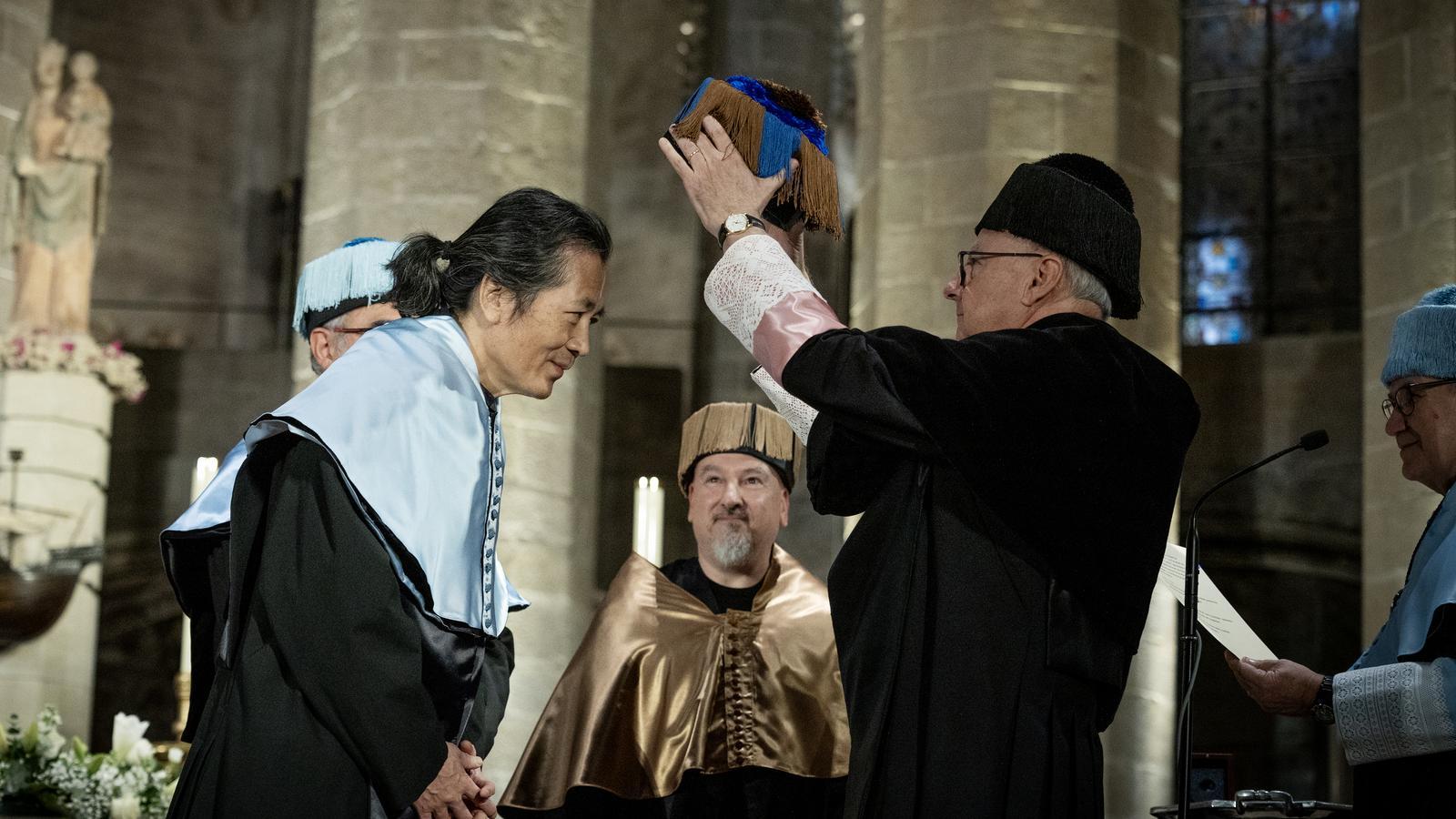
The South Korean philosopher has received the honorary doctorate from the Ramon Llull University in a ceremony at Santa Maria del Mar

-
CAT -
CAST
Before beginning his speech, Byung-Chul Han spent a good while looking at the image of the Virgin Mary that dominates the apse of Santa Maria del Mar. It did not seem like merely an artistic interest in the Gothic carving. “I am a Catholic and a devotee of the Virgin Mary,” he said right at the start. “In my church in Berlin, dedicated to Saint Matthias, there is an image of the Virgin with a sweet smile. My prayers are a tender dialogue with her, and many times I have asked her for words that I have later written.”
The South Korean thinker based in Germany is almost a kind of rock star of philosophy, with numerous followers and readers of books written in German and translated into several languages, the most recent of which is No Respect. A Social Crisis (Edicions 62, and Paidós in Spanish), in which he analyzes how neoliberal capitalism has driven many people into a frustrating and depressive individualism with the promise of freedom. He insisted on this again and again in the master class he gave after receiving, with the pomp and solemnity of these cases, the honoris causa doctorate—the first he has received—granted to him by the Ramon Llull University at the joint request of the School of Architecture and the La Salle-URL Faculty of Philosophy.
Precisely because it was a joint proposal, he said, he chose as his theme The Architecture of the Soul. “The soul has always needed architecture; they condition each other,” noted the philosopher, who then moved on to analyze the differences between the Greek, Buddhist, and Catholic temples based on the writings of the philosopher Martin Heidegger, to whom he had precisely dedicated his doctoral thesis. He did not say much about the Greek temple, which is open to the outside, but when he spoke about the Catholic temple, inspired by the Barcelona basilica, he elaborated. “I like this church very much because it generates a search upwards, towards the top, towards the sacred. And without this longing for verticality, without this eagerness to seek God, the soul is lost, destroyed,” he commented. For Han, both Gothic churches and Zen Buddhist temples, which incorporate a stone garden so that the interior also contains the exterior, are examples of architectures of the soul because they give it, he says, “a home where it can reside.”
In a constant metaphorical play between physical architecture and the architecture that sustains the human soul, Han has insisted on the importance of symbolism, narration, and rituals as anchors that allow for the generation of stability, both in stone constructions and those of flesh. Symbols and the repetition they imply allow for the creation of bonds and relationships with others, something that, he says, is being lost in contemporary society. “Without the architecture of the soul, we become homeless, because the soul is unprotected when it lacks symbolic anchoring,” he states. According to Han, “the soul of modernity is fragile and breaks,” because it is immersed in the continuous, unstable, and variable flow of information that has made us lose our relationship with people, with others, and from there, he says, stems the fact that we are a society that produces depressed and anxious individuals.
“We live in a horizontal world of information flow, but if we lose the vertical urge, we can no longer survive. Everything is placed on the same level, and that causes total indifference,” he says. Citing the etymology of the word freiheit, which in German means freedom and carries “the sense of being with friends, of being part of a community,” he has repeatedly recalled the danger of individualism, the way the culture of hatred spreads, and how, in his view, the lack of respect for others and this isolation are making us ill. “We are free when we have ties. We confuse them with chains, but these ties to others are bonds,” he assures.
In a seemingly disorganized speech, like his books, Han has vindicated common sense, empathy, and the willingness to put oneself in another’s shoes as values now disregarded that must be recovered. And, facing a society that promotes living in a permanent present looking only for one’s own pleasure, he has sung the praises of fidelity, commitment, responsibility, convictions, and the obligations involved in working for a long-term ideal. At the end, a long reference to a very popular book that exalts these values: The Little Prince,by Saint-Exupéry. “One sees clearly only with the heart. What is essential is invisible to the eyes,” says the fox. And thus, with this message, the lesson concluded.
