Marc Domènech: "Buying a painting is a way to involve yourself in your present"
Art historian and gallery owner

-
CAT -
CAST

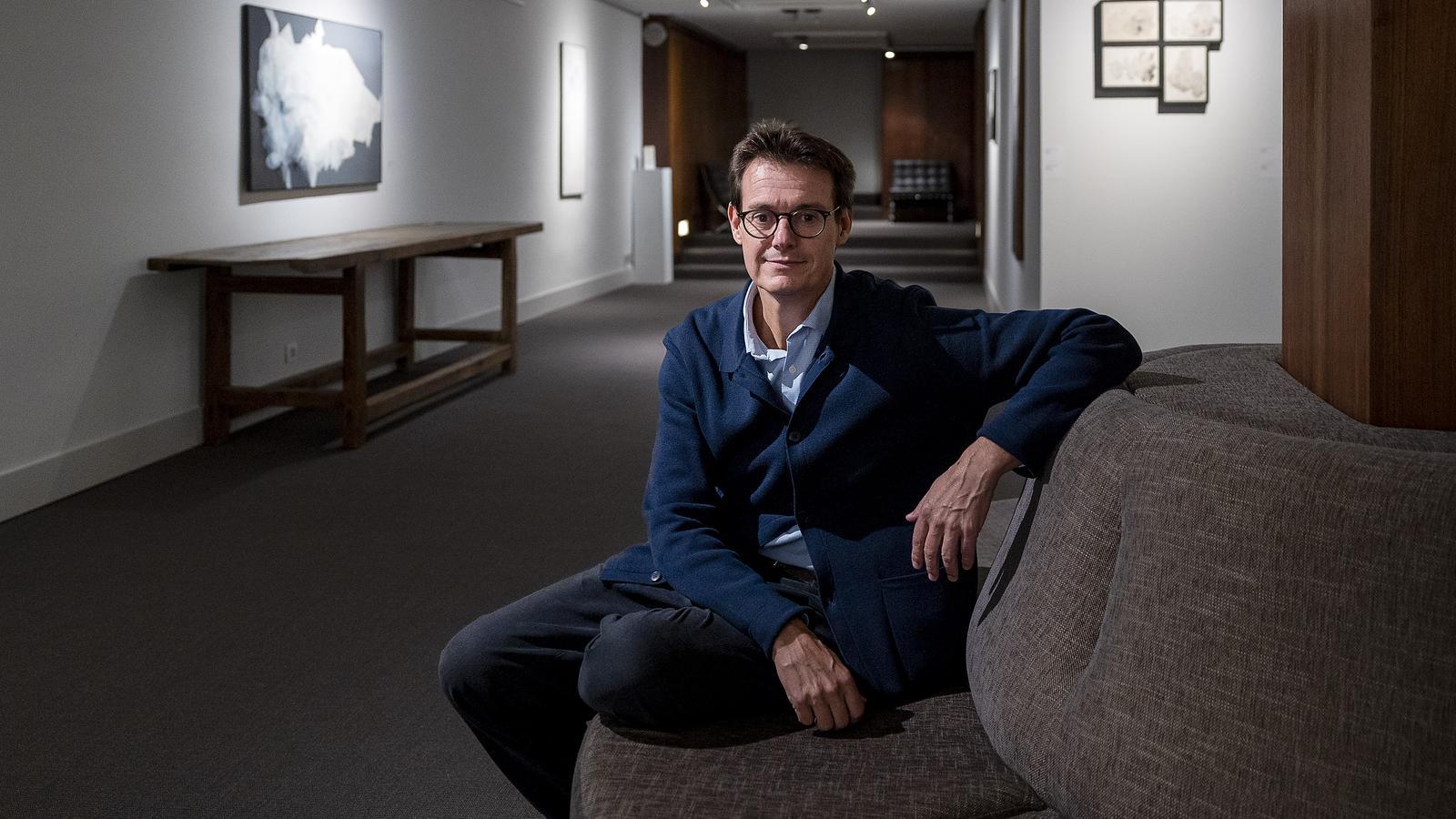
I think his profile picture must be a contemporary sculpture. Then I zoom in: it is the mountain wall of Siurana, in the Priorat, which he climbed years ago, and which looks like a human face in profile. It makes me laugh because Marc Domènech likes artists who work with organic forms, and at the gallery he directs (the Marc Domènech) it is not at all hard to imagine a painting of those that dissolve the line between humanity and nature. An art historian and second-generation gallery owner, Domènech has specialized in 20th-century art and works to recover artists who have remained on the margins of the great narratives.
Is it fashionable lately to have the walls of the house empty and white?
— It usually happens that, in houses where there are many empty walls, the bookshelves are also empty of books.
I like going to museums, but I doubt whether it is worth spending money on art.
— Of course, for God's sake! Incorporating art into your home broadens your perspective; life would be extremely boring without the creativity of artists. Buying a painting is a way to involve yourself in your present.
What kind of relationship should you have with your collection?
— It is a portrait of yourself: of what you believe and yearn for, but also of your contradictions. The good collector does not obsess over linearity or names and allows themselves to be discovered through the art they buy. And they are surprised: most collections are happily contradictory.
Is art a good investment?
— Never buy art based on economic criteria, buy because you are attracted to what you are looking at, because it identifies with you and provokes you at the same time.
How is an art bubble produced?
— When external agents use art as a mere asset. They detect a trendy name, inflate its prices and then the bubble bursts and it is discovered that the artist did not have real organic demand. This has ruined the careers of many artists.
Have you ever speculated with your artists?
— On the contrary: once I could have sold the entire stand I had of Esther Boix, and I stopped the sales because I detected these suspicious dynamics. What differentiates us gallery owners from art merchants is that when we bet on an artist, we do it because behind them there is a structured narrative that we will defend and promote regardless of the immediate market response. We start together from scratch, due to the fact that we have a conviction, but we do not know what will happen
The most expensive work you have sold?
— We contributed intensely to selling a Picasso that was worth 10 million euros. But that is very exceptional, at the gallery we sell works starting from 300 euros.
Any commercial failure?
— We held an exhibition of Jean Dubuffet and only sold one. And now the artist has tripled his valuation. I have done many exhibitions that have failed commercially, and over the years the author has appreciated to the point that the collectors who rejected works and now would like them can no longer afford them.
What should an artist who wants to sell a lot paint?
— Easy, orderly compositions with striking colors will always have more appeal to the general public. But one must be wary of what we like without any effort. In contemporary art, a beautiful thing does not necessarily have to be pretty: beauty comes from a work's capacity to stir you inside. In the long term, the artists who have been the most surprising and stimulating prevail.
Must we have faith and think that quality ends up prevailing?
— Art always wins. When there has been an authentic and personal commitment from an artist, it always ends up finding its way. Another matter is whether the artist or the gallery owner can make a living until that moment arrives.
What do you like most about this job?
— Recovering artists excluded from official criticism and museums. I am interested in investigating the causes of certain omissions, which almost never have to do with artistic quality.
An example?
— In Catalonia, many women who were at the top in the eighties, such as Magda Bolumar or Esther Boix, are displaced by spurious criteria. Institutional and corporate purchases of the era distort the market and create a mirage. I want to reconstruct the history of art by correcting these injustices.
What do you have in your dining room?
— A collage of works by 20th-century artists, both well-known and unknown. From a Will Faber greatly inspired by Paul Klee to a Dubuffet and a Le Corbusier. In general, I lean towards what is organic.
What do you feel when you look at this collage?
— When I need a push, I see people who dared to break the mold and did not settle. At the same time, I find serenity, beauty, and order there. The non-literal nature of visual art provokes you to make your own interpretation; paintings have an elasticity that allows them to adapt to your mood like no other artistic expression.
Talking to you about an artist has made me see things in her that connect me to her on every level. I can feel the tingles, but it makes me dizzy.
— I would suggest that you leave me a deposit and keep the painting at home for a few days. If you end up deciding, you can pay for it in full with a discount or pay the full price in installments.
