An unpublished self-portrait, a hidden mural and a recycled stage curtain: the secrets of Gaudí that have come to light
The first Gaudí International Congress, at La Pedrera, presents ten unknown drawings by the architect

-
CAT -
CAST
BarcelonaA century after the death of Antoni Gaudí, his work continues to raise questions. From October 22nd to the 25th, La Pedrera hosted the first International Gaudí Congress, featuring more than 40 unpublished research projects, ranging from construction techniques and conservation criteria to historical documentation and the contemporary reading of his legacy. The program also included presentations on the vegetal ornamentation of Palau Güell and the documentation of Gaudí's intervention at the Cathedral of Mallorca. These are three of the featured presentations:

Ten unpublished drawings by Gaudí
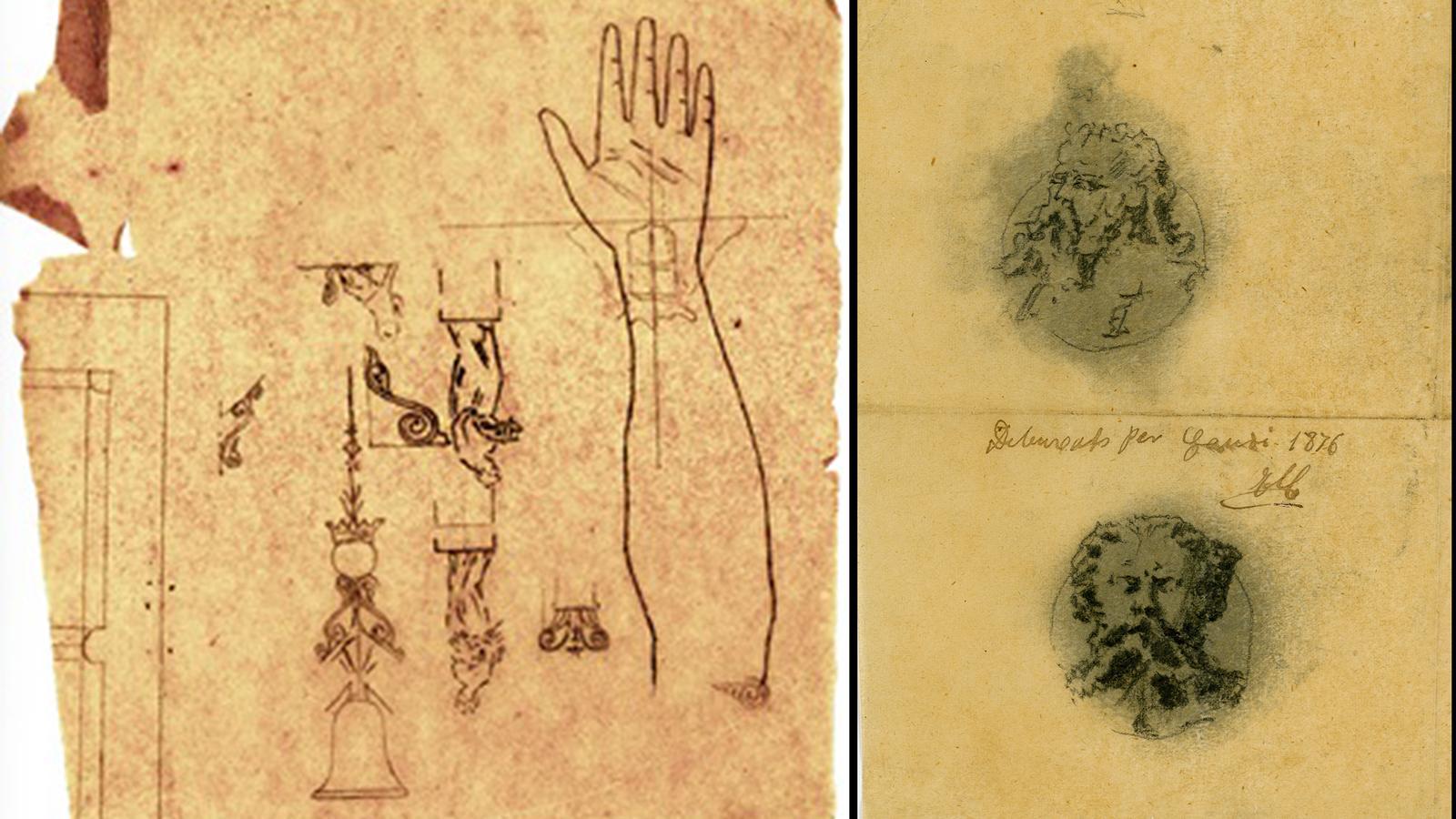
Antoni Gaudí never stopped drawing, but the burning of his workshop at the Sagrada Família in the summer of 1936 meant that only "a few dozen drawings" have been preserved, as one of his biographers, Josep Maria Tarragona, recalls, who presented ten unpublished drawings by the architect in one of the presentations at La Pedrera. The most outstanding piece is a self-portrait from the front and profile, and there is also a self-portrait of the left hand, the sketch of a siphon for a bleaching installation with a crane next to it, a metal structure that could be related to the Born Market or the Ciutadella water tank, and copies of Assyrian sculpture. As Tarragona points out, in these notes, dated between 1876 and 1879, one can already see "characteristic features of his architectural work," among which are the "ability to graphically synthesize both direct observation and the models studied" and "the continuous revision and reworking of one's own solutions during the design process."
The drawings are part of a folder of 37 that belonged to a fellow student of Gaudí, Emili Cabanyes i Rabassa (Mataró, 1850-1916), who went on to become the mayor of Mataró. In fact, Tarragona does not rule out that Gaudí collaborated "briefly" with Emili Cabanyes during his student stage on projects such as the rectification and expansion of the city of Mataró and the chapel of the Sacrament of the Basilica of Santa Maria de Mataró.
The folder has been passed down through inheritance from generation to generation, so the historical traceability is "clear," explains Tarragona, who has had the co-authorship of Francesc Xavier Jové. Furthermore, to ratify the attribution, he has compared the annotations in the drawings with "numbers, letters, and all the letters, syllables and words" of the Manuscrit de Reus, the only notebook of Gaudí's that has survived, dated between 1873 and 1879. Gaudí's relationship with Cabanyes began at the School of Architecture, and in Mataró it is documented with the laying of the first stone of La Obrera, on December 26, 1874. The last stage coincides with the crisis of this same cooperative, starting in July 1887. These dates correspond to the end of his studies and the beginning of his professional career. And, in the personal realm, Gaudí fell in love with Pepeta Moreu, who rejected him.
A hidden mural in La Pedrera is identified

Another of the most notable presentations was dedicated to the interpretation of a fragment of mural painting in the courtyard of La Pedrera, located under the metal canopy of the main staircase of Passeig de Gràcia. Before arriving at the detail, it is necessary to briefly recall the history of the mural: after an argument between Gaudí and Pere Milà, the direction of the pictorial decoration was led by Aleix Clapés, who had reproductions of fragments of various tapestries with mythological themes from the National Heritage collection painted, that is to say, motifs that can be considered outdated with respect to the boldness of the building. More specifically, in some of these murals there are stories reproduced taken from Metamorphoses, by Ovid, while in some others there are flowers.

The studies promoted by the Catalunya La Pedrera Foundation over the years have made it possible to identify the themes of all the preserved murals, but this one resisted. As can be seen in a photograph of the courtyard taken in 1914 and preserved in the Mas Archive, this detail was part of a larger painting that disappeared after the renovations that Rosario Segimon promoted a year after Gaudí's death. Finally, the interpretation of the fragment has been possible thanks to the collaboration agreement between the Catalunya La Pedrera Foundation and ICFO – The Institute of Photonic Sciences in Barcelona. The study carried out by researchers Georgios Magkanas and Pablo Loza Álvarez has made it possible to identify this mural as a reproduction of the tapestry The Capture of Carthago Nova, belonging to the series The History of Scipio, although only details of two soldiers are preserved, while a third is known from period photographs. "This discovery completes the catalog of scenes that decorate the lobbies and courtyards of La Pedrera and incorporates a new theme into its decorative program. Unlike the mythological motifs present in the rest of the mural sets, this is the only historical scene of a warlike nature documented so far in the building," state sources from the foundation.

The identification has been possible through the application of the image processing technique Contrast Limited Adaptive Histogram Equalization (CLAHE) on historical and current photographs. "The systematic comparison of the enhanced images with the collection of tapestries that Aleix Clapés knew and consulted has allowed for the confirmation of the correspondence between the mural and the original tapestry," the same sources say.
In their study, Magkanas and Loza Álvarez also point out that the choice of the war theme is due, as Carlos Lupercio pointed out in 2013, to the fact that Clapés chose the fragments of the tapestries "for their visual impact or for how they fit the architectural framework." "The thematic break is compatible with a predominantly decorative criterion, and the possible common thread would be the tapestry plates that Clapés had. The question remains open," the researchers note.

Josep Maria Jujol, Gaudí, and the tapestries of the Floral Games
The congress also included developments related to the collaboration between Gaudí and Josep Maria Jujol. Specifically, regarding the tapestries that Gaudí commissioned from Jujol for the 1907 Jocs Florals ceremony. The archivists of the COAC's Jujol Archive, Ignasi Pagès and Mònica Sans, have discovered, thanks to a previously unpublished drawing, that five years later Jujol reused them as part of the set design for a performance of Philoctetes at the Casa de Família theater, a shelter for 50 homeless people that Father Josep Pedragosa installed in the now-defunct convent of the Monges Mínimes on Carrer del Carme in Barcelona.
ARA detailed for the first time the interventions that Jujol carried out there and now Pagès and Sans have been able to observe that Jujol, probably with Gaudí's knowledge, used the three tapestries, dedicated to the mottos of the Jocs Florals—faith, love, and homeland—to create the backdrop for the stage. Furthermore, the previously unpublished drawing allows for a more detailed view of how Jujol represented the mouth of the cave where Philoctetes lives in misery at the beginning of the play. "The reuse of the Jocs Florals tapestries has four advantages: zero cost, as they were existing elements; large dimensions, covering 32 m2 of the stage background; mobility, facilitating dismantling during periods of inactivity; and theatrical effectiveness, thanks to the colors and motifs represented," state Pagès and Sans in their presentation.
"This culture of resourcefulness was part of the society in which Jujol lived. The distinguishing factor is that he bestowed artistic quality upon these reuses and transgressed the nature of the materials," the architects explain. And there is even more: "Additionally, the lower part of the drawing includes two superimposed designs of Park Güell: a circular collage of the hypostyle hall ceiling and one of the trencadís motifs that line the exterior of the bench. A single document, therefore, captures the graphic testimony of three projects: the Jocs Florals, Park Güell, and the Casa de Família," they note.
The three tapestries came to light again in 2016 when the architect's son, Josep Maria Jujol Jr., brought them to the Museu Nacional d'Art de Catalunya, before donating them along with his sister Teresa. The one dedicated to Faith was displayed, restored, in the great exhibition that the museum dedicated to Gaudí in 2021, and all three will be on display in the exhibition dedicated to Jujol in December.
