All of Bad Bunny in one song: being the king of pop making reggaeton and dembow (and salsa)
The Puerto Rican musician begins in Barcelona the European tour of the album 'Debí tirar más fotos'
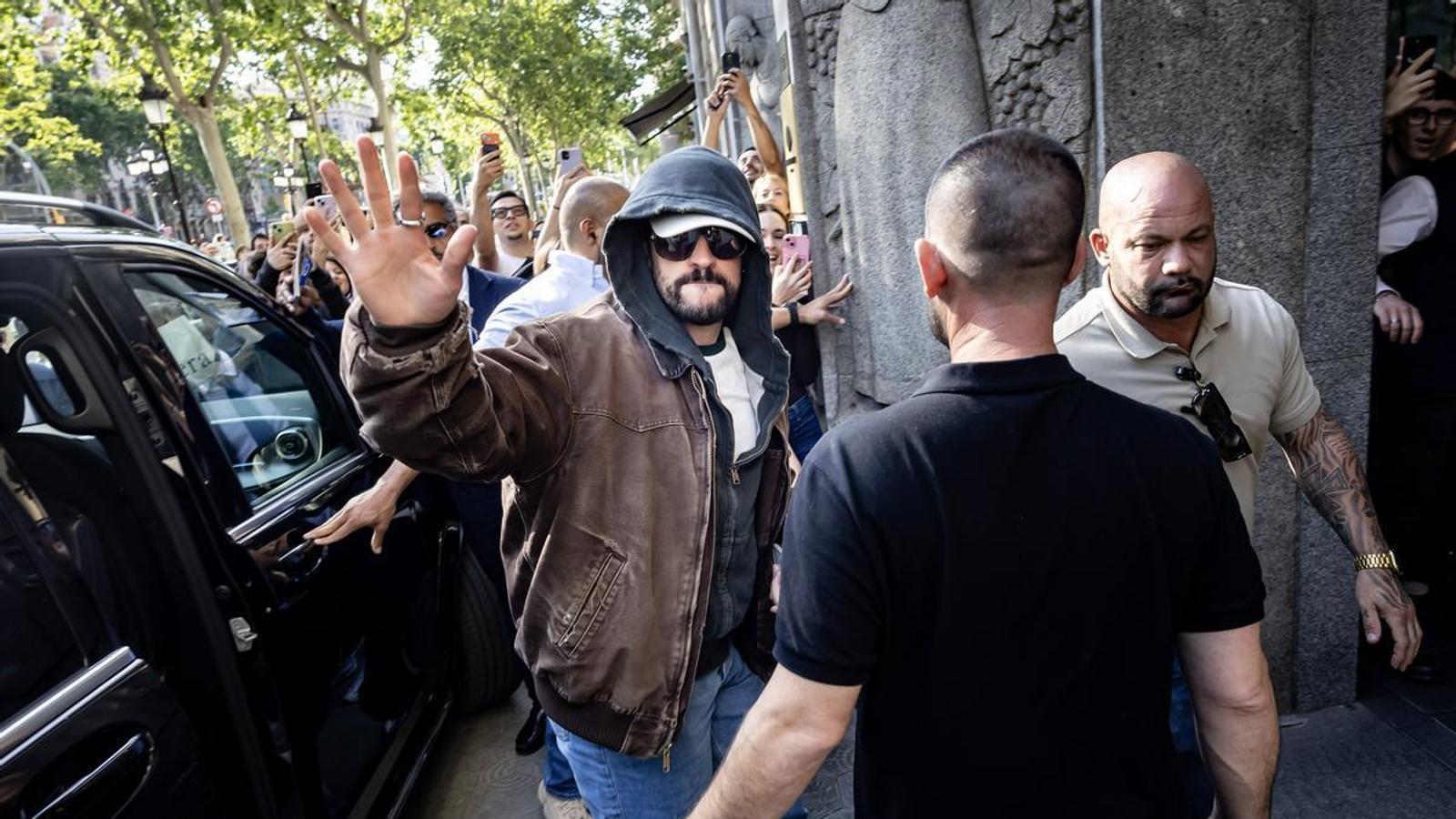

-
CAT -
CAST
BarcelonaBad Bunny can be explained with a single song. It's all there in Nuevayol, the track that opens Debí tirar más fotos (2025), the album that took the Puerto Rican artist to perform at the Super Bowl and to do the tour that goes ¿Cómo Bad Bunny va a ser rey del pop, ey / con reggaetón y dembow?" Well, he is. And with Nuevayol you can dance reggaeton, dembow, and salsa all at once without changing your shoes.
Bad Bunny is a star who masters many expressive tools and carries the flow you can dance reggaeton, dembow and salsa at the same time without changing your shoes.
sonero mayor Ismael Rivera, the singer of singers Héctor Lavoe, or the wonderful Ismael Miranda, the pretty boy of salsa. Superlatives are not superfluous when talking about these vocalists. However, Bad Bunny is intelligent enough not to shy away from engaging with this tradition. He does so vicariously with a sample from the song Un verano en Nueva York, by Gran Combo de Puerto Rico, one of the emblematic groups of Puerto Rican popular music. The voice heard at the beginning of Nuevayol is that of Andy Montañez, vocalist for Gran Combo until 1977.
This is not the first time Bad Bunny has connected with the island's musical past, but until the album Debí tirar más fotos he had not done so with such an intention to tie himself to a tradition; one of the most relevant precedents, but not the only one, was the communion between the reggaeton of Puerto Rican Tego Calderón (a benchmark for Bad Bunny) and the salsa of Venezuelan Óscar D'León in 2006, and later collaborations such as Maluma with Marc Anthony. Bad Bunny has done this precisely when urban music had long needed a shake-up and when musicians from other traditions were beginning to look at reggaeton with less reluctance.
The trombone and baseball
The choice of A Summer in New York, originally from 1975, has more readings. It is part of the era in which the Gran Combo, directed by Rafael Ithier, had already introduced the trombone in the brass section. The trombone had been one of the instruments that had given its own personality to urban salsa made in New York and sheltered by the Fania label, especially thanks to the arrangements of Willie Colón, the man who made history with Héctor Lavoe and Rubén Blades. And Willie Colón, who died in February of this year, represents several important things for Bad Bunny. As César Miguel Rondón explains in the essential El libro de la salsa. Crónica de la música del Caribe urbanoWillie Colón, who died in February this year well-made". This is an appreciation that works with other music that emerged as an expression of youthful anxieties and desires in subaltern sociocultural environments, such as punk, reggae, and reggaeton.
Willie Colón was one of the Puerto Ricans from the Bronx who stirred up salsa in Spanish in the heart of "the Yankee beast"; in fact, he was one of the promoters of urban music rooted in the Caribbean but created in the streets of New York. That cultural context is a background landscape in Bad Bunny's songs, even though he, like Residente, creates more from Puerto Rico. "I will always write about Puerto Rico," he says, as collected in the book Bad Bunny y la música como acto de resistencia (Libros Cúpula, 2026), by Vanessa Díaz and Petra R. Rivera-Rideau.
Willie Colón, "the bad guy", as Bad Bunny recalls in Nuevayol, also represents the youthful hustler fascinated by the delinquent fetishism that in the late sixties and early seventies gave urban salsa its own aesthetic, in parallel to what African American artists were doing in the United States, for example with blaxploitation cinema, and Jamaicans in the Caribbean with ska and reggae. Bad Bunny flirts with this bad boy image, but far from the streetwise cunning of salseros, the gang fatalism of Jamaicans, and the swaggering belligerence of other reggaeton totems. He is a bad boy who flows and who, instead of crossing the street with his fist clenched inside his coat, strolls through the VIP area of the Coachella Festival.
There is still another detail in Nuevayol that connects past and present cultures: baseball, the most popular sport among the Latin community of New York and the Caribbean. Bad Bunny quotes Juan Soto, the Dominican player for the New York Mets (and formerly the Yankees), in the same way that the Panamanian Rubén Blades featured a baseball bat in Decisiones, from the album Buscando América (1984). By the way, it is surely an unconscious and inconsequential coincidence, but both in Decisiones and in Nuevayol James Bond appears, an icon that transcends generations.

Puerto Rico and Pan-Americanism
Rubén Blades was one of the references that Bad Bunny honored in the memorable performance at the Super Bowl with the parade of flags from American countries, a nod to the pan-American and anti-racist call made by the Panamanian musician at the end of the song Plástico, from the album Siembra (1978), with Willie Colón. However, despite what he did at the Super Bowl and despite being the Latin American hero who triumphs in North America singing in Spanish, he prioritizes the vindication of Puerto Rican identity, almost always in a conflictive relationship with the United States, more than the pan-Latin American vindication that Blades and the Puerto Rican Residente do advocate for (for example in the song the song This is not America).
Bad Bunny's fight is more local, but it is not difficult for it to be shared by people from other countries, despite the nuances derived from being from an island that is a free associated state of the United States (neither a state of the United States nor a fully sovereign state), where, despite having US citizenship, residents cannot vote in presidential elections. He speaks of the grievances, neglect, and predation that the island suffers, both from the local government and from Washington. He speaks about it mainly in Lo que le pasó a Hawaii. Bad Bunny also reflects the complexity of being a US citizen of Puerto Rican origin. As such, he does not have the problems that migrants from other countries have to face, but, aware of the anti-immigration raids launched by Donald Trump, he has excluded the United States from the tour, precisely to avoid the detention of migrants who might attend the concerts.
Linguistically, it champions a hegemonic language in most of the American continent, whose political and administrative use has contributed to the decline or disappearance of indigenous languages, but which at the same time is a language that suffers various underestimations in the United Statesa language that carries various underestimations in the United StatesBad Bunny is not defending a language in danger, that's evident, but in the context of the US music market, the decision to continue without singing in English has broken a dynamic. It's enough to remember that artists like Shakira released albums in Spanish and English versions to try to conquer the English-speaking market. Bad Bunny, like Rosalía, hasn't needed to. On another scale, because it is indeed a minority language, it would be like artists who have not renounced Catalan to be able to perform outside of Catalan Countries.
The dembow territory
In Nuevayol, the sample of Un verano en Nueva York, with the rhythmic key of salsa and the push of brass, coexists with electronic drums that announce rhythmic patterns of 21st-century urban music, specifically dembow, of Dominican origin like Marcos Borrero, producer of a large part of the album Debí tirar más fotos (the rapper El Lápiz Conciente, whose name appears in the lyrics of Nuevayol, is also Dominican). It is here, in the dembow territory, where the song unfolds like a genuinely badbunniesque artifact. The lyrics also change. From the rhyme "primor / York" with well-marked Rs, it moves to the liquid consonants characteristic of the Puerto Rican accent that Bad Bunny reinforces, and each stanza finds a different sonority. It's not quite like the structure of salsa, because it doesn't follow the intro-theme-montuno-mambo-ending circle, but it does have a scent of it. Just as soneros take advantage of the montuno to say their piece, Bad Bunny takes advantage of the central verses to explain himself, but with a voracity more typical of hip-hop.In the first verse, he boasts of being a star: the years go by and he continues to sell records like "Frida Kahlo paintings" (always Latin American references). As Héctor Lavoe did, he suddenly goes from vanity to humility to introduce a warning message about drugs, first ambiguous (purely descriptive) and then more direct, or so it seems: "El perico es blanco, sí, sí / El tusi rosita, eh, eh / No te confunda', no, no / Mejor evita, ey
". If he's going to get drunk, he says, it's better to feel closer to Puerto Rico by having a little glass of rum The parrot is white, yes, yes / The pink tusi, eh, eh / Don't let yourself be fooled, no, no / Better avoid it, heyFinally, Nuevayol closes by recovering the heart of the Gran Combo before delving into a coda that seems disconnected from the song, but which makes sense within the fragmentary dynamic of urban music and which functions as the final paragraph of a love letter to New York, specifically to the Nuyorican city, that of the Puerto Ricans. "You are hot, I am hot too", he sings. It's Bad Bunny and self-confidence, not necessarily sexual, but that interpretation could be accepted. In any case, it is a final proclamation of the pride of being who he is while transmitting it with empathy, surely one of the keys to Bad Bunny's success. The king of pop making reggaeton and dembow (and salsa).

