Philippe Aghion: "In Europe we have prevented industrial policy and now we are paying for it very dearly"
Economist and professor at Collège de France, Insead and London School of Economics and winner of the 2025 Nobel Prize in Economics

-
CAT -
CAST
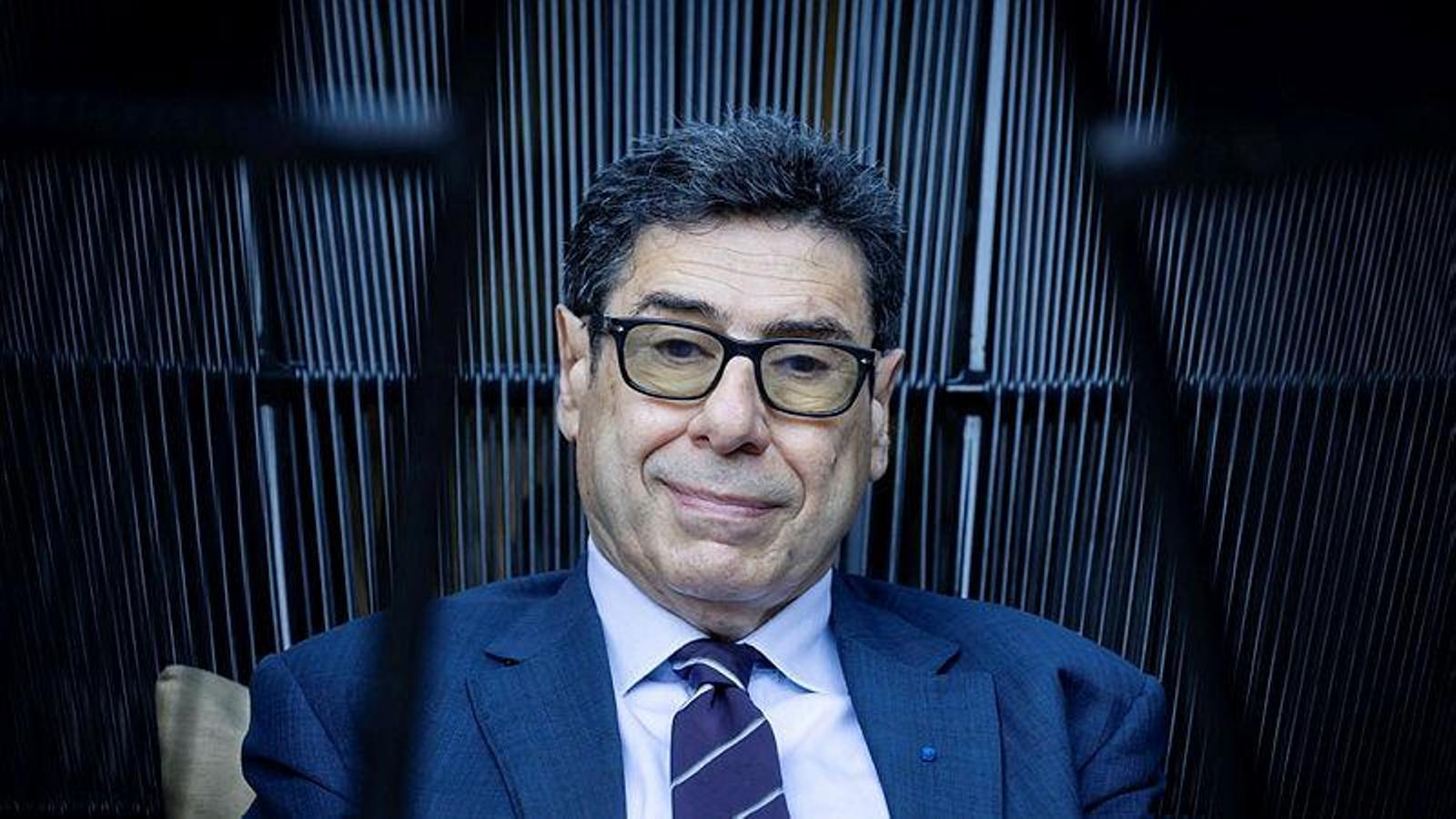
BarcelonaPhilippe Aghion (Paris, 1956) won last year the Nobel Prize in Economics for his research on the impact of technology and innovation on economic development. Aghion, a professor at the prestigious Collège de France, Insead, and London School of Economics, currently focuses his work on the role of artificial intelligence (AI) in growth and how Europe can improve its policies to reduce dependence on Chinese and American tech giants.
Aghion has attended the Empreses in Barcelona, where he was invited by the Catalan Foundation for Research and Innovation (FCRI) and the Barcelona Knowledge Hub of the Academia Europaea, and was awarded the European Hipatia Science Prize by the Barcelona City Council.
Last year he received the Nobel Prize for his work researching the impact of technology on economic development and the concept of creative destruction. What does this research consist of?
— It talks a lot about competition policies in Europe. Compared to the United States, do we in Europe have a better competition policy?
It talks a lot about competition policies in Europe. Compared to the United States, do we in Europe have better competition policy?
— Is competition policy the only problem for innovation in Europe?
Is competition policy the only problem for innovation in Europe?
— Does Europe have an advantage compared to the US and China?
Does Europe have any advantage compared to the USA and China?
— Yes. First of all, we have values: democracy and freedom. We have a social model that is much better than that of the USA. This will be very important with AI, because AI will destroy jobs and, in fact, it already destroys them. But it also creates them: companies that adopt AI become more productive. Consequently, there is greater demand for their products and, therefore, they hire more staff. Thus, a system is needed that facilitates the transition from one job to another. Danes have the flexicurity system: you lose your job, you receive 90% of your salary for two years, the state trains you and helps you find a new job. In the rest of Europe we don't have exactly that, but we are quite close compared to North Americans, who have absolutely nothing. Therefore, we have democracy and freedom, a social model and an environmental model. We are much better environmentally than Americans, and that is good.

Is European science up to scratch?
— When talking about the EU, it is said that it regulates too much. Is this true?
When talking about the EU, it is said that it regulates too much. Is this true?
— The EU is a regulatory giant and a budgetary dwarf, because it was made to prevent Germans and French from fighting. Many laws were needed, but this is not good for disruptive innovation.
Is there an AI bubble?
— What is a bubble? Many projects emerge, but there comes a time when some projects start to fail. This bursts the bubble, but it's not a tragedy. The 2008 financial crisis was not caused by the internet bubble; it was caused by subprimes, debt. One must be careful with debt, obviously, but I am not afraid of the effects of a bubble and I do not see the AI bubble bursting in the short term, because I still see a lot of development in it.
Are we in Europe afraid of the North American giants driving AI?
— Yes. However, the Chinese have been able to make a cheaper equivalent to ChatGPT. Therefore, we have possibilities. We simply have to invest, it is necessary for the EU member states that are serious about their budgets to step forward and European debt should be issued, as was done with covid, to finance AI gigafactories. AI is data and computing power. We have a lot of data; what we lack is computing power.

This implies public and private investments.
— It is so. A European DARPA would be needed, which unites public and private capital, but since industrial policy was not authorized in Europe, it could not be done.
How is industrial policy authorized if in Europe it is, above all, a state policy?
— Not necessarily with all European countries, but with a coalition of volunteers.
In Catalonia, there is much talk now of industrial policy and how it relates to productivity, because we have a productivity gap with the rest of Europe and the USA.
— There is a productivity gap between Europe and the US. We caught up with American productivity between 1945 and the late eighties. Since then, we have been declining because they made the information technology revolution and we were unable to integrate it fully, because they have this ecosystem. But Barcelona is a hub of knowledge, a very leading place, one of the most dynamic in Europe. It is evident that Barcelona and Catalonia will play a very important role in the European technological recovery.
Really?
— Yes, I've been impressed. By everything that is being done, but also by the people in charge of research in Barcelona and throughout Catalonia. You have everything you need to be at the forefront of this recovery.
He has discussed a lot about taxation with his colleague Gabriel Zucman, who has studied wealth concentration a lot.
— Perhaps because he has debated with Zucman, it is said that he is left-wing and you are more liberal.
Perhaps because he debated with Zucman, it is said that he is left-wing and you are more liberal.
— I am a social democrat. Zucman is a friend. It is not a left-right debate, but within the left. In my youth I was a communist and I have always been obsessed with poverty. I believe in inclusive growth. I think school should be of good quality for everyone. I believe in social mobility through school. I strongly believe in social dialogue, in the fact that unions play a very important role. And I strongly believe in the need for progressive taxation, but without it discouraging innovation. My difference with Zucman is that, according to him, there are no companies or innovation. In my world, on the other hand, I think you cannot distribute what is not produced. For me, the concentration of wealth can become a problem and this is where taxation comes in, but also competition policy, to ensure that large established companies do not hinder the arrival of new players, because the arrival of new talents is a source of social mobility.
He usually says he is optimistic.
— Yes, but a fighter optimist. As long as there are things to do, one must try.
Are you also optimistic about industrial policy from a purely political standpoint?
— It is very complicated. For example, in France we try to make planes with the Germans and the multinational Dassault prevents it. This way we are not going anywhere. At this point, governments should square up to companies and tell them: "We are sorry, but we will move forward with this".
Does Europe catch up with the US and China technologically?
— Do you see a future where the US can move closer to a social model similar to the European one?
Do you see in the future that the US can approach a social model similar to the European one?
— I don't see it immediately, because they are falling into populism. Since they don't have a good social model to protect the weakest, they point to external culprits, such as immigrants or other countries. This is often what happens when a system fails to properly protect its citizens from economic cycles, globalization, or the negative effects of technological change. They are not going through a good time.
This danger also exists in Europe.
— Populism is people who feel abandoned. I think this is important, and I think Macron has done good things, but he has also made mistakes, like ignoring social dialogue. You cannot reform against the unions, you have to be with the people. Sometimes, to go faster, it is thought that social dialogue can be dispensed with. This fuels populism.
