The Nobel laureate Philippe Aghion assures that AI will bring one percentage point each year to productivity
The economist denies that automation has destroyed jobs and warns against the "over-regulation" of technology

-
CAT -
CAST
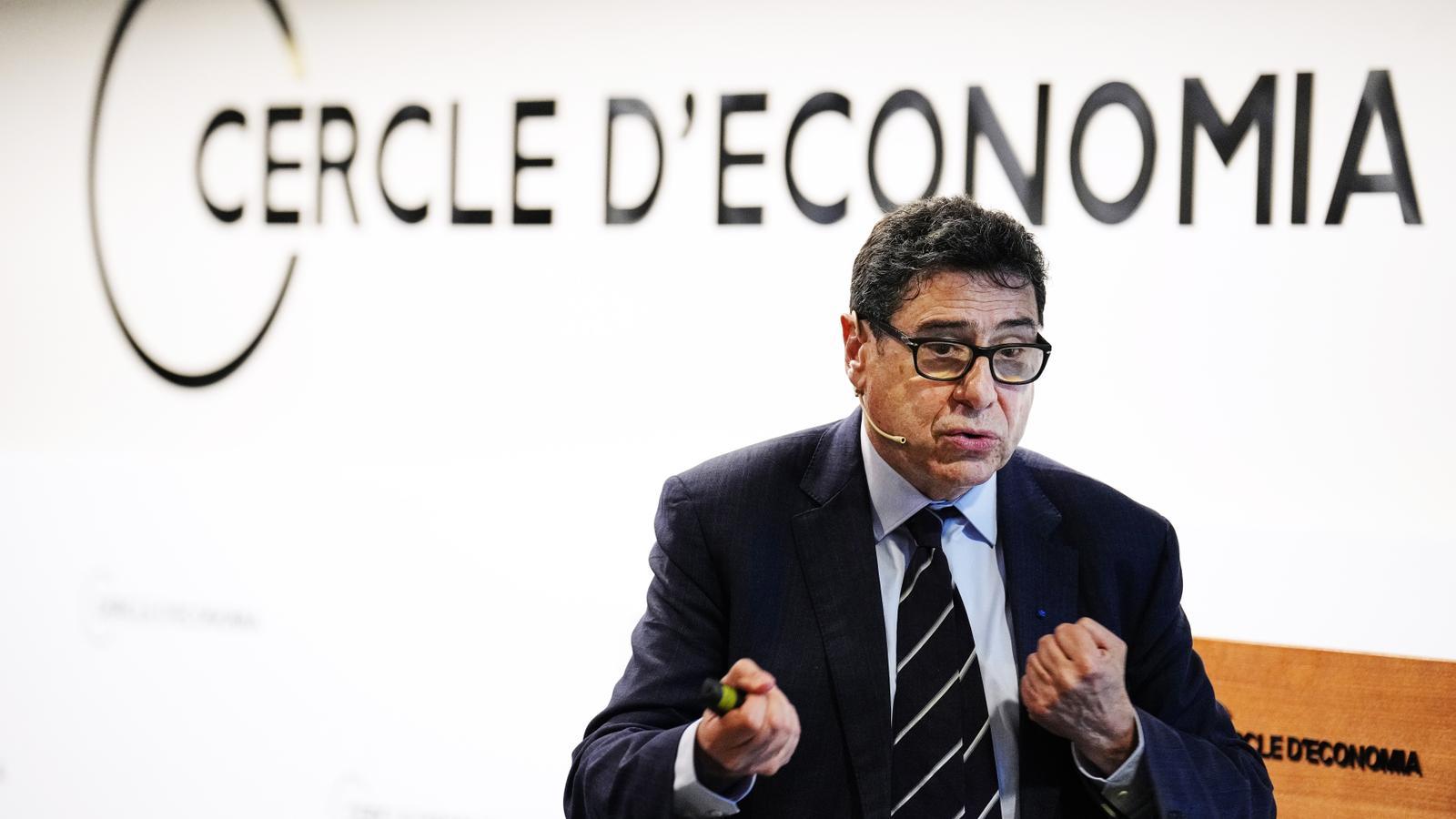
BarcelonaThe winner of the 2025 Nobel Prize in Economics, Philippe Aghion, has championed from Barcelona the effects of artificial intelligence on the economy. According to the expert's calculations, AI can add more than one percentage point to total productivity over a decade. The new contributions, however, are conditional on countries' ability to "build the right institutions" to regulate and promote it. "AI has great potential, but we need to adapt our policies to take advantage of it," he argued at a conference held this Tuesday at the headquarters of the Cercle d'Economia.
Aghion won the main award in the economic world along with Joel Mokyr and Peter Howitt for their work "explaining economic growth caused by innovation". During his speech, he advocated for an "optimistic" view of the effects of artificial intelligence on the economy as a whole. Against the more critical voices, who point to "scarce economic potential and negative effects on the labor market," the French economist sees application in practically all areas. The changes for the better, moreover, would be "permanent": AI's innovative contributions to economic activity would continue to make positive contributions of 0.3 percentage points annually to productivity even beyond the first 10 years.
The contributions of AI are so clear in the Nobel laureate's opinion that he even foresees positive effects for the labor market. Far from the labor alarms raised by figures in the sector, such as OpenAI founder Sam Altman, Aghion maintains that the irruption of this technology in production processes already has a "slightly positive effect" on the number of workers. The calculation, it should be noted, is in aggregate terms: the expert acknowledges that "jobs have been destroyed" by task automation; but he points out that "many more will be created" by the increase in productivity he anticipates in the immediate future.
Excessive regulation
In line with most economic institutions, and despite general optimism about AI, Aghion warns that the European Union is in clear "decline" compared to other global powers. "Not only in productivity, but also in innovation," he lamented, despite the good pace maintained by community economies in basic scientific activity. Firstly, he points to "over-regulation" as one of the major problems for the Twenty-Seven: while he is in favor of regulation that sets the limits of technology, he believes that Europe has a "regulatory millefeuille" that does not allow technological advancement. The European Commission's first attempt to establish a legal framework for action, the AI Act of 2024, "goes too far". the AI Act of 2024, "goes too far". Against this vision, the French economist advocates for "active industrial policies" that offer incentives, not limits, to technology companies to innovate, and to do so in Europe. Without a system that moves in this direction, with direct public aid to companies that can deploy AI on the continent, the main players could opt to take production to countries where "there is no regulation".
"Local computing"
A more lax legislation for technology companies, however, is only one of the needs that Aghion identifies to found a sovereign Europe in AI. He also calls for a decisive commitment to infrastructure: "AI needs computing power, and industrial policy must serve to build data centers". He also considers a "European cloud" essential to act outside the three major players in cloud computing: Google, Amazon and Microsoft. He actually considers the excessive concentration of market power in a few North American players a problem for the development of artificial intelligence, and calls to "foster competition" among companies to boost the industry.
Beyond data centers, Aghion detects a significant gap that hinders European innovative capacity in the field of AI: capital. The Nobel laureate argues that "there is not enough venture capital" to accelerate emerging companies with artificial intelligence products with market potential. The solution, in his opinion, is pension funds, among other actors; which must be pushed to focus their activity on the local ecosystem and not to relocate investment to the United States. "Strong incentives are needed for European savings to stay in Europe", he concluded.
