Ezequiel Giró: "Everyone uses us and nobody knows us"
President of Giró Group
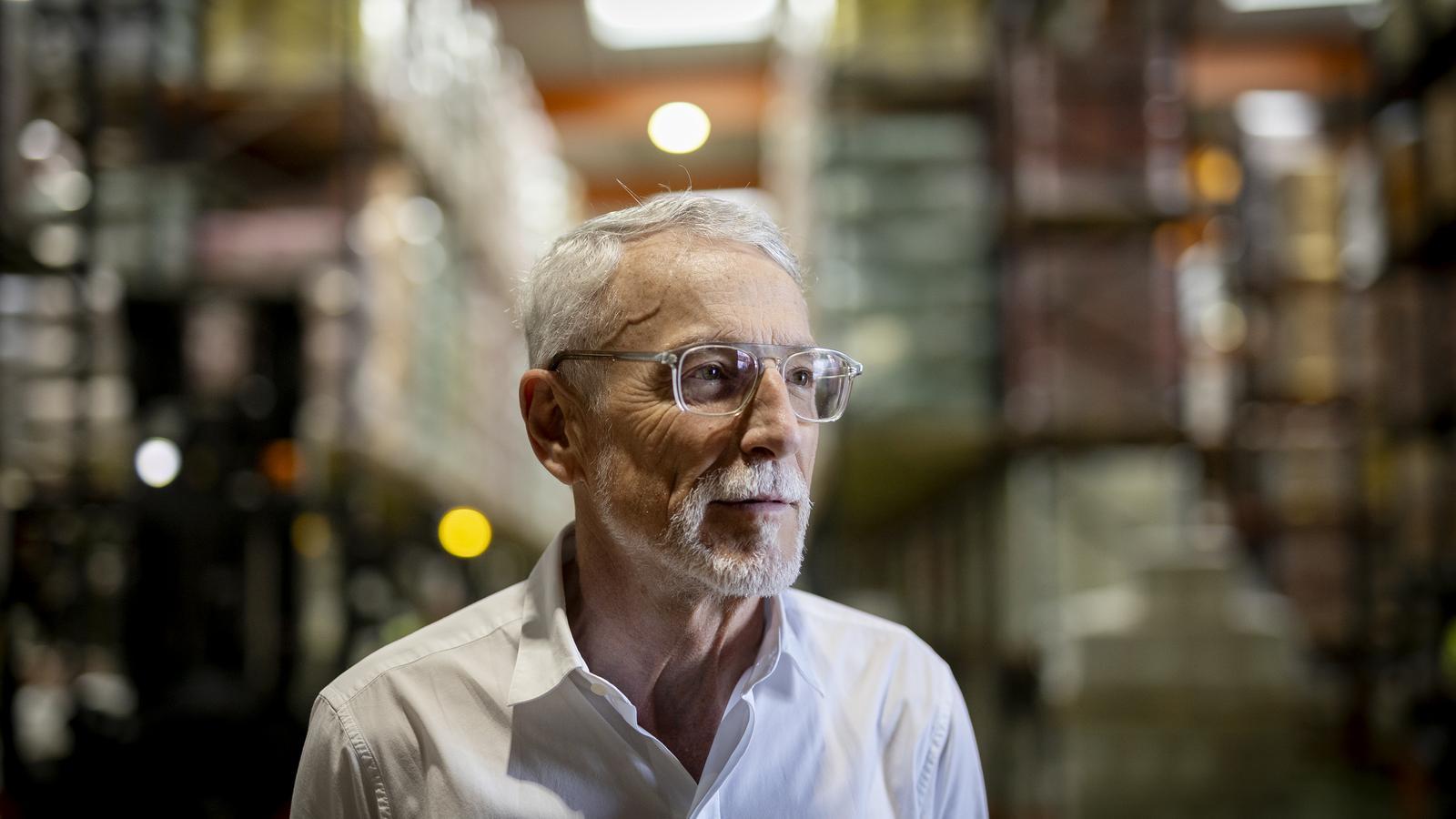

BarcelonaEzequiel (Zequi) Giró, president of Grup Giró, shares the same name as his grandfather, the company's founder, and his father. Around four out of every ten fruit and vegetable mesh containers worldwide have come from the factories of this family business from Badalona, which celebrated its first century last year. With its annual mesh production, one could travel more than 36 times around the Earth or go to the Moon and back almost twice. Production will increase from the end of next year, when a plant in Morocco, which will be the sixth, plus two more for machinery, will begin operating, with an investment of 20 million. This year, the group is looking towards 200 million in turnover, after closing 2025 with consolidated sales of 190 million and an operating result of 25 million, explain at the company's central headquarters in Badalona, Giró and his nephew, Àlex Rivière Giró, who is the CEO.
If you had to define the company in a few words, how would you define it?
— Ezequiel Giró: We provide solutions to the fruit and vegetable sector. They are technical solutions. We were born as a textile company with my grandfather.
It's a centuries-old story, isn't it?
— E.G.: The great-grandfather is not counted. He made Manila shawls, carpets, clothes, textiles. In 1925, my grandfather set up on his own. For a couple of years he worked with his brother. He continued to make some clothing items, but basically dedicated himself to making technical applications of textiles. At that time there was a very powerful textile industry in Catalonia. And it provided services and applications for textile factories.
And when was the business reorientation?
— E.G.: The grandfather already made mesh, which is practically the same as what is used today, but it was a technical application within the textile world. To dye the skeins of yarn, they wrapped them in a mesh so they wouldn't get tangled. And this was the mesh.
And then...
— E.G.: In 1952, the company passed to my grandfather's sons, who were six brothers. And in '59, the mesh for packaging was made for the first time... In fact, the origin was Mr. Matutano's potatoes, who later became very famous for potato chips. And now, 99% of what we do is around the packaging of fruit and vegetables.

What can we know about last year's results?
— Àlex Rivière: Sales of 187 million euros, but the consolidated figure is 190 million and an EBITDA of 25 million.
So, the 200 million are within reach, right?
— A.R.: The 200 million is within reach, yes. In addition to packaging, which generates a lot of volume but little value, we sell machinery and automation.
Do they have a strategic plan?
— E.G.: Yes. Looking three years ahead. In any case, forecasts are increasingly short-term, because of how the world is...
And what forecasts does it include?
— A.R.: We foresee growth because we have business lines in which we trust and are sure will grow a lot, such as automation, and also because we are making significant industrial investments to expand our production capacity, which will lead to growth.
How much do they allocate to investments and in what?
— E.G.: It depends on the years, but it's an average of 10 million per year.
And what does he/she/it do, basically?
— A.R.: We now have a very large industrial investment project. We are building a plant in Morocco. And this will be our sixth mesh factory, along with those in Badalona, Ripoll, Teruel, and the United States. Then we have two more for machinery and printed materials [the labels for the containers].
When is the Morocco plant scheduled to operate?
— A.R.: The fourth quarter of 2027. It will be a mesh factory to supply the Mexican and North American market.
From Morocco?
— A.R.: Yes. We have a factory in the United States, which is our number one market, and in Mexico. They are the fastest-growing markets. We have a production unit in the USA, in the state of Georgia, in Vidalia, but we have found it more convenient to grow industrially in Morocco, which offers us certain advantages, such as sending materials from here.
How much will they invest and what characteristics will the plant have?
— A.R.: We will make a total investment of around 20 million euros. This will be over the next few years. The idea is to reach the production of 300 million more meters of mesh per year. It is a plot of 20,000 square meters, on which we will build a factory in two phases that reaches 16,000. We will employ about 100 people there.
I believe the word internationalization has not been foreign to them for years, right?
— E.G.: From the 60s. Since we started making fleece netting for packaging with my father, right away to Germany, Sweden, Switzerland, at that time the richest countries, the export began and life has been like that ever since. The difference with my period is that we started to establish subsidiaries. Before we worked with distributors and from the 90s onwards we established the United States subsidiary, we did the one in Mexico, the one in Germany, the one in Italy. In the most important markets we considered that we had to be there directly.
What proportion of total sales goes abroad?
— E.G.: 70%. This is direct. It should be taken into account that a very important part of what we sell here goes to Europe, because most of our clients here are exporters, who are the ones who sell citrus fruits to Germany, England, France.
And who are its clients?
— A.R.: Our client is the supplier of fruit or vegetables to large supermarkets.
To grow these years have they had to make acquisitions?
— E.G.: We have made several. 2022 was the last. In the 90s we bought a factory in France, which was a competitor; around 2000 we bought a machinery factory and in 2022, Serfruit, which is dedicated to the automation of industrial plants.
Now they are very focused on automation, aren't they?
— A.R.: Correct. One of our future growth sources is automation, through Serfruit, this company we bought, which was very strong in the national territory, and integrating it with Giró has made its offering reach the whole world. And now we are doing automation projects in Germany, Italy, and the United States.
But what kind of automation?
— A.R.: The automation of the process of treating fruit and vegetables when they arrive at the packaging plants. What we do is offer this service of both engineering and application.
— E.G.: The entire installation is designed. There is a part that we manufacture ourselves and another that is subcontracted, and then the entire installation is supplied to the client. There is the design part, the industrial implementation part, the very powerful IT systems part, precisely to control this entire installation and so that the client has control at all times of what is happening and what they are doing.
Have you ever considered the stock market?
— E.G.: No, because we haven't needed it until now. We have been able to face all the investment, either with our own resources or with debt. We have a healthy financial situation and that means that when we go to the bank to ask for money, we don't have a problem.

And the capital is 100% family-owned?
— A.R.: We are now in the third and fourth generation. Currently, we are 28 individual shareholders, although, logically, there are corporate instruments in between, but today there are 28 people who own shares. The majority of the shares are in the hands of the third generation, but there are already many members of the fourth generation who also have shares.
They have mechanisms, such as the family council and others, so that not all relatives have to be managers just because they are, right?
— E.G.: In our case, since the 90s, family members cannot work at the company. In my case, a cousin and a brother of mine were exempt from the rule because we were already in. For Àlex as CEO, an exception had to be made and the board of shareholders accepted it because we also like that, at least, there is one person from the family.
— A.R.: That the maximum responsible for the organization is from the family is something that we value. We have a very professional management team. What we do maintain is that the position of president or CEO are members of the family. And there is a board of directors in which we do have external members, but the majority is occupied by family members. And then a family council to give it a voice.
What else does being a family group bring?
— E.G.: From a commercial relations point of view, many of our clients are family businesses, whom we have known for two or three generations, and a bond is established, apart from the pure and hard business. It is a relationship that we believe is important.
How is the business of mesh packaging, machinery, and printing distributed?
— E.G.: 30% mesh, 30% printed materials (labels that go on packaging) and 40% machinery and automation.
One of its achievements was one of its machines...
— E.G.: The Girbagger allows many different packaging to be made with the same machine and much faster. Since the supermarket always asks for different things, our clients cannot buy new machines every year. It is important that the same machine can do many things. It is a way to keep the supermarket happy and not have to invest so much.
Does the anti-plastic policy affect you?
— E.G.: The nets began to be made with cotton, and then it moved to plastic. For various reasons, including the oil crisis in the 70s, when raw material prices soared, it was decided to make the thread, which is in fact a polyethylene tape. A polyethylene film, we cut it, we make some strips that are stretched, and this becomes threads. It has the advantage of being very economical, very resistant. It is the most efficient packaging. The proof is that it has been practically the same for 60 years.
And how are sustainability policies applied?
— A.R.: This is something very intrinsic to Giró. Many, many years ago we started to develop a whole range of compostable products and nowadays products with cellulose. That is, absolutely recyclable and plastic-free. The problem is that, logically, all of this is more expensive. And what we have found is that, if there isn't a regulation or a law that requires it, no one is willing to pay five times more for the same packaging. At Giró, twenty years ago we already started to have all our ranges plastic-free and this is a small percentage of our sales, because the law does not require it.
— E.G.: We have all the options. For example, bio supers prefer cellulose containers. And for everything plastic, we have been equalizing materials to facilitate its recyclability.
What proportion or market share would they say Giró has.
— A.R.: If we talk about packaging, then 50% or a little less, 35% or 40%.
In any case, despite their presence, the end customer, the individual, doesn't know them, right?
— A.R.: Whoever goes to the supermarket buys some oranges of one brand or some lemons of another. We are a silent product.
— E.G.: Everyone uses us and no one knows us.
In a century, the company has been adapting, from textiles to what it does today...
— E.G.: Around netting, many things were done that lasted until the 90s. For example, Terry's bottle netting or Brugal rum cozies or netting for mussel cultivation that was used in Galicia. In the 60s, we were suppliers to stocking manufacturers because we had a machine that was capable of making the shape of Terry's or Brugal's bottle. It was a time when fancy stockings became fashionable. I had heard my aunts say that this factory had been paid for with the money earned from stockings. And I remember as a child, in my house, when I still lived in Badalona then, it was full of these bags, Glory or Platino stockings.
And what importance does it give to R&D?
— A.R.: The R&D department is made up of about 15 people. We have the traditional line, that is, the one that helps us develop our business, our fabrics, our materials, our machinery. And now, a year ago, we launched what we call the innovation office, which is about seeing how to innovate in all aspects of the company, not just in what the business requires. We have already collected over 300 ideas from the entire staff, which we are now filtering, and there is a committee that prioritizes which ones are the most important and will go to the board of directors. Innovation is something very intrinsic to the company; in the end, Giró was born with innovation.
