Diego Luna: "We must take care of those who are here to take care of us"
Actor and director, premieres 'Ceniza en la boca'
-
CAT -
CAST
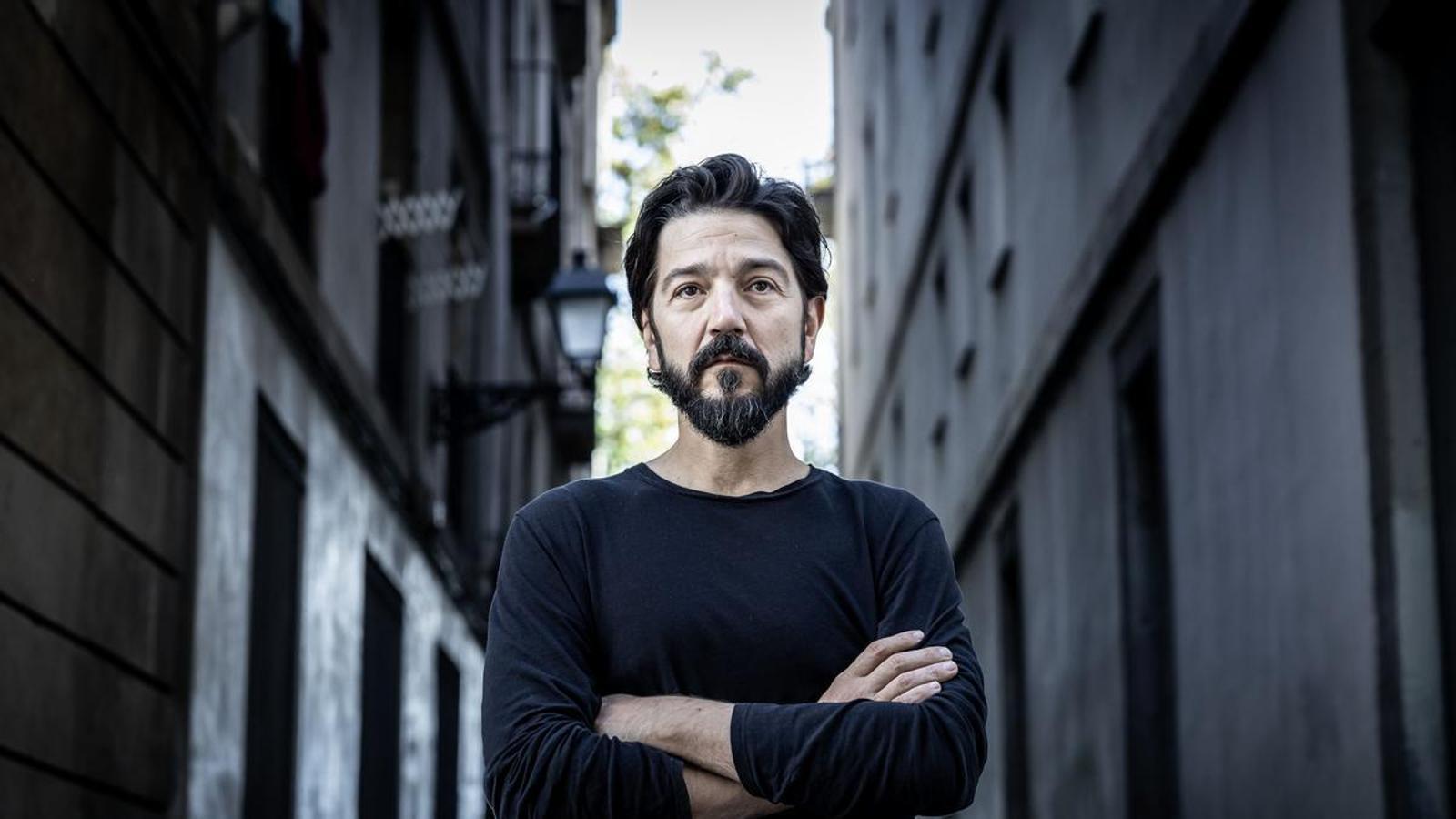
BarcelonaWhen Diego Luna (Toluca de Lerdo, Mexico, 1979) was just two years old, his mother, the artist and set designer Fiona Alexander, died in a car accident. Upon reading Brenda Navarro's novel Ceniza en la boca (Sexto Piso, 2022), the actor and director recognized the echo of his own experience in a character as different from him as Lucila, the Mexican teenager who migrates with her younger brother to Spain –first to Madrid, then to Barcelona– to reunite with the mother who abandoned them eight years earlier. But above all, he was fascinated by the clash of perspectives: “The daughter sees her mother's departure as an act of abandonment, but the mother feels she is making a great sacrifice for her children. As a father, I cannot stop thinking about how painful it must be to live away from one's children and start from scratch in another place. But I am also a son, and the absence of the maternal figure is a subject that has occupied my thoughts every day of my life”.

This Friday, Ceniza en la boca hits theaters, the magnificent adaptation that Luna has directed of Navarro's book, in which he portrays Lucila's experience as an undocumented migrant and the harshness of a day-to-day life that, as her little brother says, "is not living, just surviving." Luna's sixth film is his best work as a director and confirms his talent beyond his acting career, with such important milestones as Y tu mamá también (2001), Mi nombre es Harvey Milk (2008), Rogue One (2016) and his excellent prequel in the form of a series, Andor (2002-2005).
Has telling Lucila's story, abandoned as a child by her mother, helped him confront his own maternal absence? Has it been the way to make the project his own?
— I initially wanted to talk about migration and the effect it has on some families, and I found the perfect vehicle in Brenda Navarro's book. I was interested in those absences that accompany a migration and that leave a mark that ends up defining your life. If you read the book, you will surely find your own story in it, and I also found mine: that of a daughter who has to live without her mother, and who later constructs a narrative and a mythology based on this defining absence. Later on, life leads her to confront her mother's narrative, which is that of sacrifice. And even though she can come to understand it, the mark that abandonment left on her is too great. This is fascinating to me, and it is a subject for which, inevitably, I feel a very deep vibration, and it makes me feel a very immediate proximity to the characters.
The circumstances are different, but I imagine the wound is similar.
— Yes, and that is why I want to reflect on the subject, but not as a self-indulgent exercise with me at the center. That is to say, I try to empathize with the characters, letting this wound help us speak the same language. And then comes an actress with her own wounds, or my editor and partner Diego Rabasa, co-author of the script with Abia Castillo. To write the film, I try to leave my ego aside. It has been such an intense journey, so financially irresponsible, that it is only worth it if it allows you to delve deeper and reach other people who connect with your reflection.
In this sense, it is interesting that a Mexican filmmaker has portrayed with such realism Madrid and, above all, the Barcelona of Latin American migrants.
— We worked intensely in association with local producers, such as Valérie Delpierre, from Inicia Films. And when looking to find the story that Brenda had written, we worked with specific references. This is the story of a Mexican woman who migrates to reunite with her mother in Spain. And who leaves Madrid to get away from her mother and her brother, to be capable of considering a different life, a life of freedom that she does indeed find in Barcelona. And the specificity of this story, like all stories in cinema, is essential. But the phenomenon is global. Different in every place, but with similar challenges.

Despite the intense history of Mexico as a host country for Spanish migration, the inverse relationship is marked by prejudice and dehumanization.
— One might think that the fact that the same language is spoken in Spain as in Mexico makes everything easier and ensures understanding, but suddenly you encounter other layers of rejection that are common to all countries. Someone who has migrated to the United States will probably have similar stories, as will people from Central America who migrate to Mexico. Everything is related to ignorance and fear. Rejection and violence are in intimacy and everyday life, in what seems harmless, but the fact is that arriving in a country and feeling part of it requires precisely a very intimate and fragile connection that is very difficult to establish. But that is what creates community.
In the film, these connections are established mainly with other Latina migrants.
— These Latin American communities are very interesting, because afterwards Latin America is much more fragmented than any community of Latin migrants. I made a program called Pan y circo in which Jorge Volpi said that he left Mexico as a Mexican, and that it wasn't until he arrived in Madrid and lived there for a few years that he felt Latino. We are not Latinos. We were a Mexican or a Colombian or whatever, and it is when you arrive in a place that you discover that these affinities are important, and that until now you had prioritized the differences.
One of the most hopeful moments of the film is when this intimate connection is established with the family for whom she works through the learning of Catalan.
— Lucila has moved to a place where she thinks things will be easy because they speak her language, and she ends up feeling more comfortable in another place where she has to learn a new language. It seems inconceivable, but I have known many similar migration stories. For me, the moment when the older woman for whom Lucila works helps her pack her suitcase and, therefore, takes care of her is very important. This relationship speaks to us of what could be, of what we are capable of. Instead of fear and racism, the older woman considers the possibility of helping Lucila. We also have to take care of those who are here to take care of us. We can put ourselves in each other's shoes. And showing our best version is the answer to the ignorant speeches of hate that are being normalized all over the world.
Putting oneself in another's shoes is also a challenge for Lucila.
— Totally. And she is unable to offer her best version until she returns to Mexico as an adult and understands why her mother left. Until then, she is not prepared to listen to her and engage in dialogue with her. We must try not to drown in our own discourse. Let us try to understand the other. This is an exercise that is asked of all the characters in this film.
If I had to tell the story of how the son of two theatrical set designers became one of the great Mexican actors of his generation, what would be the first scene?
— Ah. How interesting. It must have been the first time they left me alone in the theater seats. I had already been backstage, in some cradle, but I was six years old the first time they sat me in a seat and left me in the auditorium, with the freedom to move wherever I wanted. It was there that it all began, where I felt safe and where I practically grew up.
Did you spend many hours at the theater when you were a child?
— Yes, but it is not just that. The first time I remember going on a trip to Europe with my father I must have been five or six years old, and when we returned to Mexico City our house had been cleaned out. They had broken in to rob us, you know. My father was so trusting that he probably left the keys in the lock. But I tell you this because for me the safe space was the theater. There, those things did not happen. In the theater, there was no need to lock up. In the theater, everyone was there by their own choice and through a bond that created a community.
For you, the theatre was home.
— Exactly. That was where they made me feel free for the first time and that I could be at peace. And that was where I started to make a living for myself.
2026 marks 25 years since Y tu mamá también, which launched his career. A few months ago they honored his co-star and friend Gael García Bernal in Mallorca and he recalled a day on set when they were carrying a box of camera equipment together and, suddenly, they looked at each other and said: “This cinema thing is chingón, guey”. He remembered it as a key moment in deciding that cinema was his path. Was it for you too?
— Yes, without a doubt. To Gael's story, I will add that that happened during a break in the filming that we took for Easter. The film was shot chronologically, like the characters' journey, and everyone wanted to take advantage of those five days to go home and rest. But Alfonso [Cuarón] and Emanuel [Lubezki] did not want to stop and they stayed to shoot some second unit shots from a cliff, a couple of very simple takes. And Gael and I decided to stay with them, Gael supporting the camera team and I the directing team. Basically, he dedicated himself to carrying boxes and I to closing some roads with the walkie-talkie so that cars wouldn't pass. And not only did we feel comfortable, but also useful and inspired. That was, effectively, one of the three moments in which I ratified the decision to do this.
And the other two?
— The first was when I did a play at 17 with my father. I sat down with him and said: “Listen, we should pay tribute to mom”. We chose a play and offered it to a director who had studied with my mother and was her great friend from university. We performed it in Mexico and it was called El cántaro roto. I acted in it, my father was in charge of the scenography and everyone who participated in it had some connection to my mother. And it was what made me realize that theater serves life, that theater can turn into life. And the other important moment was the first time I directed a film. Without a doubt.
