The Village: the dream made place
The architects from Olot RCR have in works in the Vall de Bianya a pioneer research center on space

-
CAT -
CAST
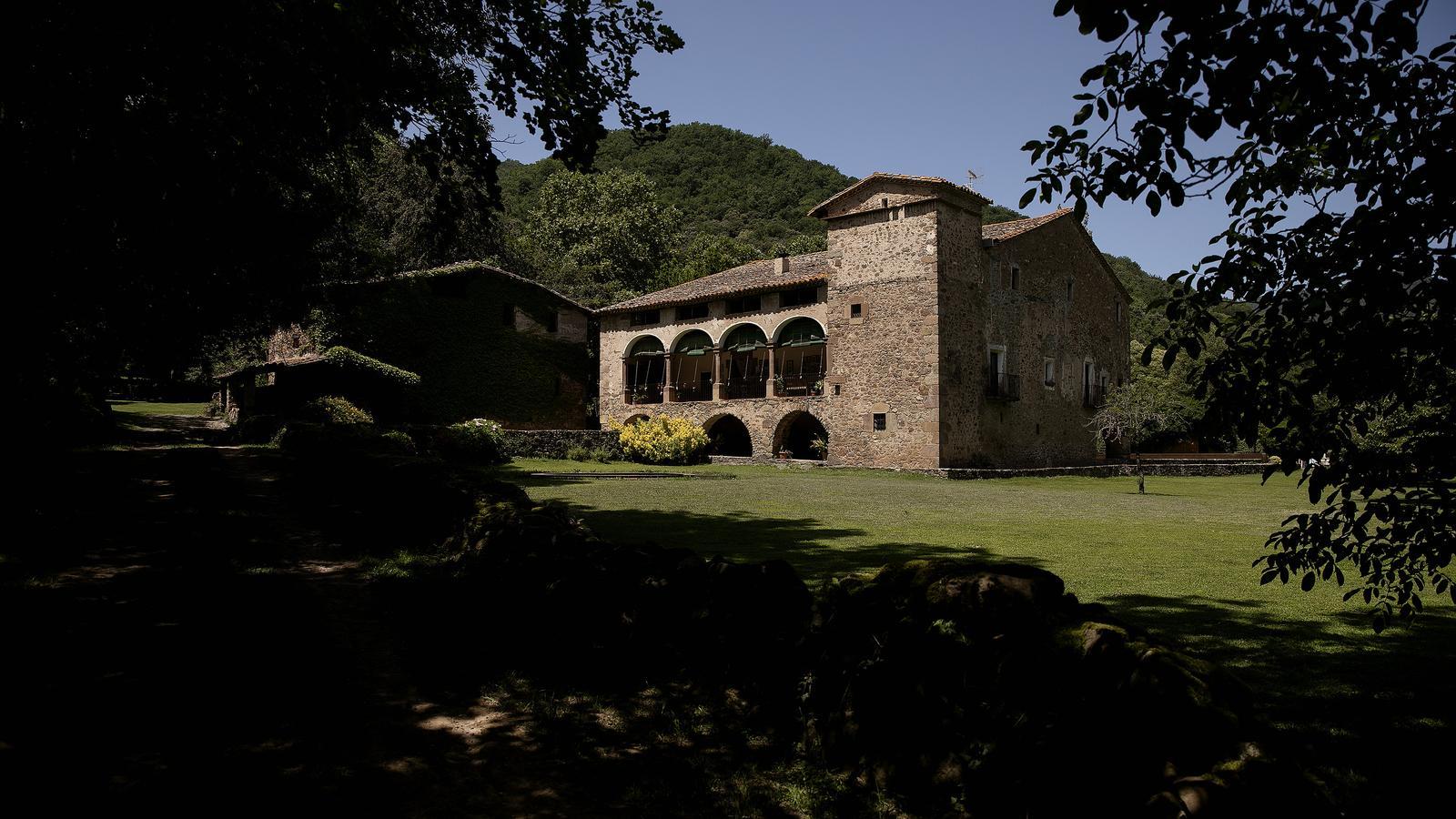
The Valley of BianyaSummer has arrived in La Garrotxa: the gold of the harvested fields and the green of the forests coexist on the route between Olot and La Vall de Bianya, on the way to La Vila, the estate where Rafael Aranda, Carme Pigem, and Ramon Vilalta, the RCR, are building their dream place, a pioneering research center on space. More specifically, as they themselves have reflected, it is "a living and thinking space to transmit new awareness directly and concretely through nature and architecture". "This is an exceptional project: we are used to working on commission, and here what we want is to build an idea," says Ramon Vilalta, on the way. The RCR set out to make the dream of La Vila a reality after winning the Pritzker Prize in 2017, the Nobel of architects. They already knew it because they had built a small pond for the previous owner, but when they acquired it, they conceived a much more ambitious project, where they want to bring together, in addition to architects, artists, thinkers, scientists, musicians, engineers, philosophers, psychologists, designers, filmmakers, students, and entrepreneurs, to "highlight hybridization". "We have always thought that culture is the most precious value we have as a country," says Vilalta. "In Catalonia there are very creative people, but we don't know each other, we don't connect. Just by making it possible for people to meet transversally, the La Vila project would already give a lot," he emphasizes.

In La Vila there is a farmhouse dating from the 12th century and various agricultural facilities. There is also the old Capsec farmhouse. It would seem like a place stopped in time if it weren't for the works that RCR are carrying out there. After discovering that one of the stables has very deep foundations, they decided that its center would be sheltered by this stable and all of it gathered by a gigantic roof that will help integrate it into the landscape. "For us, surely the important change that will happen in architecture will be that we will move from iconic and inert works, where you look at them as a passive spectator, to the fact that great architecture will be that in which you activate spaces, and in this interaction, this experience becomes unique," points out Vilalta. Thus, in La Vila they speak of "relational architecture, more dematerialized and dynamic-living". And of "humanitacle", that is, "a genuine way of understanding society and the world; a project of synthesis, integral, sustainable, inclusive and beautiful. A cosmology of life of women, men and the act of inhabiting". "Humanity becomes the protagonist and source of inspiration for experience as perception of all senses and relationships to foster creativity – say RCR–. An immersive, sensory and atmospheric space: with sun, clouds, rain, light, darkness, the Moon, shadows, veils, reflections, water, humidity, air and aromas, sounds, fire, vegetation, insects, animals, people… All movement. A symbiosis is established not only with the immediate environment, the landscape, but also with the distant environment, with the universe, which creates a relational environmental experience, of emotional but also spiritual perception. The architecture of the place does not impose itself, it does not want to be colonizing, arrogant, it wants to be attentive to move subtly".
In the trajectory of Aranda, Pigem and Vilalta, architecture and life are maximally integrated: Carme is the first Pritzker winner who is a mother – of two daughters – and with Vilalta they form the first couple to be awarded this prize. "We know we are living in a time of birth, full of contradictions, with crises superimposed permanently, to engender a new reality. It is about inspiring ourselves not to be trapped by paralyzing fear, disorder, shocks, and the chaos we perceive," say the architects. The works were to be finished by this Sunday, but the winter was surprisingly rainy and they could not meet the planned deadlines. Part of the building is a forest of props holding up the formwork. But it is already possible to begin to intuit what the complex will be like, formed by a string of rooms of monumental sobriety open to nature. The access will be excavated in the open air. In the architecture of RCR, the interpretation of the place is essential, and at La Vila they tried to keep the existing trees in their place. In the end, they had to be transplanted to continue with the work, and now they watch over the complex like a row of silent guardians.
The RCR's ambition is for La Vila to bring together the worlds of research, pedagogy, and business. The rooms will have a versatile and flexible use, except for a lounge area that opens onto an interior garden and a small excavated amphitheater, whose back wall is intended to function as a screen for projections. On the other hand, the lounge area is inside the room where there will be an immersive experience on space perception, by Layers of Reality, but technology will not entirely compromise the space. The markings necessary to create the navigation interface will be printed on panels that can be hung and unhung from the side walls. And the RCR shuns the ordinary even in the restrooms, which here are like three half-eggs with a hole, carved into a wall with a drain.


A large translucent cover
The large roof of La Vila will be an enlarged version of the existing one. Two iron porticos, like the existing concrete ones, will extend it on the side closest to the farmhouse. Then, the old corrugated sheeting will have to be removed to create a translucent roof, open at certain points, so that users are aware of the weather at all times. The walkway inside will not be enclosed, but this space, which is at the same level as the farmhouse, could be a meeting point and also host various workspaces. The floor is dotted with holes that represent various constellations, including the constellation of Aries. In practice, these openings are small windows for the lower floor, but, in the spiritual universe of RCR, they are the sign of a new era that will bring many good things. "We have met in Bianya to share. If we share with passion and love, the La Vila project will create beauty, well-being, and smiles for everyone. And in this time between the wonder and the bewilderment of the world, it must serve as a shelter to engender new relationships of freedom and creativity, and to be able to feel that it has been worthwhile," say Rafael, Carme, and Ramon. La Vila is driven by the RCR Bunka Foundation and the RCR LAB·A laboratory, and has institutional support and private sponsors.
