Marilyn Monroe: the vulnerable star one hundred years on
The mismatch stains all the texts that the actress left us, who was an avid reader
-
CAT -
CAST
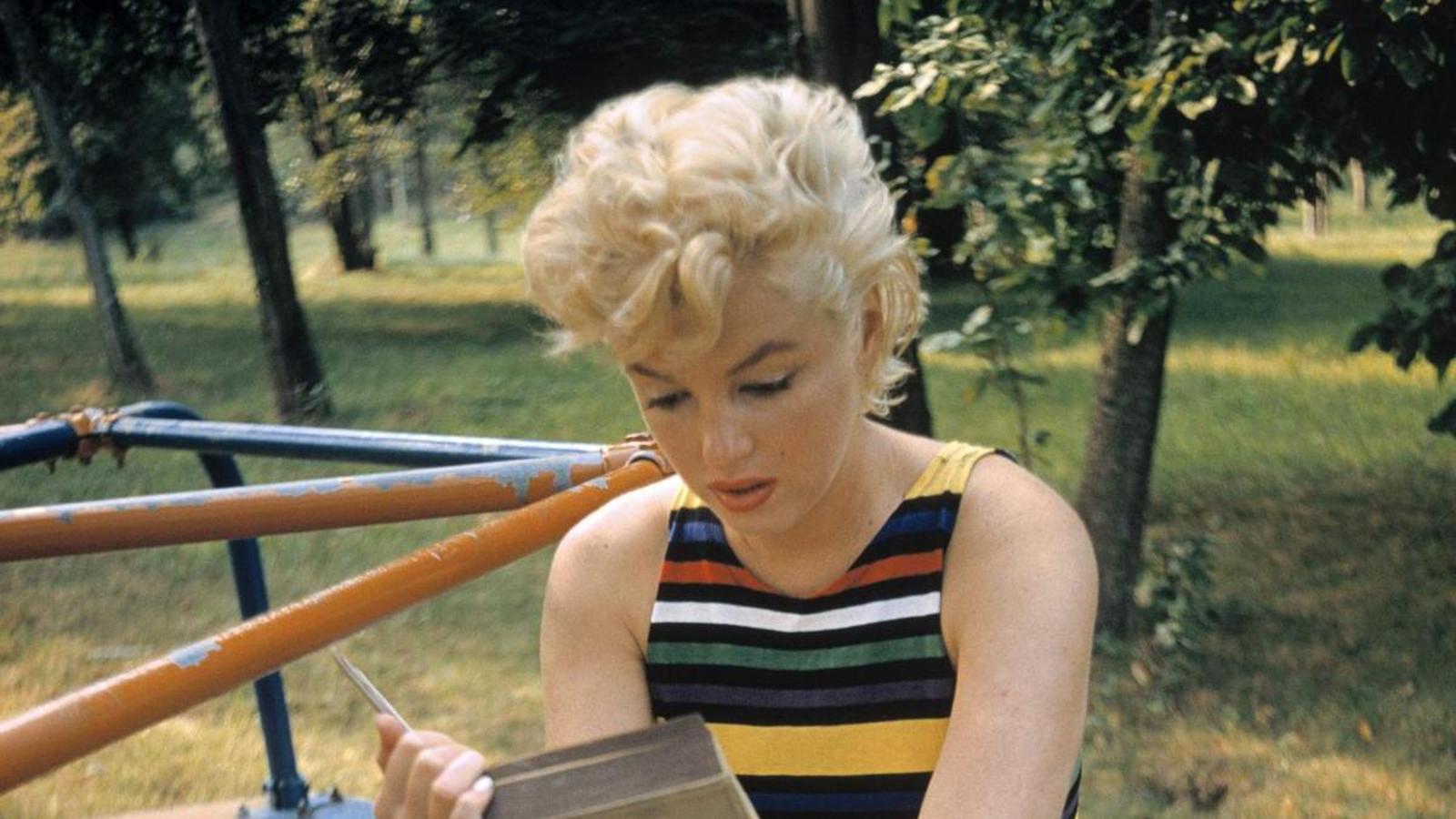
BarcelonaWhen Marilyn Monroe died on August 4, 1962, her belongings went to Lee Strasberg, who had been her teacher at the legendary Actor's Studio and had become her confidant. Among the actress's possessions were a handful of manuscripts, letters, and some of her own poems, texts that Monroe often scribbled on hotel stationery wherever she stayed. All these personal writings were first edited in 2010, under the title Fragments" (Spanish edition published by Seix Barral), and they offer a privileged glimpse into the inner world, expressed in the first person, of this actress who was born a century ago, on June 1, 1926. They also give us a lesser-known image of the star: that of the avid reader; that of the actress who feels secure in front of photographers but not when she has to speak with journalists; that of the woman who connects with the progressive political concerns of the time; that of the performer who finds in New York a territory for artistic enrichment at the antipodes of Hollywood glamour.
Oh damn I wish that I were/ dead —absolutely non existent— gone away from here...Oh damn I wish that I were/ dead —absolutely non existent— gone away from here..." (Oh, damn, I wish I were dead —absolutely non existent—, gone away from here…).
In another text, she recalls that "as a child/my unspoiled first wish was to be an actress." Adolescent Norma Jean realizes that, despite her shyness, she has the ability to attract attention. During World War II, when David Conover, an army photographer, is doing a report on the female war effort at the aircraft factory where she works with her mother-in-law, he immediately becomes clear that the image of that brown-haired girl with an infectious smile is what interests him. Conover encourages her to become a model, and thus she begins to appear on magazine covers like Laff, Peek, Pageant or Parade, the most direct path to Hollywood. A sharp agent, Emmeline Snively, manages to get the studios to notice her. The construction of the star Marilyn Monroe begins from the pin up Norma Jean: a new haircut, platinum blonde dye, name change, a touch of sophistication that leaves behind the everyday girl from the covers, and screen tests that convince the bosses that the young woman has that special gift in front of the camera, even though she still lacks acting experience.
But Marilyn struggles to launch a career: studio executives see the starlet, but not yet the star. And certainly not the actress. At first, she only makes cameo appearances in The Asphalt Jungle (John Huston, 1950) or All About Eve (1950). In this splendid film by Joseph L. Mankiewicz, the theater critic played by George Sanders praises the "idiotic streak" of the naive but attractive actress portrayed by Marilyn, and predicts a triumphant career for her precisely because of it. Even in fiction, Marilyn's image is already associated with the archetype of the "dumb blonde." However, in her first significant roles, she can demonstrate a potential as an actress still far from the image of the bombshell that will make her a star. Fritz Lang involves her in one of his noir melodramas, Clash by Night (1952), an adaptation of a Clifford Odets stage success, where she plays a working-class girl in a fishing village who admires and is complicit with her sister-in-law, the protagonist played by Barbara Stanwyck. That same year, she also stars in Don't Bother to Knock, a psychological thriller by Roy Ward Baker, where she plays a babysitter with mental health problems. The actress appears with short, brown hair, and can shine in a character defined by her psychological complexity rather than her physical attractiveness.
Marilyn in the popular imagination
But in 1953, three titles cemented Marilyn Monroe as Hollywood's most impactful sex bomb: Niagara by Henry Hathaway, Gentlemen Prefer Blondes by Jean Negulesco, and How to Marry a Millionaire by Howard Hawks. It is especially her role as Lorelei in the latter film, where she sings that "diamonds are a girl's best friend," that shapes popular imagination. It is also what has generated the most unexpected defenses of Monroe as an actress and a star. Critics at Cahiers du cinéma, for example, adore the film. Jacques Rivette, the first major interpreter of Howard Hawks's cinema in the French magazine, is among the great champions of the film and Marilyn. To the point that he was inspired by the friendship between the characters of Monroe and Jane Russell to shoot his best-known film as a director, Celine and Julie Go Boating (1974). The importance of the female bond in Gentlemen Prefer Blondes must be highlighted, because in Hollywood at the time, still under the Hays Code, very few films featured a relationship between two women at their center.
Marilyn's work in this iconic musical also fuels one of the best texts by Richard Dyer, the pioneer of academic analysis of film stars. For the theorist, Monroe's portrayal of Lorelei, the naive gold-digger, encapsulates like few others the contradiction that often arises between a star's image and the role she plays. Dyer recalls that the character of Lorelei in Anita Loos's original work, on which the musical is based, is the "material girl" par excellence, the woman aware of her sexual appeal who uses it selfishly as a means to access a life of luxury. The Lorelei of the film directed by Howard Hawks maintains this basic personality, but stripped of the cynicism of the original character. Monroe imbues a character defined by her manipulative ability and her lack of interest in love with genuine innocence. The actress embodies, through naivety, two values that are often laden with guilt and premeditation: sex and ambition. Herein lies her uniqueness.

In the two comedies she stars in under Billy Wilder, The Seven Year Itch (1955) and Some Like It Hot (1959) she offers variations on this archetype. In the first, Monroe embodies the quintessential male sexual fantasy of the average man in the fifties: the naive blonde who exposes herself sexually, but without the ambition of the fortune hunter or the threat of the femme fatale. The decade following World War II marks a process of redomestication of women, condemned to return to their traditional roles after having proven they could take on the same jobs as men during the conflict. This conservatism also carries over into cinema, where more independent female roles are marginalized, from the queens of screwball comedy to the femme fatales. While Marlon Brando and James Dean lead a renewal of male stardom based on youthful rebellion and disillusionment with the adult world, the new female stars exhibit a more uninhibited sexuality, but cannot express the same discontent. In The Seven Year Itch (1955), Monroe embodies this equally domesticated sexual fantasy: an accessible sexual promise without a concrete personality. Nevertheless, the actress manages to give her character psychology. As when, just before the iconic skirt-lifting scene, she expresses her empathy for the monster protagonist of Creature from the Black Lagoon (Jack Arnold, 1954), the film she goes to see with the protagonist brought to life by Tom Ewell.
Monroe, capable of seeing the humanity behind the monster's mask, finally has a character to match her in The Misfits (1961), John Huston's film based on a work by Arthur Miller, her then-husband. Few titles in cinema history have an aura of doom like this project, which brought together a group of performers on the verge of collapse, each from their own weariness. It is not only the last film for Monroe, but also for Clark Gable and Montgomery Clift. Full of decadent, traumatized, and adrift characters, The Misfits challenges the foundational imagery of Hollywood cinema: the old cowboys are now washed-up entertainers in Reno. The sequence in which Monroe's character reacts desperately to the horse roundup is an unparalleled emotional milestone. Here, the actress can finally embody a form of female rebellion against a form of naturalized male violence, that of domination and predation of wild innocence. The intensity with which she plays this moment makes it clear that she understood this form of predation well.
One hundred years after her birth, Marilyn Monroe remains not only alive in the popular imagination as the paradigm of the cinematographic sex symbol. The actress still connects with audiences of various generations in a way that other icons like Brigitte Bardot or Sophia Loren have not achieved. Monroe has ended up embodying the idea of a star as a contradictory figure: her worldwide fame did not save her from deep loneliness. And it is in this vulnerability that her texts, her image, and her performances, with which millions of viewers still identify today, resonate.
