"Cadiz is an indecent place": the ship's log of a French ship from 1714
The memoirs of a French ship that circumnavigated the world in the 18th century portray the life of sailors on a merchant vessel
-
CAT -
CAST
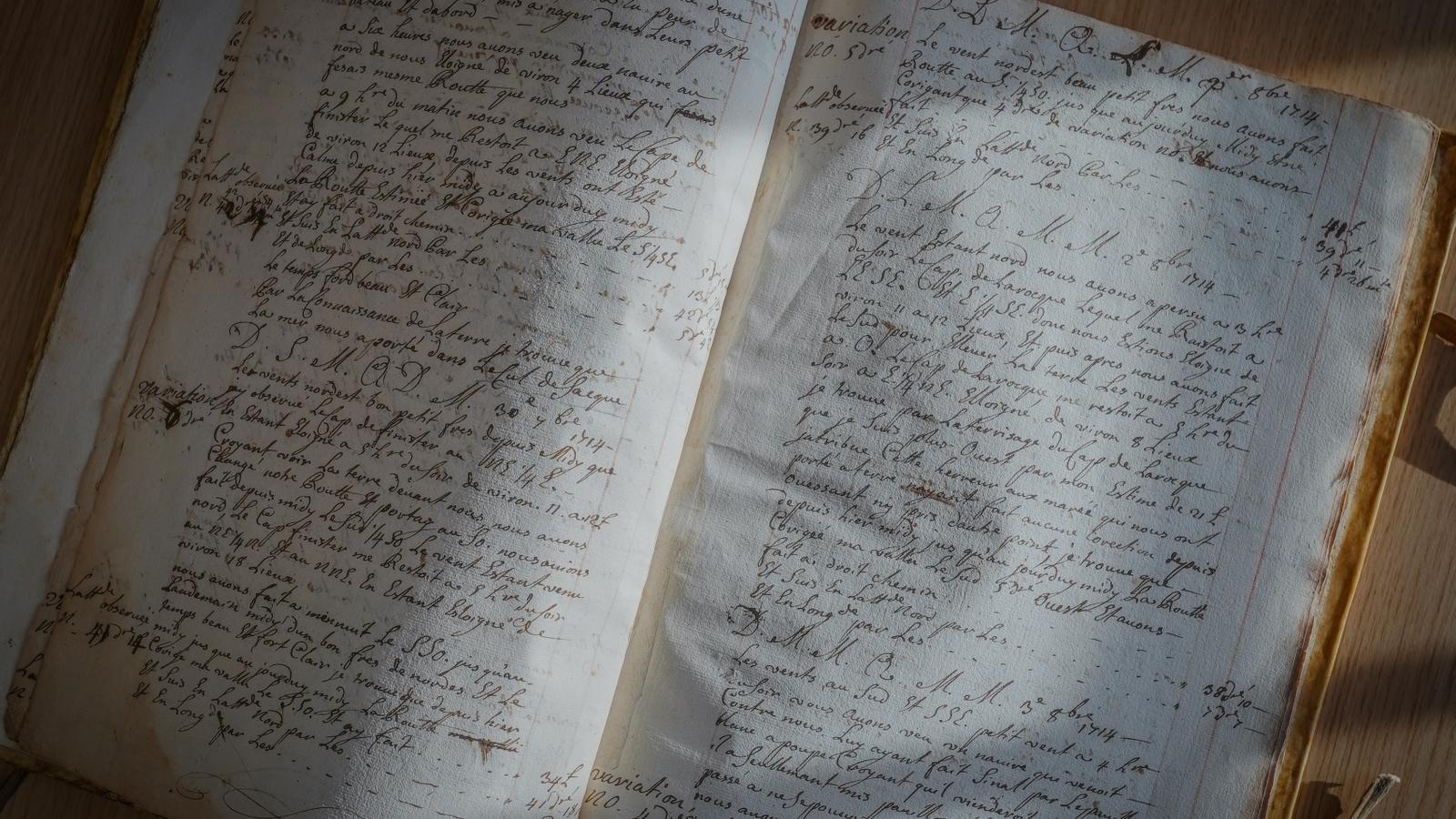
The memory of a ship remains among its wooden planks, from port to starboard, but its chronicle, on the other hand, in the experiences of sailors accustomed to the sea and oblivion. The history of the Grand-Dauphin, one of the first French merchant ships to circumnavigate the world, was known, from its departure from the port of Saint-Malo (northern France) at the beginning of the 18th century, to its stays in Cadiz, Chile, Peru, and, finally, China and Indonesia. However, the memory of the one hundred and forty men who inhabited this three hundred and fifty-ton ship monster had remained an anecdote lost in the fleeting abyss of time. Until now. Antiquarian and collector Jean-François Letenneur discovers the ship's logbook in the year 2000, archived since May 20, 1717. Letenneur conducted an exhaustive study to determine its historical interest and deliver it, this year, to the Maritime Museum of Saint-Malo, where it is currently being analyzed for public exhibition.
With the museum's acquisition, technicians have determined that the author of the text portrays the history of French seafarers during the ship's second circumnavigation. "[The logbook of the Grand-Dauphin] allows us to discover small details that, in a single sentence, become very valuable anecdotes for understanding the lives of the men on board," the museum's director, Jean-Philippe Roze, assures ARA. The most extraordinary aspect of the account is the three hundred years of preservation, practically perfect, of a volume measuring 360 by 230 millimeters, with about one hundred and sixty-six pages. "We have the hypothesis that it may have been intended to serve as the basis for the writing of a work or a travelogue," explains Roze. An entire adventure "very well preserved" in family archives and passed down by "inheritance" to this day. "A logbook did not only serve to inform the Ministry of the Navy; it could also lead to publications, given that in the 18th and 19th centuries, great maritime narratives and travelogues began to emerge," Roze acknowledged.
The ship's documents were kept and carried by officers, as it was a mandatory document after Colbert's ordinance of 1681, which required the delivery of the document to the port to justify each stop and each setback. This official text certified the maneuvers followed, the routes taken, and all decisions made during navigation.
The Grand-Dauphin weighed anchor on September 3, 1714, to travel to the Spanish Americas, the so-called South Seas, laden with Breton linen fabrics, tools, kitchen utensils, clocks, and lace. Upon returning to the port of Saint-Malo, it presented itself to the administration responsible for civil maritime activities, which was the admiralty of the coastal city.

The achievement of this manuscript is its very preservation, as only those of great geographical interest were kept, such as those recounting the discovery of lands, or those related to scientific expeditions, like the mission of the ship Bougainville (1766-1769), to which the first French circumnavigation was attributed. However, the Swedish historian Erik Wilhelm Dahlgren, in the early 20th century, made known the existence of earlier commercial voyages, such as the Grand-Dauphin three decades earlier.
“Ultimately, I don't think it will completely change the historical view we have of the voyage,” explains Roze about the manuscript, which documents the second voyage of the Grand-Dauphin. As he recalls, French trade routes between Saint-Malo, Cadiz, Chile, Peru, and China had already been studied since the early 20th century by European researchers. Nevertheless, he points out that the document provides previously absent information. "It gives us life. It shows us the daily life [of French sailors]". According to Roze, while the captains' official reports were usually limited to technical and commercial matters, the manuscript allows for observation of specific aspects of daily life on board. “We see the ship's damage, the repairs, the relationships with the Spanish, with American colonists, and with the Chinese,” he points out. All in all, not very friendly relations. “I expected the inhabitants of Saint-Malo and Cadiz to be very close, because there were very close commercial relations between the two cities,” he explains, giving the example that shipowners and sailors from Saint-Malo often sent their sons for apprenticeships “to promote commercial exchanges”. However, the manuscript presents the Andalusian city as "dirty" and “the author describes it as an indecent and sordid place, with untrustworthy people”.
Gaditan subterfuges
The manuscript of the Grand-Dauphin records the arrival at the Bay of Cadiz on October 5, 1714, after a voyage across the Atlantic that led the vessel to recognize the Andalusian coast. During the early morning of October 6, the sailors arrived at the mouth of the Guadalquivir and Sanlúcar de Barrameda and corrected their course to embark in the Bay of Cadiz, where the reefs known as Los Cochinos and La Diamante, visible at low tide, forced them to anchor off Cadiz. There were also the Queen's English ships, of 60 cannons, and the King of Toulon's, of 50, which greeted them with seven friendly cannon shots.

In the early days, Spanish authorities prevented the crew from disembarking. The manuscript never explains why, only that they wanted to "arrest them by order of the King of Spain." Although the year 1714 was marked by the end of the War of the Spanish Succession, the text also narrates an episode of nighttime merchandise trafficking, a common occurrence that could explain the Spanish hostility. “Our first captain did not want to go ashore for fear of being arrested,” narrates a fragment of the manuscript. A few days later, the author of the manuscript did go ashore, annoyed by the appearance of the “poorly built” city of Cadiz. “The streets are very narrow, very badly paved, and very ugly,” he writes. But he marvels at the clothing of the women and of some men “very jealous of their lovers.” “When [the women] leave home, they put on a large skirt and a type of veil they call a mantilla”.
The diary narrates the nighttime trafficking of bullets and merchandise between ships and the city using an auxiliary vessel moored to the main ship. “In order not to let anyone know that we were unloading merchandise and loading others, around ten at night we brought a small boat alongside our ship, in silence,” he details. The Grand-Dauphin leaves the bay of Cadiz on the morning of October 26, with the hold full of ammunition and merchandise for the Americas. All things considered, with a final burst of shots and cannon fire from their companions still moored.
The memoirs of an anonymous author
It was suspected that there had been several authors of the manuscript, due to grammatical errors and changes in handwriting over time. However, Roze has confirmed that it is written by the same hand. “We have the crew's log and we know the names of all the members, but we have not yet been able to identify who wrote the diary,” admits the museum director. “There is one thing that did surprise me: their way of writing phonetically suggests an accent. Perhaps it's just my hypothesis, but it seems they add vowels at the end of some words, as if they were writing as they spoke,” Roze detailed.
, elevated to a legend that deserved to be preserved for more than three hundred years in a drawer.
Grand-Dauphin leaves Asia crossing the Strait of Sunda, between the current islands of Indonesia. During this route, the ship runs aground in the Java Sea and is forced to stop for six weeks in Batavia to repair the damage. Once the vessel is restored, it resumes navigation through the Indian Ocean, where the text, uninterrupted until now, stops at the Cape of Good Hope before finally returning to Europe.
On the margins of the diary, the deaths of the sailors during the crossing appear “by drawing a cross”. The author illustrated the high-seas feat of adventurers relegated to ostracism and accustomed to the stoic recounting of travel anecdotes with a beer in hand. The voyage of the Grand-Dauphin or of so many others ended up in oral memory to explain what did not interest the authorities. This is an adventure narrated a thousand times and capable of being the engine of impossible crews like the pariahs of the Nautilus or the mutineers of the Bounty. A daily life without krakens, elevated to a legend that deserved to be kept for over three hundred years in a drawer.
