What is a beech doing in Barcelona?
The Historic Botanical Garden, a treasure of biodiversity

Yes, there are still farmhouses in Barcelona, even though it is one of the most densely populated cities on the planet. One of my favorites is the one behind the National Museum of Art of Catalonia. It is not excessively old – it is more or less a century old – but it contains most of the ingredients of any farmhouse: a dovetailed door, a sundial on the facade, with the phrase Progredior ultra retro non referar (We move forward, we do not return to the past). There are no longer any poultry or pigs. Inside, elements of peasant life are still preserved, such as a series of hollowed-out pumpkins that served as containers for water and wine. "This farmhouse was built as a livestock pavilion for the 1929 International Exposition," Jaume Pàmies Pagès, a geographer who has worked at the Barcelona Botanical Garden for years, explains to me. Previously, he had worked as an environmental educator, mountain guide, forest ranger, and gardening teacher. The ground floor is opened to the public on special occasions, when there is an activity: workshops, talks... Normally, the gardener and the volunteers of the Association of Friends of the Botanical Garden use it to store the tools for the vegetable garden that occupies part of the so-called Sot de la Masia (a large hole from an old quarry). This garden produces seeds of traditional native varieties and some exotic ones, but all non-hybrid. "We cultivate, reproduce and conserve varieties that the modern world has been displacing, such as the black pea (typical of the north of the regions of Solsonès and Berguedà), the Tiurana chili pepper, the white eggplant and the queen mother broad beans –says Jaume–. It is our grain of sand for the conservation of biodiversity", he adds..The farmhouse has also preserved a wood-burning stove. On the coldest days they light it to heat the large room. They burn wood from garden trees that have had to be cut down (they have fallen in a storm, they have died, it has been necessary to thin their bases...). "I like it when, early on a winter day, as I walk up the stairs from the MNAC to the Lluís Companys Olympic Stadium, I see the chimney smoking and even smell the wood smoke," comments Jaume.
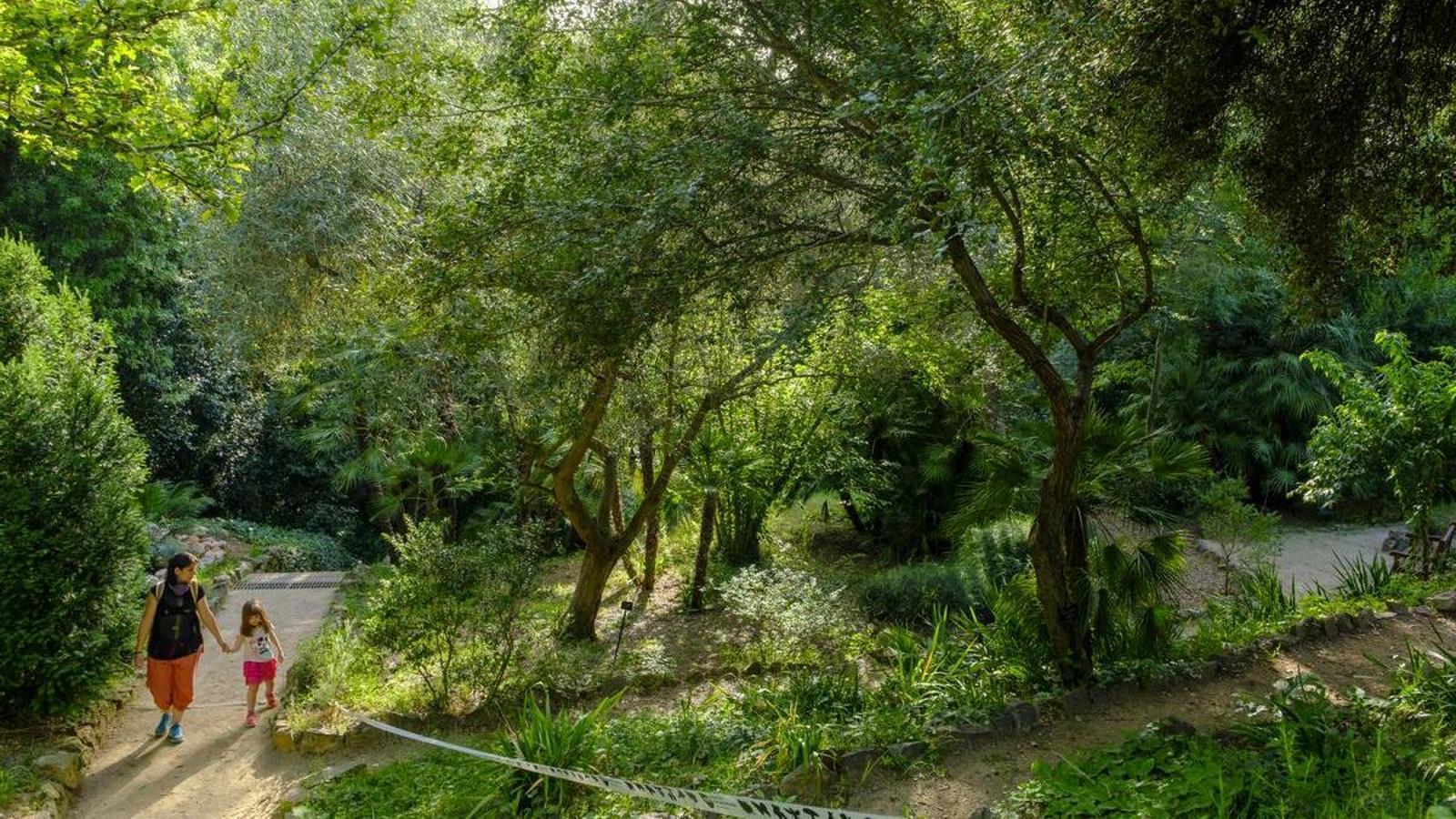
In the Sot de la Masia there are also singular trees, such as a camphor tree or a ginkgo. But where there is a spectacular collection of trees is in the adjacent hollow, the Sot de l'Estany. In this large hollow, also created for stone extraction, there are some of the tallest trees in Barcelona. The thing is, they don't look like it, as they are inside the hollow. Furthermore, there are four monumental ones, the highest distinction from the Generalitat and, therefore, the highest protection: a Rehder's winged walnut tree, an American red ash, a narrow-leafed ash, and a false plane tree. "Look at what a beautiful beech tree I'm making!", says Jaume. Beech trees are found in much higher places, in colder climates, not by the sea. I think of the Fageda de la Grevolosa, Jordà's, the Retaule, in the Ports de Beseit... All located at a considerable height. But the microclimate of this hollow, where the temperature can be up to four degrees below that of outside, is determinant for the beech to feel at home. While walking, Jaume tells me about animals I don't see. Like the tòtil, which needs water sources, and here it has them. "The tòtil population in the Sot de l’Estany is the second most important in Barcelona in terms of quantity, after the area of the Labyrinth of Horta." The tòtil is a protected native toad. The word tòtil should also be protected, a mild insult half fallen into disuse.tòtil, a mild insult half fallen into disuse."And when was this magnificent garden created?", I ask. "It was an initiative of the botanist Pius Font i Quer. In 1930 he began to gather a collection of endemic and rare plants, obtained especially in the Iberian Peninsula, the Balearic Islands and Morocco. In addition, there was a collection of plants in the Parc de la Ciutadella that were transferred here", Jaume tells me as we watch a blackbird giving us a little recital. "Notice that it's a male, a blackbird. It's easy to recognize because it has completely black feathers and an orange beak", says Jaume, who recognizes the voices of several birds. "Many birds find food here, a place to nest (some already find it made: a few nest boxes have been installed here) and rest". We now pass directly under a tree whose leaves are identical to the flag of Canada. "An acer pseudoplatanus, a false plane tree", he says, seeing me look up. You know them all!This garden in Montjuïc, a little-known treasure of biodiversity, hosts species from the Mediterranean, North Africa, and Central Europe. It also plays a key role in the conservation of endemic plants, such as the menorcan loosestrife. It is open to the public with free admission. NOTE: A few weeks ago, a landslide occurred in the Sot de l’Estany, and this area is now temporarily closed. For 150 peopleI am surprised to read at the entrance of the garden that the maximum capacity allowed is 150 people. More or less it is the capacity of a small theatre. Many more can fit in here. But, of course, it is a place of peace, where crowds are not welcome. The other information that surprises me is that you cannot enter if there is only half an hour left until closing, considering that the garden is not very large. It is the way to encourage a calm and unhurried stroll to leave.

