The talent scout who changed the history of Espanyol
Josep Manel Casanova, considered the father of the blue and white youth academy, ended his career at Malaga

-
CAT -
CAST
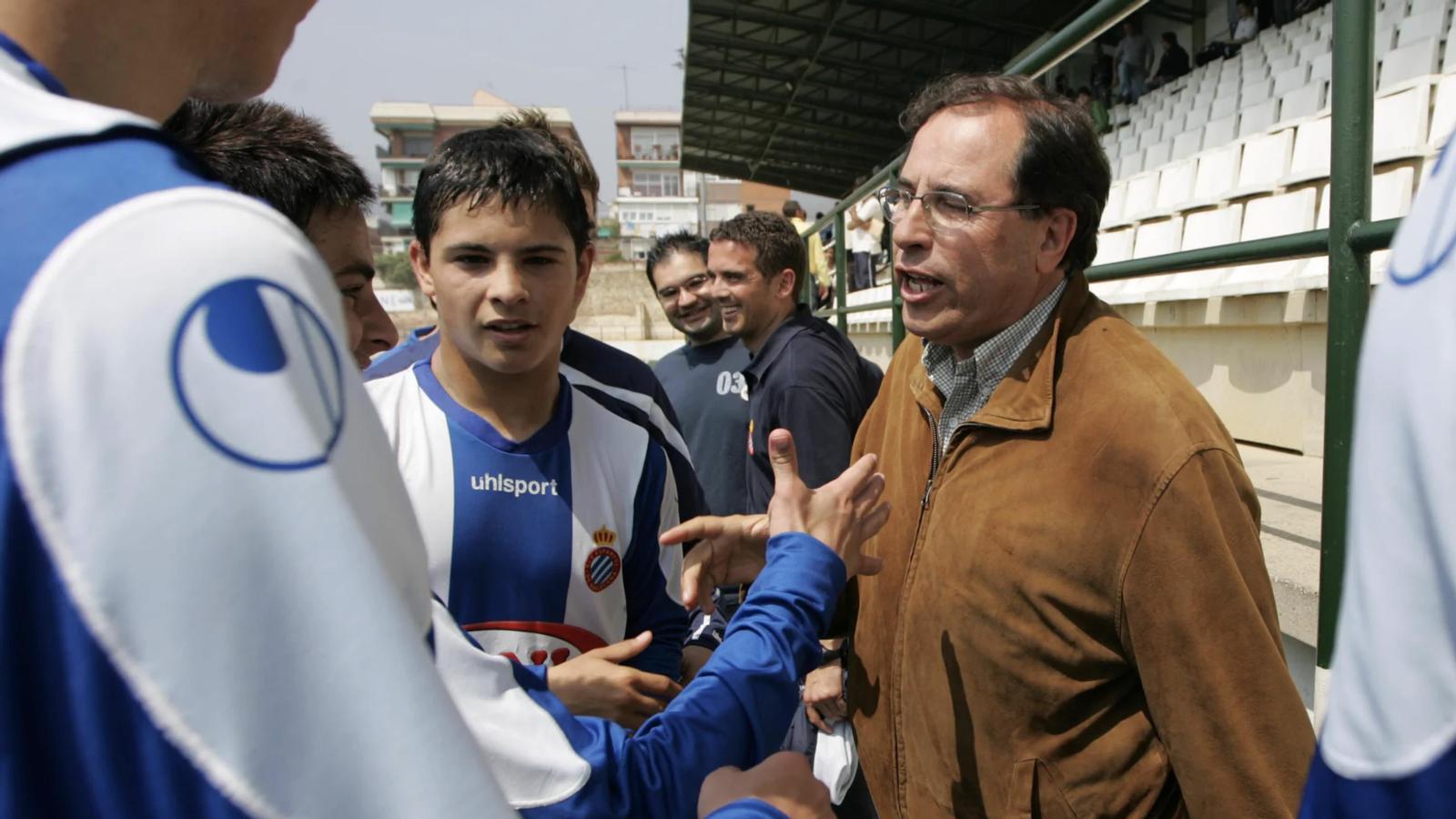
BarcelonaRaúl Tamudo, the top Catalan goalscorer, was signed from Milán Santa Coloma in exchange for six balls. And Joan Capdevila, the only white-and-blue world champion, was discovered when he was playing for Tàrrega in a Copa Generalitat triangular tournament. Barça also wanted him, but he was ultimately convinced by Josep Manel Casanova (1951-2017), a former player, former coach, and coordinator of Espanyol's youth football for nearly two decades. Lardín, Sergio González, Coro... The list of talents he forged is very long. That is why he is considered the father of the white-and-blue youth academy. When he died of a heart attack while watching a youth match of Málaga, many of them, as in the case of Tamudo and Capdevila, said goodbye to him by explaining that he had "changed their lives".
“It changed mine too because it brought me to live in Barcelona,” says David Alonso from Córdoba with emotion. He loves the City of Counts so much that he stayed there and is now the president of Martinenc, a historic club in Catalonia. He scouted him in 1993, after seeing him live in Córdoba and Madrid when he was playing for Séneca, and housed him at 17 Gran de Gràcia street. Since 1990, at his request, that apartment functioned as a residence for players from out of town. “More than a residence, we were a family,” confesses Amanda, who, with Javi, her partner, helped Manel and Lili run the business. It was inaugurated by Roberto Fresnedoso, who would end up playing more than 150 matches in the First Division.
“He was ahead of his time”
“He made Isco come from Andalusia to train. I have photos of him; he was very fat. He ended up leaving for another team,” explains Carles Casanova, who is Manel’s son and has been working in the blue-and-white youth academy for over 25 years. "Back then, that wasn't done. Apart from Espanyol, at most Barça and Madrid signed players from outside their region. He was ahead of his time. I remember a lunch at Cal Dimoni with Paco and Fernando Roig, from Villarreal; they wanted to know how we worked in the youth academy,” he adds.
“We did crazy things: I went there and back with him from Almeria by car on the same day to watch a match,” recalls Ramon Guerrero with a touch of nostalgia, an old friend of Casanova and one of the first coaches he signed for the youth academy. “He lived for football and Espanyol,” says Amanda. Her son confirms it: “He could be at a birthday party and in the middle of lunch say he was leaving because the Cadet B team was playing at three. And he would leave, you know?”
“He would watch ten minutes of a match and tell you “We have to have this one because he is different”. And we were very quick at capturing the kids,” reveals Guerrero about Casanova’s formula for success: a clinical eye, tireless work, and affection. “Darder went to La Masia, but he didn't quite adapt. Casanova brought him to the residence and after two days the family called me: he was delighted with us. And Espanyol signed him,” says Amanda, who acted as a mother to them: “I went to the tutorials, to the doctor, and acted as a teacher if necessary.” She reported everything to Manel, whom she defines as “ten people in one”.
Living with Barça
“I was very attentive to you: your grades, your training sessions... I always asked you and listened to you, but I pretended I didn't know anything even though I already knew everything,” adds David Alonso, who still remembers the long periods spent talking with him at the Viareggio tournament. The day Casanova let him go, they both ended up crying. “He taught me to have a bond with the children and their families, to take care of them and love them,” says Carles. That is why he felt so bad when, one summer, the Bartra twins, Oriol Romeu, and Isaac Cuenca left all of a sudden. “Cucurella, Carles Pérez, Cristian Tello... We have had many escapes to Barça,” lists Casanova, who has understood that “it is practically impossible to fight against this, because 90% of the people in Catalonia are for Barça.”
Even so, for a long time Espanyol caused him trouble, to the point that it was the reference youth academy in the territory and prevailed over the city rival in recruitment. “My brother and I had a pre-contract with Barça and by magic we ended up signing for Espanyol. Afterwards, we met with the club to apologize,” reveals Pedro Nieto, whom Casanova signed from Ferran Martorell and thanks to whom he was able to do his military service in L'Hospitalet: “Since I was training with the first team, Captain Blasco used to ask me for signed photos of Răducioiu.”

The Intertoto key
“The Intertoto crop marked a before and an after. From then on, they really started to bet on youth football,” says Pedro Nieto, who like Tamudo, Capdevila, Sergio González, Toni Soldevilla and Quique de Lucas was scouted by Casanova, the architect of that generation which was the foundation of Espanyol's first title in 60 years: the 2000 Copa del Rey.
Àngel Morales was also there, and he still remembers the two rejections he received from Manel: "The first time was in a tournament I played in Sallent with the youth team and then during a pre-season with Cristinenc Espanyol, at the Polígon Gornal. He told me I was too young, but three years later he signed me for the reserve team". Morales would end up playing more than 130 matches with the first team and, once retired, working in the 'periquito' youth academy with his son.
The construction of La21
"Until the beginning of the century, youth football was decentralized, and he had to bring order and make decisions in an era when each team trained and played on different fields," adds Morales. Precisely, this was Manel's great aspiration, who, as the youth academy coordinator, inaugurated the Sant Adrià sports city in 2001, known as La 21. Since it was built, 25 years ago now, more than a hundred footballers from the academy have debuted with the first team.
Those who come from outside now live at the Túrbula facilities in Sant Adrià. "In 2018, we named it the Josep Manel Casanova Residence. It is my tribute to Manel," comments Ramon Guerrero, who is its director and the longest-serving employee of Espanyol's youth football. Gate number 75 at the RCDE Stadium also bears the name of the eternal youth academy coordinator, who ended his career at Málaga, which Espanyol faces this Friday. There, he was received with graffiti against him and ended up being sent off with the honors of a star after turning their academy into a benchmark in Andalusia and producing more than 150 million in assets by signing young footballers like Darder, Fornals, or En-Nesyri. "How much did he generate for Espanyol? That is incalculable. It is an immense legacy," concludes Guerrero about the talent scout who changed the history of the 'periquito' club.
