The secret of Japan in the World Cup is a man marked by the Hiroshima bomb
Hajime Moriyasu, the Japanese coach, defends that his team can aspire to win the competition

-
CAT -
CAST
BarcelonaWhen the Japanese anthem began to play before the Japan-Netherlands match on the first day of this World Cup, the Japanese coach started to cry. He remained serious, while singing the Kimigayo, but tears streamed down his cheeks. "It's always an emotion to lead my country. Many things have crossed my mind here," he said. The Japanese press deduced, since Hajime Moriyasu (1968) gave no further explanation, that he was referring to being in the United States, as his life, in large part, is marked by the atomic bombs of Nagasaki and Hiroshima.
"I was born in Nagasaki and raised in Hiroshima," explains the veteran coach. The two cities that received the impact of the only two atomic bombs dropped on civilian populations. His father was a child when he survived the Hiroshima bomb, but lost many family members. A father who would work in the naval sector, so he moved from port to port, which is why Moriyasu was raised in Nagasaki, before returning to Hiroshima, where his family was from. There Moriyasu would become one of the best footballers in the country thanks to being discovered by Kazuo Imanishi, a hibakusha, an expression used in Japan referring to someone who survived the bombs. Moriyasu was always grateful to this man who actively participated in demonstrations against nuclear power plants and nuclear weapons. Memories that marked Moriyasu's childhood.
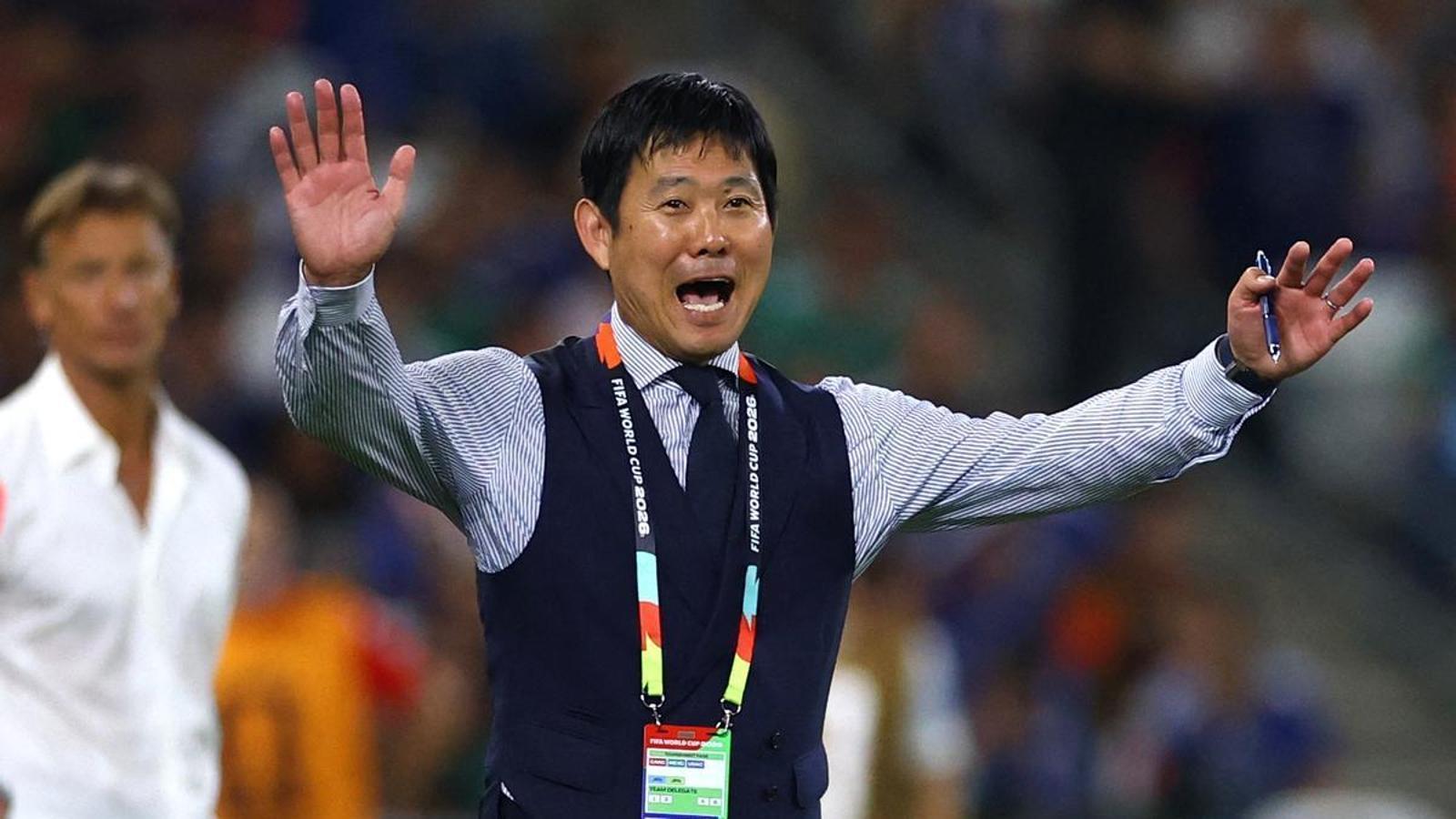
This coach has become a cult figure in his country for his way of managing the group. Against the Dutch, he brought out a large blackboard on which he drew giant numbers. Each number was a code to communicate a tactic to his players. It looked like an image typical of amateur football, in this digital age, but Moriyasu ignores the noise. "It's a visual image, the message gets to the players," said a serious man who, after achieving a good draw against the Dutch, wanted to send a message to the European press: "I thank Dutch football for everything it has done. Many Dutch coaches were in Japan and some were great teachers who influenced me," he said. In the land where teachers, the sensei, are highly respected, now it is Moriyasu who is a great teacher of Japanese football with a challenge: to win the World Cup.
"Moriyasu and the players say the challenge is to win the World Cup. A good part of the fans are surprised, as we have never overcome two knockout rounds, but the message is this," explains journalist Shingo Sugawara. "We Japanese think this is the best team of all time. We have never arrived with a team like this, even though we have some injured players like Kaoru Mitoma or Wataru Endo. We have a lot of enthusiasm," says Sugawara. And, in fact, in the friendlies before the World Cup, the Japanese defeated Brazil for the first time. Then, in a few days, they won at the temple of Scottish football, Hampden Park, and then at Wembley against the English. "And in the last World Cup we defeated Spain and Germany," adds Sugawara. The 4-0 victory against Tunisia certified that the team is functioning well. Never before had an Asian team won a World Cup match by four goals difference.
Japan has been a footballing reality for some time now, although they have not yet managed to play five matches in a World Cup. This is their first challenge, to reach the round of 16 or beyond. "I think we have the quality to reach the quarterfinals. After that, who knows if we will win or lose. The fact that we can now say this about Japan, regardless of the opponent, is truly incredible. The first challenge is to contribute to the development and growth of Japanese football," he states. When asked if they can really be champions, Moriyasu replies that "it is a possibility." He does not dismiss it. He is not joking. Footballer Daichi Kamada thinks the same: "I think we have a chance," he affirms.
A booming sport in a country that adores baseball
Japan is one of the teams that has improved the most since its World Cup debut in 1998. Four years later, in 2002, they were hosts and surpassed the group stage for the first time. "There is great work in player development. More and more Japanese players are shining in Europe. The league is consolidated and football is now very strong," says Ricardo Rodríguez, a Spanish coach who has worked in Japan. The result is a team that no longer fears facing European rivals. Now they will try to finish first in the group ahead of the Dutch, if they manage to defeat the Swedes by many goals. "Tactically, they are very well-drilled teams. And the individual quality in attack is very good," he adds. For years now, football has been as popular as baseball in the land of the rising sun. This World Cup's viewership, for example, is very good.
And all under Moriyasu at the helm. "He places great importance on group strength. On having harmony. In fact, he left out midfielder Hidemasa Morita, one of the best midfielders, because he had criticized technical decisions in the press," says Sugawara. Moriyasu is in charge and is respected by everyone, thanks to a technical staff in which he has incorporated former Celtic and Espanyol player Shunsuke Nakamura as assistant. The Japanese team has attacking quality and competes well. They follow the orders of a man who, as a youngster, wanted to play baseball.
Moriyasu is a peculiar man who always carries a notebook. Because he always takes notes, the Japanese have come to build a statue that immortalizes him in this pose, where fans take photos every match day. Over the years he has become a respected figure, even though in 1993 he was part of a cursed generation, the one that missed out on the World Cup in the United States in 1994 and conceded a goal in the final minutes against Iraq in a match they were winning. That draw with the Iraqis on October 28, 1993, became a trauma for the Japanese known as "the agony of Doha," the scene of the match. When Japan finally qualified for a World Cup in 1998, he was no longer there.
Having become one of the players with the most appearances in the history of Sanfrecce Hiroshima, as a coach he made his way precisely at this club. For this reason, he was hired as coach of the Under-23 team for the Tokyo 2020 Olympic Games, then moving on to the senior team. At first he was labeled defensive, but little by little he has given meaning to a generation full of talent that surprised Spain and Germany four years ago, with second-half substitutions that were winning plays. In the United States, the Japanese want to continue growing. For now, they are on the right track.

