The difficulty of retaining talent at Barça
The club has suffered an exodus of players due to economic turbulences, 'fair play', and the large investments of foreign clubs
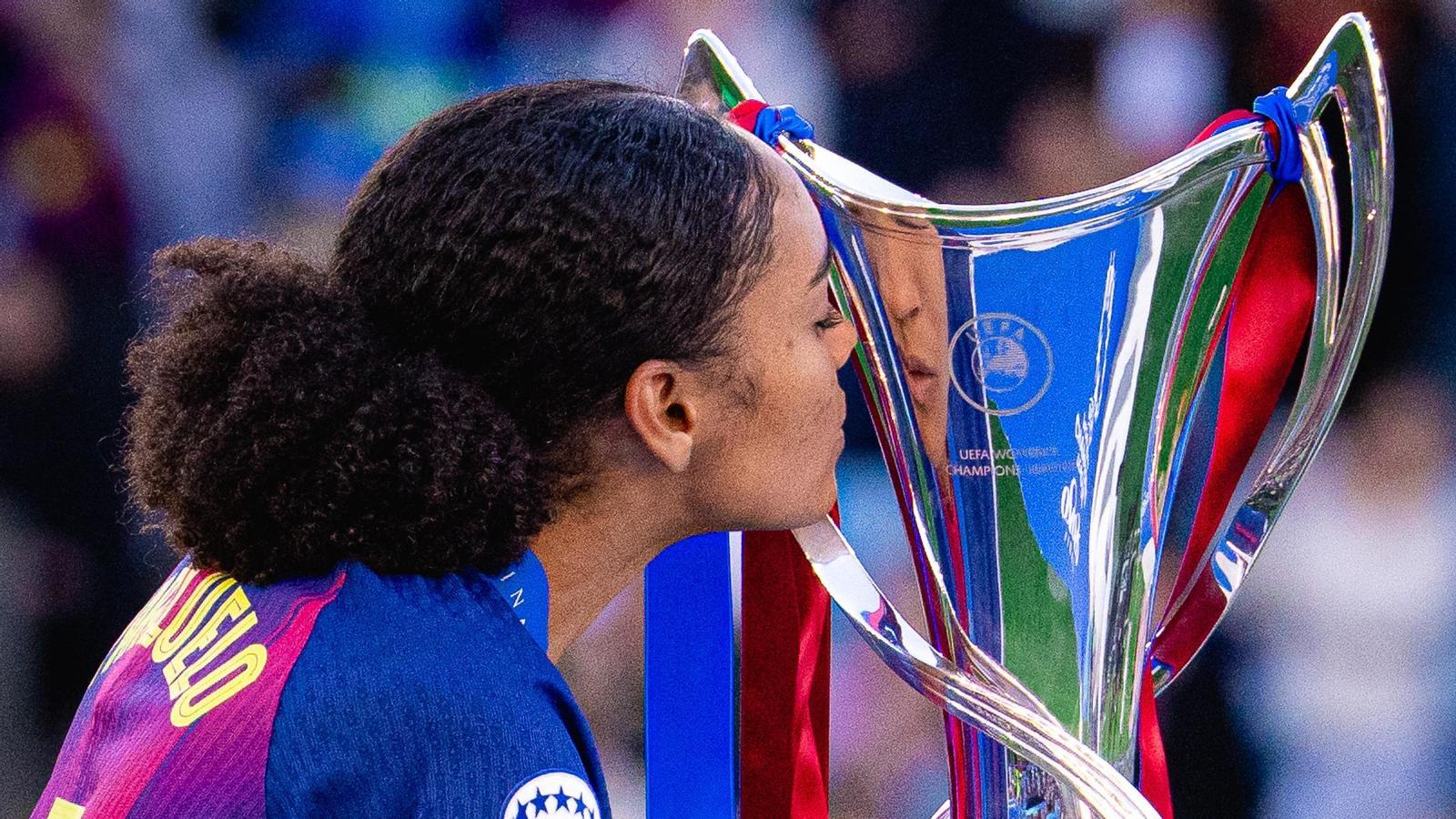

BarcelonaIf there isn't a radical plot twist, Salma Paralluelo will stop being a Barça player in a few days. The Aragonese footballer has decided not to accept the renewal proposal she had on the table because she considers it insufficient. Between budgetary limitations and the fact that raising the offer would have caused an upheaval in the wage scale of the women's team, the sporting direction has decided to stand firm. Thus, Salma will go abroad to collect the million euros she demanded and that up to four clubs are willing to offer her. The Blaugrana team could only pay her 700,000.
The decision of Salma is perfectly understandable in professional sports. The problem for Barça is that this is not an isolated case, neither in the women's team nor in the rest of the sections. Although the Blaugrana club boasts a broad and very successful multisport model, economic turbulence has put its viability at risk. Before the pandemic, income was good enough to have a competitive men's football first team and to allocate a good handful of millions to compensate for the losses of sections that have historically been deficitary. But with the crisis derived from covid-19 came a series of cutbacks that, six years later, continue to diminish the competitive capacity of all teams.
The women's team was an oasis in the midst of this context of cutbacks, as it was the only section that managed to be viable. Barça was not afraid to invest in it. The rise and visibility of the football played by women, which is in the process of full professionalization, allowed the numbers to work out at the end of the season. But everything has a limit. Even if the Blaugrana commitment remains firm, it cannot compete with other projects, mainly European ones, that have decided to invest even more money in sport.
La Lliga F cannot compete against the determined commitment of other competitions
One of the best-known cases is that of Michele Kang, the billionaire patron who is the new owner of Olympique Lyonnais, a rival of the Blaugranes in the Champions League final, and the club where Mapi León will end up, one of the five players who have not renewed their contracts. Nor does it help that the F League is falling behind in terms of investment compared to what is happening in the English Premier League, which will be the new destination for Ona Batlle, after accepting the proposal from an Arsenal that offered her a much juicier contract than Barça's.
In this talent drain, the famous fair play
of the League also plays an important role. Although it is a concept from men's football, the salary limit is calculated taking into account the club's global expenses. That is, increasing investment in the sections means reducing muscle to strengthen the team coached by Hansi Flick. In fact, a few years ago, when the club employers' association demanded a viability plan from Barça, the cut of 15 million in the global of the sections played a key role before authorizing the registration of players. Although this summer the entity will leave behind the concept of excedent and return to the 1:1 rule, which allows normal operation, Laporta and his team will allocate the bulk of the money to men's football. In the case of Pere Romeu's team – which has renewed – it will have to settle for a single high-level reinforcement while rebuilding the team from the talent emerging from the academy.
The basketball budget has fallen by 25%
The other big loser is the basketball section, which has seen its budget cut by 10 million in the last three years, going from 38 million in 2023 to the current 28, and this represents a 25% reduction that led to traumatic departures like Mirotic's because there wasn't enough money to pay his salary. This season, the one leaving is Xavi Pascual, who will pay the termination clause after being in charge for only half a season. In his case, Pascual – who can still be League champion – announced his departure in a press conference where he cited only personal reasons. But the reality is that Dubai, his new club, was offering him a salary proposal that tripled what he could earn in Barcelona.

In basketball, the competition is not only between the teams competing in the Euroleague, but also among young players, which is even more worrying. In recent years, some of Barça's youth players have packed their bags for US university leagues. It's a win-win. They are offered more money, more visibility, and the dream of landing in the NBA. And, in the worst-case scenario, they can always retrace their steps and return to Europe. In 2024, Lithuanian point guard Jakucionis left, last year shooting guard Dame Sarr did the same, and this season Joaquim Boumtje-Boumtje and Sayon Keita have already announced they are leaving. They might not be the only ones.
The roller hockey and futsal sections, with cuts of around 10%, have also suffered the effects of the crisis. And, of course, the handball section, which had up to ten departures last season and at least two confirmed this season, among whom stand out players like goalkeepers Gonzalo Pérez de Vargas (2025) and Emil Nielsen (2026), who will earn abroad what they could not earn at Palau Blaugrana. Despite everything, the sporting director's keen eye and the good work of coach Antonio Carlos Ortega have allowed the team to regenerate instantly, winning this season the seven titles that were at stake. But this formula is not eternal, as the coach rightly denounced in most of the interviews he gave after winning the Champions League: "If we don't invest, the castle will eventually fall".
