José Antonio Gallardo: the sad precedent that the death of Jesús de Miguel has evoked
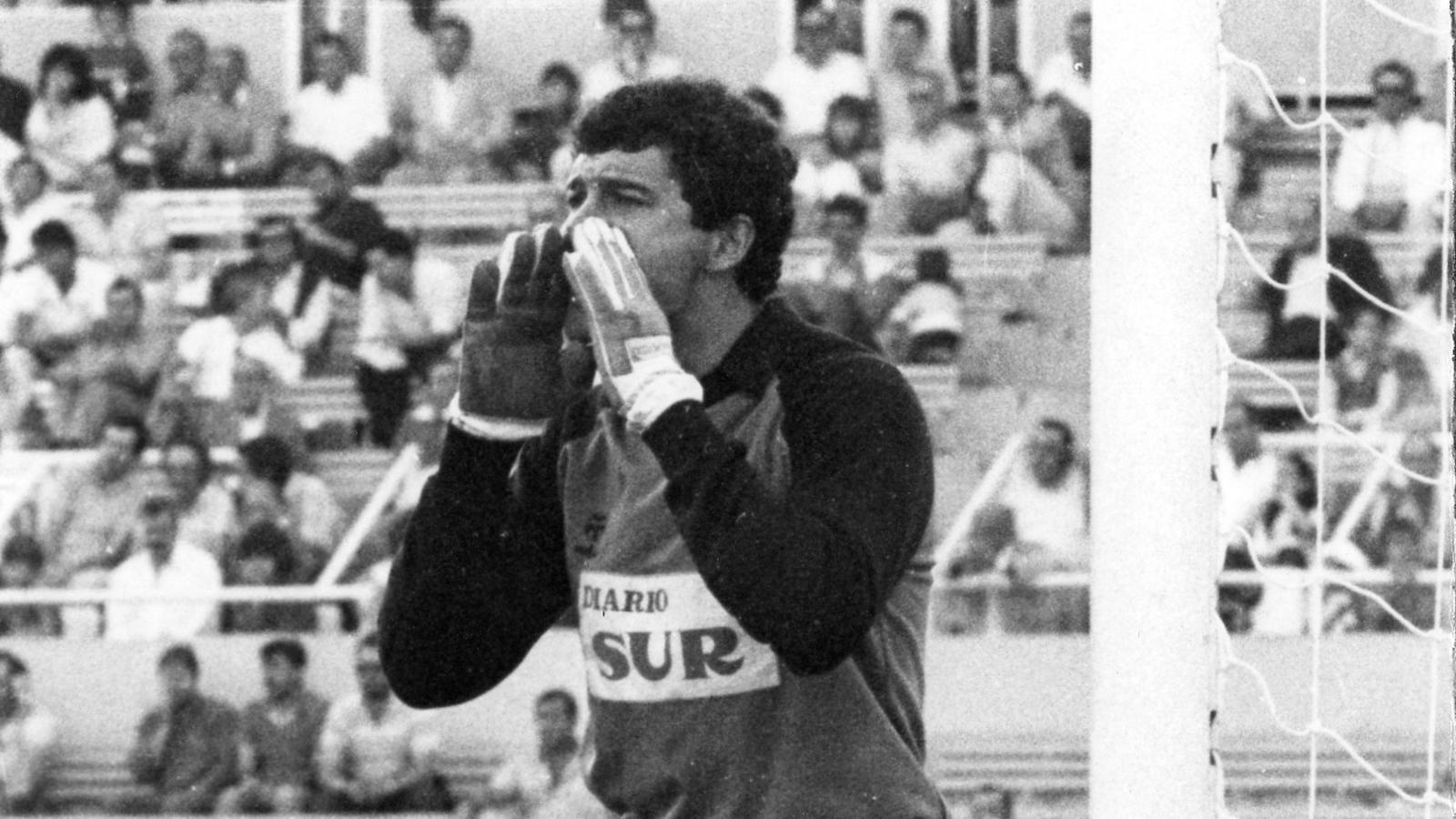
Almost 40 years ago this Malaga goalkeeper lost his life after colliding with a Celta de Vigo rival
-
CAT -
CAST
Torelló"Look, I believed a lot in God and at that moment I stopped believing. It was horrific," admits Manolo Canillas (Málaga, 1960), a former Málaga and Sabadell player. The dramatic death of Jesús de Miguel has brought the pain for the death of José Antonio Gallardo, 40 years ago now, to the surface again. The then-Málaga goalkeeper died three weeks after a fatal collision with Baltazar, a Brazilian striker for Celta. It was the last death of a professional Spanish football player due to an impact with a rival until the tragedy this week. Canillas explains that, when he saw the action, he thought of Gallardo instantly.
Gallardo was a 25-year-old goalkeeper who was experiencing his best moment. He was finally a starter for Málaga, in the Second Division. His teammates compared him to the Russian Rinat Dasayev. "He was very good. He triumphed too late, and when he triumphed God did not let him continue," laments Canillas, a midfielder who even became an international with the under-21 team. Gallardo had renewed with Málaga for five years at the end of November 1986. Zaragoza wanted him. Canillas explains that in that era they earned less than two million pesetas, less than 12,000 euros. They had known each other since their youth categories and some afternoons they would meet for a beer.
The match against Celta was on Sunday, December 21, 1986, at Balaídos and the fatal moment was in the 17th minute. "I will never forget it. I offered myself to a teammate, but he turned around and passed the ball back. It had rained and the ball remained stuck. Gallardo came out and they collided with Baltazar." Baltazar's knee impacted with force against Gallardo's head. Canillas remembers the goalkeeper motionless on the grass, unconscious: "He wasn't moving." They took him to the hospital and the match continued. Celta ended up winning in the 90th minute with a brace from Baltazar himself.

Gallardo stayed in Vigo for observation. Baltazar visited him at the hospital and explained through tears that the goalkeeper didn't remember anything. The X-rays revealed a triple fracture in the left parietal bone of the skull. On December 24, three days after the incident, he was allowed to return to Malaga. "We went to see him at the hospital and he was doing as well as we could expect. It seemed like he would pull through. Later he was discharged and even came to see us train at La Rosaleda," continues Canillas.
On December 31, he celebrated his 25th birthday. He had a slight facial paralysis, but he was recovering his memory. On January 7, he went to visit the apartment he and his partner had recently bought. They were supposed to get married in the summer. But suddenly everything changed: after lunch, he began to feel unwell, with dizziness, tremors, and vomiting, and that same afternoon he was admitted to the hospital in a coma. They performed life-or-death surgery on him for over three hours for a cerebral hemorrhage caused by the rupture of an artery in the same area where he had received the blow on the day of the match. The surgeon explained that it was one of the largest cerebral hemorrhages he had ever seen because it affected almost three-quarters of the brain.
The press kept reporting on the footballer's state of health, which was becoming more delicate every day. "They no longer let us enter the room. We would see him through the glass," notes Canillas. On January 9, his condition was very critical. The coach, Antonio Benítez, fainted during a visit. By January 13, it was practically irreversible, and on the 14th, El País reported that Malaga had contacted a young Juan Carlos Unzué in case they needed a replacement.
Death arrived on January 15 at 4:45 in the afternoon. After a cardiac arrest, after a week in a coma. "I continue to think that God exists, but He was very harsh with him. There is a movie called Heaven Can Wait: Why was He so unfair to him and didn't wait? He took him away at his best moment. He could have waited a little, let him enjoy life a little. Life is death, and if you are born you will die, but it wasn't his time," he laments.
A time when there was no talk of mental health
The Malaga players watched over Gallardo's body throughout the night at La Rosaleda and the next day carried the coffin to the church and the cemetery. Canillas was one of the pallbearers. "I have the photo from that day to remember him always. I will not forget him until I die myself. It was very, very painful. We had a very hard time and we cried a lot. I wouldn't wish it on anyone, not even my worst enemy," he continues. Every December 31st he remembers him on social media. Gallardo was buried with the Celta shirt on the coffin and has a gate at La Rosaleda. He was awarded the Zamora trophy posthumously because at that time he was the goalkeeper with the fewest goals conceded in the Second Division. Baltazar would be the top scorer and two years later he was the Pichichi of the First Division with Atletico Madrid.
Canillas says it was also very difficult to overcome the absence. Looking at his locker in the dressing room, four steps away, and seeing it empty. "It is extremely hard to go from seeing someone every day to never seeing them again, all of a sudden. I don't know how the Tenerife players will cope. You lose the desire for everything and you don't pick yourself up, but you have to return and move forward because life goes on," affirms Canillas. In the football of that era, neither mental health nor psychologists existed: they brought in an ex-player to tell them jokes, to try to make them smile and forget the reality.
Canillas takes a breath and concludes: "The pain is never forgotten. Perhaps I forget some sons of bitches who, when they die, I think 'screw you', but good people are never forgotten".

