How is the day to day of the Generalitat Firefighters?
One is not a firefighter only when there is a fire. It is necessary to provide a response also in the face of any emergency. ARA has accompanied the firefighters of the Mataró Park on a 24-hour shift to get to know the trade from within
-
CAT -
CAST
Fire, smoke, epicness, heroism. A firefighter emerges from the flames in slow motion, surrounded by thick smoke with a person in their arms. This is how a large part of society must imagine what it is like to be a firefighter. Although a part of their work does resemble that, there is a large part of the task and preparation of the firefighters' trade that goes unnoticed and is just as important as the moment of action. The painstaking work, unknown to many people, is part of their day-to-day, and is a basic and indisputable pillar that makes the Fire Department of the Generalitat de Catalunya a global benchmark.
Being a firefighter is knowing how to respond. You are not a firefighter only when there is a fire; being a firefighter also means being prepared to know what to do in very different situations. A large part of their day-to-day consists of training to be able to have the capacity to react in different situations; from a forest fire, to water rescue or support for the population. Being a firefighter is learning to work as a team and knowing how to identify everyone's strengths. The reality of the corps is very broad: preparation, cooperation, and capacity for response.
What is the job of being a firefighter like beyond putting out fires? It is important to exercise the effort to escape the common imagination and visualize the work of firefighters after the moment of service. From ARA, we have accompanied the firefighters of the Mataró Park on a 24-hour shift to be able to explain the trade from the inside. The goal is to focus on all the tasks that firefighters carry out and expand the imagination of the profession.

What is a working day like for a Generalitat firefighter?
Any given day for a Generalitat firefighter begins at 7:00 a.m. at the station where they are assigned. Fire stations are classified into category A, B, or C, depending on their size, number of personnel, and the type of Basic Intervention Units (BIU). The Mataró Station is type A, as it is the reference infrastructure for the region and covers the entire area from Vilassar de Mar to Tordera. At the same time, it has a capacity for 8 simultaneous intervention vehicles and 3 Basic Intervention Units (BIU), which is a fire vehicle with the minimum assigned crew that is activated to respond to an emergency or service.
Firefighters do not have a conventional schedule. Their weeks are organized into 24-hour shifts, followed by 3 days of rest. Throughout this 24-hour workday, the corps has a scheduled work routine that helps them prepare both physically and mentally for future emergencies. Despite having a strict routine that they must follow, this can be conditioned if a service arises where they must act. A firefighter's day is based on being prepared for the moment that has not yet arrived.
During the shift, they know that at any moment the alarm may sound. The wait is part of the job. But, before being able to act, one must be prepared. How is the 24-hour shift organized? Throughout the day, they perform material inspection tasks, a morning team meeting with the high command, service practices, community, and training.
From preparation to response
The firefighters' shift on October 2nd kicks off the day without four members of the team: the colleagues have had to go to support the Cambrils firefighters due to the meteorological situation of the last few weeks. The torrential rains, floods, and the damage caused do not give respite and require more crews to be able to deal with them. Even so, at the Mataró Park there must be a minimum of 8 firefighters during the shift.
If the day permits, at 8:00 a.m. the firefighters begin their first morning task: the inspection of vehicles, equipment, and work tools. An exhaustive check, piece by piece, to verify that everything is in order and ready to be used at any moment. Apparently, it may seem like a routine task without much importance, but this daily material inspection is what ensures the safety of the workers, as well as work guarantees, and allows for the avoidance of unforeseen events or errors.
While carrying out the inspection tasks, a couple of firefighters, Anna and Clara, find an error in an air chamber and replace it. When they have finished checking all the equipment, they take a drive with the trucks to check that the vehicles are working correctly.

The “Community”
After checking the vehicles and the equipment, they go for breakfast. Meals are organized in shifts. They do what is called Community: with an excel spreadsheet, cooking and shopping tasks are distributed among the workers, and they also organize themselves to drive the trucks during shifts, in this way the departure is more agile and efficient.
The firefighter in charge of meals during this shift greets his colleagues with background music and French omelette and goat cheese sandwiches. The atmosphere is relaxed and easygoing, and there is a sense of community. Together, they help him finish preparing the remaining sandwiches.
During breakfast, firefighters talk about the year they joined, what motivated them to take the civil service exams, and how the profession has changed over the years. At the same table, there are a few veteran firefighters who have been in the profession for more than 25 years. There are also three new recruits, Anna, Clara, and Sergi, who have been working under the firefighter category for less than a month. All three passed the civil service exams from the January 2024 call. The opposition process is so long and elaborate that they finished the training school just a few weeks ago.
The 2030 Firefighter Plan aims to reach a staff of 4,000 firefighters to strengthen response capacity in the face of the increase and complexity of emergencies. For this reason, the Generalitat has opened a new call for 300 positions which ended on September 29th. This year, the competitive examination has changed: the physical tests are more similar to the functions they perform once they are firefighters, simulating the efforts they would have to dedicate in different emergency service situations, such as in the case of a house fire, water rescue, and forest fire.
All three agree that studying for competitive exams is a process that entails many personal sacrifices, such as time and money. "You cannot study for these exams half-heartedly, you have to be 100% committed to the opposition because otherwise you waste time and money," comments Sergi. Clara adds that "the firefighter competitive exam is completely elitist, you have to have time, make many sacrifices, and be willing to spend a lot of money".
Now that they are officially part of the corps, after passing the School and the internships, they believe that the most important thing to learn the trade is to absorb the experience of the veterans. There are no two days the same for firefighters: the different situations they have to face make the reality of the trade changing and unexpected. “The firefighter's trade is an infinite trade, it is practically impossible to do everything”, declares Anna.
Information session
Once breakfast is finished, all the firefighters meet in the meeting room for the morning briefing or information session. The session consists of seeing how the day's shift might unfold. The high command, in this case the corporal, Dani, holds a preliminary meeting with the entire region and then conveys it to the rest of the team: the incidents occurring in Catalonia, what daily practices they will carry out throughout the day, how tasks will be distributed regarding incidents, and, in general, how the shift will develop.
During the briefing, they put themselves in a service situation. Due to the downpours and weather conditions, they plan a water rescue. They start by defining who the best swimmers are, who could drive the jet ski and the truck, and even who will go in each truck and which vehicles they will take. The goal is to have the maximum number of roles and tasks distributed to streamline a possible service.
Social and pedagogical role
After the briefing session, one of them is in charge of preparing lunch and the rest begin the simulations and technical exercises. During the rest of the morning, they perform practical intervention maneuvers, such as high-angle rescue, traffic accident simulations, or extinction techniques in confined spaces. The exercises must be carried out in uniform and with all safety measures, just as if they were performing a service.
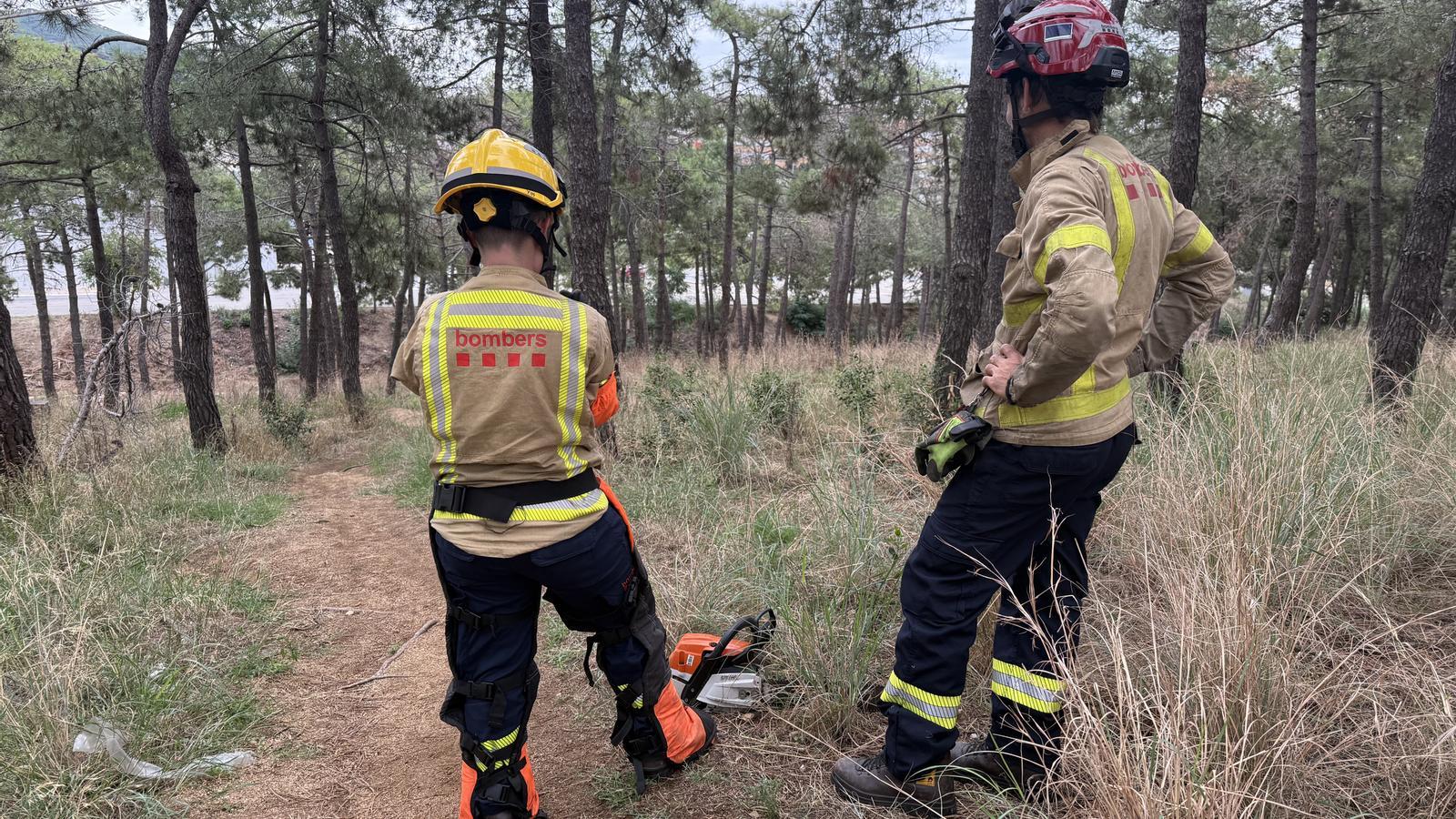
Occasionally, firefighters receive visits from schools to explain their professional and social work to children. During the visit, they show them the vehicles, and they can see how the radio communication system, water hoses, siren, among others, work. But, suddenly, all the firefighters are on alert: the alarm sounds, and they receive a message over the radio. The distribution is fast, and there is no room for error. Everyone knows what to do and where to go. Luckily, the service is simple: there is a tree about to fall, and they need the firefighters to remove it. In less than 10 minutes, they are already at the scene preparing the procedure.
What does it entail to be a firefighter?
The profession of firefighter raises questions about what the profile of the people within the corps should be like. Many of the firefighters at the station agree that they are people who enjoy sports and the natural environment. They like doing outdoor activities, they share an appreciation for the mountains, and they are moved by an impulse and an instinct to save and protect nature. “With my colleagues, we all have the same profile: we like the territory and it is a vocation. To be a firefighter, you need to be decisive, active, have very good physical condition, and be a hardworking person,” explains Carles, a firefighter for twenty-one years.
Sergi defines being a firefighter as a job where there is a lot of work “it is important to be a good firefighter at the core: the profile of a firefighter must be a person who likes to take action, work in a team and do so in open spaces. They must know how to work and learn from a variety of opinions, but the most important thing is to have a proactive, open mind and know how to work in a team”. At the same time, you must like uncertainty, adrenaline and excitement. Being a firefighter is a job that constantly surprises you and you never know where or how you will end up.
