From purchase to experience: how companies generate trust with the client
The meeting organized by BBVA, Cecot and the newspaper ARA brought together different business voices and perspectives on how to make the customer experience a success
-
CAT -
CAST
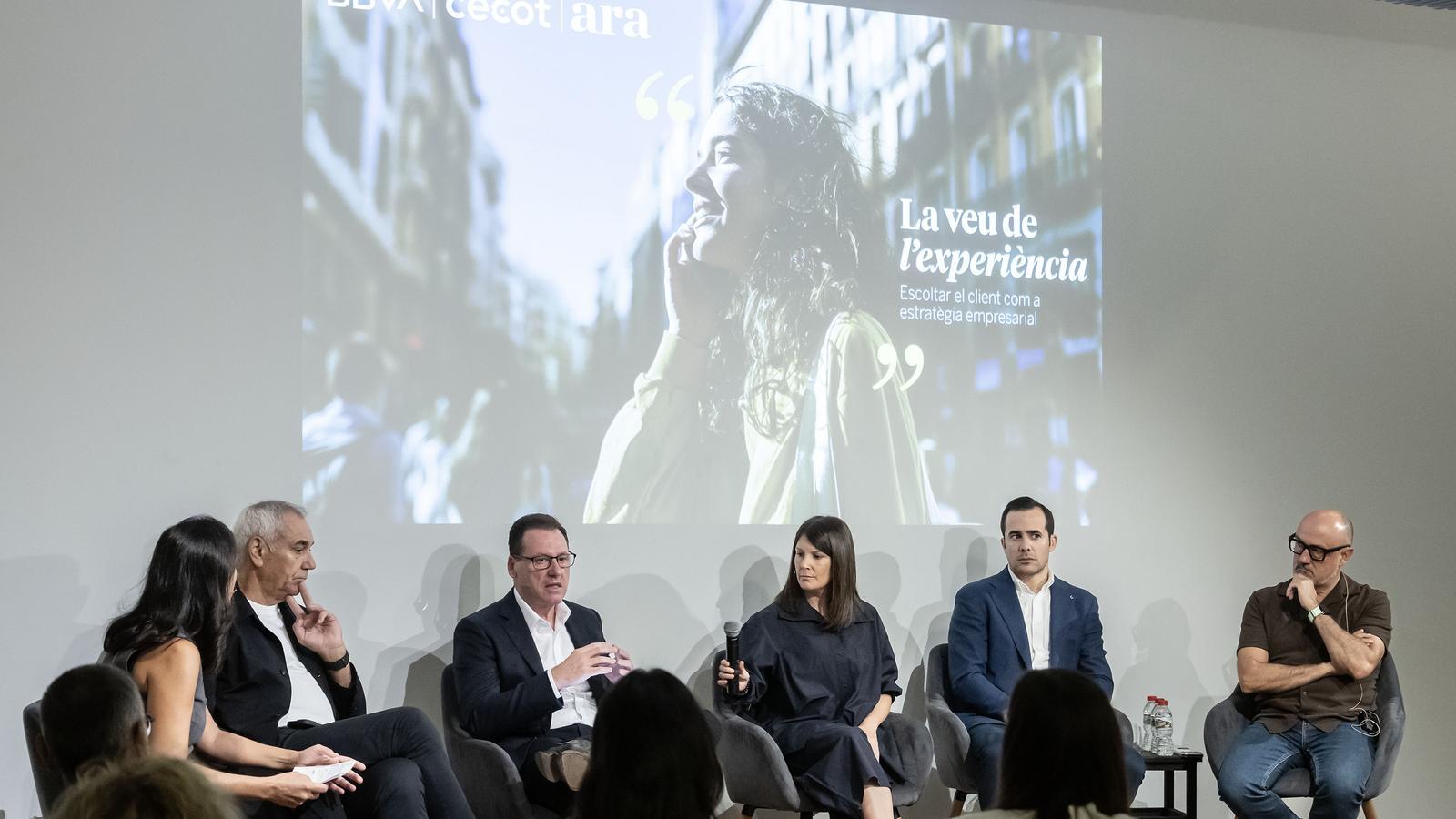
Technology has transformed the relationship with consumers, but proximity and personal treatment remain decisive. This was one of the conclusions of the meeting organized by BBVA, Cecot, and the newspaper ARA, with the participation of Kave, Ametller Origen, and Laboratorios Gebro Pharma, focused on how to combine digitalization and customer knowledge without losing the human factor.
Francesc Julià, founder and president of Kave; Tania Abellán, transformation director at Ametller Origen; Ricard Castellet, head of digital transformation at Laboratorios Gebro Pharma; Oriol Alba, general secretary of Cecot; and Francisco Pla, regional director of Business and Institutional Banking at BBVA, analyzed, in a colloquium moderated by journalist Laura López Sedano, how to respond to increasingly demanding consumers and offer them more personalized, agile, and close experiences, under the question "What makes an experience memorable?".
Kave, with a 44-year history, created its own brand 13 years ago, driven by the speed at which multi-brand stores were disappearing. It was then that it bet on the digital channel as "a fast and economical way to reach the consumer," recalled its founder and president, Francesc Julià. "We were practically digital illiterates, but we understood the potential of the networks. Creating our own brand involved a risk coming from the B2B market. We started the digital part in France and, since then, we have sought that balance."
In fact, without the online channel, Kave would not have physical stores today. "Thanks to digital, we have information that allows us to know the customer and know in which cities it makes sense to open them. It is information that we obtain ourselves and, therefore, we do not need any agency to tell us."
For Ametller Origen, the approach starts from the physical experience and the desire to approach the traditional market model: "With more than 150 stores, our challenge is to scale the proximity typical of the traditional market. We take as a reference the neighborhood greengrocer, who knows their customers, what they buy, and how they buy. What we want is to achieve that degree of intimacy, but at scale."
However, the challenge lies in contextualizing all the available information. “We have a lot of transactional, behavioral, and customer service information. The challenge is no longer having more data, but contextualizing it: we know what the customer has bought, but not necessarily what they need. The challenge is connecting all this information to turn it into real customer knowledge. Digital allows us to activate this knowledge relatively easily, but the great challenge is to also bring it to the store and put it at the service of our teams,” asserted Tania Abellán, Director of Transformation at Ametller Origen.
From the point of view of small and medium-sized enterprises, the limitation of resources brings other challenges to the table. As explained by the Secretary General of Cecot, Oriol Alba: “For a small or medium-sized enterprise, it is essential to be attentive to consumer behavior in order to detect opportunities and be able to anticipate them. Saying that you care about the user experience cannot just be a slogan, but it is vital to ensure the survival of the business.”
For BBVA, “what has changed the most is the level of customer demand, especially regarding speed and clarity. Whether they enter the app, call, or go to an office, this is what has transformed the way of managing the relationship with them. The customer wants us to accompany them and listen to them. We have to think like them and ask ourselves what they need. Listening is very important,” stressed Francisco Pla, Regional Director of Business and Institutional Banking at BBVA.
What's more: “We want to know how the customer feels at the moment they are living the experience. In the app, we have a feature that allows us to know this and respond in a much easier way. We want to go from being a bank that responds to being a bank that understands and changes things. It is no longer just about forms.”
Digitalization has transformed the substance, but not the importance of personal treatment. As Francisco Pla explained: “The first thing we must understand is that the customer does not live in separate channels: for them, everything is BBVA. We must guarantee quality at all points of contact. We want to offer a continuous experience and not have separate channels, but rather combine them and make them interact to advise each person.”
Human contact continues to govern relationships and the digital world becomes one more tool to continue winning over the client. “This is the great challenge: transferring trust to the digital world. Freshness in the digital environment is a challenge for the entire sector,” noted Tania Abellán. “In products like fruit, the weight of trust is enormous. When you make an online purchase, you place that trust in another person. If you receive a peach that does not meet your expectations, you might think that there was surely a better one. That is why it is very important to characterize the product well. In fresh produce, each product is different, while in e-commerce we tend to want to standardize everything, and that is not always possible.”
Hence why Ametller Origen is working on “the perception of order quality, packaging, and even achieving a “wow” effect the moment the food purchase is received. The picker must be very clear that they are doing the shopping for you and must do it as if you were doing it yourself. Quality is not an absolute concept. We still lack more bidirectionality. Omnichannel means that the brand promise is the same regardless of where the customer buys. We focus on trust”.
But, since not all purchases and not all services are the same, the strategies are also different. At Kave, the challenge is to “make the customer fall in love”. As Francesc Julià highlighted, “ours is not a reactive or spontaneous sale, but a reflective one. We have two main channels to make ourselves known: social networks and stores, which also function as a customer acquisition tool. That is why we open stores in central locations: they are part of our marketing strategy. In our case, the purchase has a very important rational and reflective component”.
The pharmaceutical sector must meet other requirements. “Our real clients are the specialists and the doctors, and it is them we must convince that our product is good,” explained Ricard Castellet, head of digital transformation at Laboratorios Gebro Pharma. But the product is no longer everything. “Within the pharmaceutical industry, the focus is no longer just the product, but also the digital services that accompany the patient. We are launching support applications, but when it comes to patient data, zero. I cannot and do not want to know who they are, and that leaves me very calm”. On the other hand, having information about the professionals is important to be able to continue advancing.
At Laboratorios Gebro Pharma, the interest focuses on offering careful service to healthcare professionals and, with this objective, they are working with artificial intelligence. “We are talking about investments of hundreds of thousands of euros and three to five years to demonstrate scientific evidence. What we can do is create profiles or clusters to understand the different uses and needs and try to offer each one what they are really interested in. A doctor who has just started does not need the same information as a professional with much more experience. It is about accompanying the customer and providing adapted scientific information”.
Support thus becomes a fundamental element, and technology opens up new possibilities for improving service. At Ametller Origen, “the physical experience remains very relevant,” which is why they are working on a project that connects data and knowledge and also seeks to put it at the service of store teams. “Store staff are being asked more questions all the time. Generative AI has accustomed us as consumers to having immediate answers to practically any question, and this expectation also reaches the store. We cannot expect our teams to have all this knowledge naturally. That is why we have the Ametller Brain project, a tool that will be available to the customer, but which we also want to bring closer to the store staff. The human relationship is very important to us. This platform will allow us to provide answers to our employees so that the time they spend with the customer is truly of high quality. It is about freeing the staff from certain tasks and helping them with technology. Technology must allow us to give our teams more knowledge and free them from operational tasks so they can dedicate more time to what really adds value: being with the customer. If we achieve this, technology will not make us lose proximity; it will allow us to scale it.”
Francesc Julià also agreed on this point with Tania Abellán. “Technology brings us a lot. We all leave a trace on social media and our obsession is to know the customer: what they want and what they are looking for. The digital part provides us with a lot of information that we can later use to train store staff. 700 people might walk in, and, in the end, we have to be able to detect the 20 who really want to buy. This customer knowledge is what we obtain from the combination of the two channels.”
"It seems clear that the customer wants an increasingly personalized experience. Artificial intelligence is also helping our staff to reduce operational tasks and to be able to dedicate more time to adding value to the customer. AI is not here to replace people but to multiply their capacity," insisted Francisco Pla.
Listening is one of the best ways to get to know the client, so human interaction remains essential. “Common sense is very important. We must move from the insistent salesperson to a more reflective and patient salesperson. If you listen to the client, they open up and it is much easier to understand what they need and accompany them in the purchase,” asserted Francesc Julià.
“We must build excellent experiences by putting the client at the center, listening, measuring, and correcting constantly. Excellence is not a destination, but a culture of continuous improvement. If we do the everyday things extraordinarily well, a memorable experience will be a consequence,” added Tania Abellán.
As Ricard Castellet explained, “now we have a triangle formed by the brand, the client, and technology. We must build this relationship regardless of whether the technology is visible or invisible, as can happen when you go shopping at Ametller. The relationship becomes complicated and diversified, but, at the same time, technology can help us make it more human. Ten years from now, it will probably not be ethical to work without using approved and validated artificial intelligence.”
The value of people
At this point, it will be “important to reformulate the binomial between technology and the human factor so that the combination of both is capable of generating trust”, as pointed out by Oriol Alba. "The difficulty companies face in finding workers is forcing them to rethink work organization. Technology is a good ally, but the key element is where to place the human factor, that is, what are the key processes where it is necessary to count on the intervention of a person".
“We must open the debate on where we place the human factor: where ten people used to work, perhaps now there are five and the rest of the processes are robotized. Brands must decide at which moments of the experience they want to keep them. At the same time, you can take advantage of technology, not only to replace tasks that a person used to do, but to improve processes, productivity and create a better customer experience”. Ultimately, people can end up being the differentiating feature when it comes to winning over the customer and turning their shopping experience into a reason to return.
“The way of acting is what adds value and allows building a long-term relationship of trust”, concluded Francisco Pla, regional director of Business and Institutional Banking at BBVA.
