Catalonia is playing a strong hand. In little more than a decade, video games have gone from being a peripheral activity to becoming a cultural industry with international projection. Around it, an ecosystem has been woven that combines independent studios and multinationals, talent trained in universities, investment, incubators, events, and public policies. But there are also imbalances and a global context of uncertainty, marked by layoffs, studio closures, business concentration, and the emergence of generative artificial intelligence. The challenge is to consolidate the sector without losing talent and projects.
TheWhite Paper on the Catalan Video Game Industry 2024 placed the sector's turnover at 756 million euros in 2023, 6.6% more than the previous year, with 5,174 professionals and 262 active studios. Catalonia accounted for 53% of the Spanish video game turnover and approximately half of the employment. More than 90% of the studios, however, are located in Barcelona, a fact that reinforces the hub but also highlights the potential for territorial growth.
Alongside the major players, there are studios capable of creating intellectual property with global reach. Nomada Studio turned Gris into an international phenomenon and consolidated its trajectory with Neva. Herobeat won a BAFTA with Endling: extinction is forever. Piccolo Studio, Studio Koba, and Baroque Decay are other exponents of Catalan independent creation.
Indie is an essential part of the ecosystem. The evolution of the IndieDevDay gathering is proof of this: converted in 2025 into BCN Game Fest, it brought together more than 17,000 attendees, 180 independent studios, more than 200 video games and more than 40 publishers and hosted more than 1,200 business meetings.
Between small studios and large multinationals, however, there is a key space for the maturation of the sector. "One of the main challenges for the sector is to consolidate this group of medium-sized companies," points out Marisol López, Director General of Innovation and Digital Culture at the Department of Culture. It is necessary for more studios to be able to "publish a second, a third, or a fourth video game, increase their professional structure, and consolidate projects with longevity."
DeviCAT: networking to build an industry
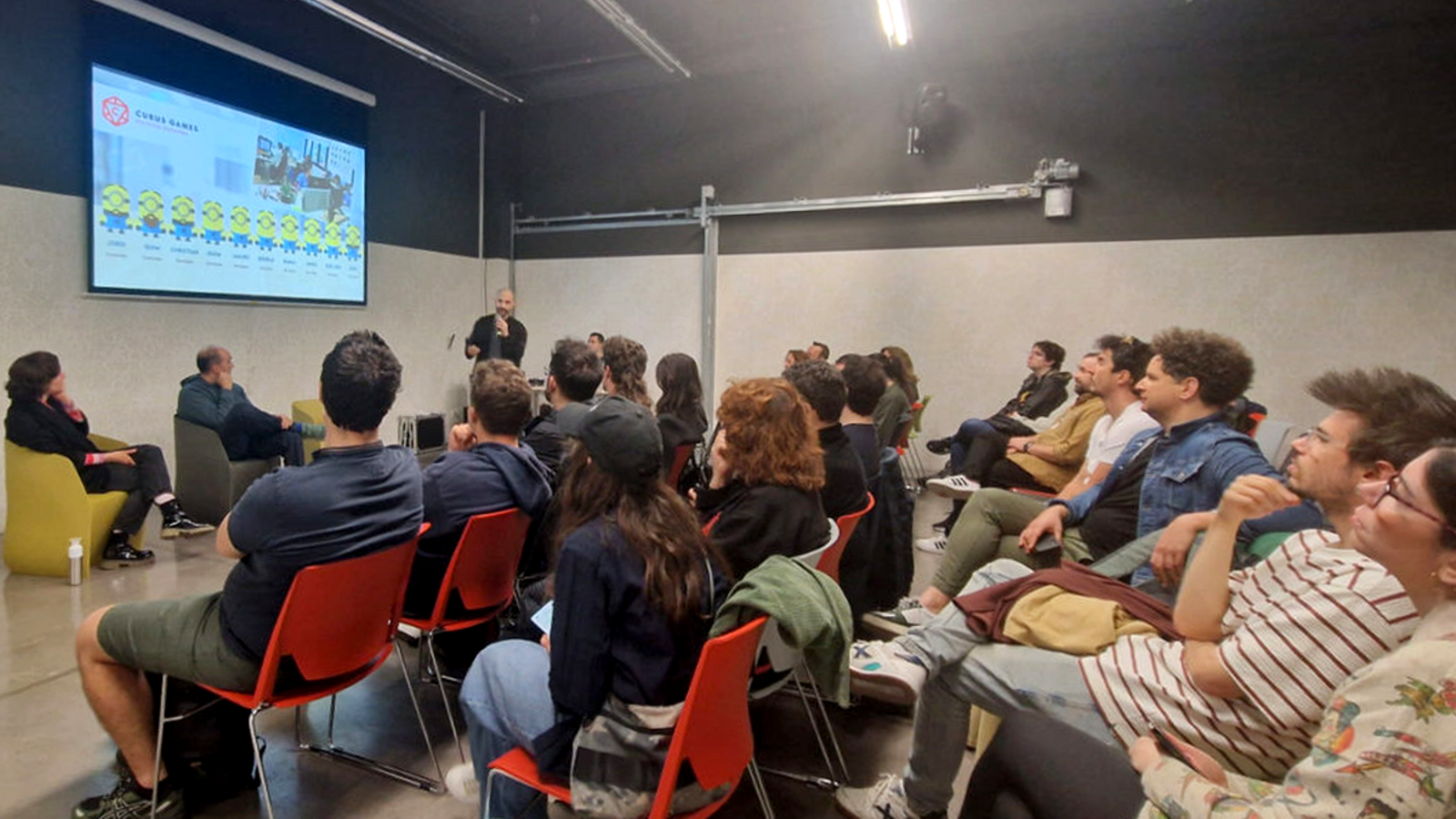
DeviCAT, the Association of Video Game Developers and Publishers in Catalonia, was born in 2012 to articulate a common voice for the sector before the administrations. Integrated since 2017 into the PROA Federation of Audiovisual Producers, it maintains its independence and works to structure the Catalan video game ecosystem, connecting companies, institutions, training centers, and professionals.
The association acts as a space for dialogue, knowledge, and connection. Monthly Meetings and collaboration with incubators, educational centers, and initiatives like GameBCN facilitate contacts and opportunities. It also works to align training with the needs of the industry and promote internationalization, access to funding, publishers, and markets. "Rather than just talking about specific profiles, we believe it is necessary to reinforce practical experience: working in multidisciplinary teams, understanding the processes and tools of a studio, meeting deadlines, iterating, receiving feedback, and taking a project to a professional level," explains Daniel Del Amor, coordinator of DeviCAT.
For Del Amor, companies and training centers must maintain "a permanent dialogue" so that curricula evolve at the pace of the industry. Creating a good video game and building a sustainable company are different challenges: it is necessary to reinforce knowledge of management, funding, marketing, publishing, business development, and internationalization.
DeviCAT defends the video game as a cultural, technological, and economic industry and focuses on business consolidation: "The goal should be that not only do many studios emerge in Catalonia, but that more and more of them can consolidate, grow, and maintain ownership of their projects and their IP."
This consolidation is linked to the ability to retain talent. "Talent policies and business consolidation policies are closely related," points out Del Amor. For this reason, the association demands funding instruments adapted to development cycles, support for internationalization and the creation of proprietary IP, incentives for private investment, and measures that favor the growth of studios.
Building an industry also means strengthening connections within the sector. "Sharing experiences, knowledge, and contacts between studios of different sizes can be enormously useful," affirms Del Amor. Catalonia has a powerful ecosystem; the challenge is for this power to translate into more companies capable of consolidating and competing internationally.
The market for a video game studio is global from day one. In 2023, Western Europe accounted for 64% of the Catalan video game market and the rest of the world, 36%. However, the sector maintains a strong business imbalance: 47% of the studios have a turnover of less than 200,000 euros, while companies with more than 50 million account for 55% of the turnover.
Now the Department of Culture is preparing a new phase. "We will soon present the Strategic Plan for the video game sector in Catalonia for the coming years," announces López. Developed with more than forty professionals from the sector, it will be, according to the director general, "a plural and shared plan," which should not be executed solely by the Administration.
Public policy must also accompany technological transformations. The Department monitors the impact of artificial intelligence, which the sector perceives as a tool with potential in prototyping and the initial design phases, but which also raises questions about creative and production processes. López considers that this transformation is still evolving and will require monitoring.
The data depicts an ecosystem with critical mass, talent, export capacity, and international presence, but also with a high territorial concentration, a polarized business structure, and difficulties in financing and scaling projects. Catalonia plays among the main European video game hubs; the challenge is to turn this position into a more solid industry capable of retaining and growing the talent it generates.